
A winning B2B X strategy centers on a founder-led voice, reply-first engagement, and consistent value-led threads that convert public attention into private conversations and pipeline. Yes, tech and AI brands should invest in X, but the return depends on three moves done consistently: show up as a person, reply before you post, and track DMs and profile visits, not impressions.
TL;DR:
- Consistently replying to target accounts and tracking profile visits and DMs is more effective than focusing solely on impressions.
- Establishing clear account roles, updating bios, and fixing pinned tweets within 30 days accelerate important engagement and credibility.
- Original data posts, technical threads, and problem-solving content outperform generic updates in driving meaningful interactions.
- Response-driven engagement with a targeted list of accounts helps convert conversations into qualified sales leads more reliably than broadcasting.
- Most teams fail by chasing viral moments instead of building a steady, process-oriented rhythm that leads to reliable pipeline growth.
Table of Contents
- What Is a B2B Twitter Strategy, and Why Does It Still Matter?
- Your 30-Day X Audit and Quick-Win Checklist
- How Should You Optimize Profiles and Assign Account Roles?
- Which Content Formats Actually Work for B2B on X?
- How Do You Turn Replies Into Real Sales Conversations?
- What’s a Realistic Weekly Cadence for a Small Team?
- Which KPIs Actually Predict Pipeline From X?
- When Should You Amplify Posts With Creators or Paid Spend?
- How Do Executive Accounts and Employee Advocacy Multiply Reach?
- What Does a 90-Day X Rollout Actually Look Like?
- What Do Most B2B Teams Get Wrong About X?
- When Should You Bring in Nowix for X Management?
- Sources
What Is a B2B Twitter Strategy, and Why Does It Still Matter?
X remains valuable for B2B because it is one of the only platforms where an industry argument breaks out in public, in real time, and decision-makers jump in before their competitors even see the thread. A B2B Twitter strategy is the deliberate use of that speed, an operating plan for who posts, what gets said, and how public engagement gets pulled into private sales conversations.
That distinguishes it from a general B2B social media strategy, which spans LinkedIn, X, and sometimes YouTube or Reddit. The consensus among practitioners is platform-specific: LinkedIn earns long-form thought leadership, while X wins on real-time conversation, breaking news, and unfiltered debate among the people who actually buy your product.
For tech and AI companies, that unfiltered quality is the entire point. Product launches, model releases, funding news, and technical controversies all play out on X before they hit any other channel. A brand absent from that conversation isn’t neutral. It’s invisible at the exact moment buyers are forming opinions.
The practical version of this strategy is simpler than most marketing plans: pick a single clear job for your account, post like an actual human, and treat replies and DMs as your real sales channel. Everything else, threads, cadence, paid amplification, supports that core loop.
Your 30-Day X Audit and Quick-Win Checklist
Before building anything new, fix what’s broken. Run this audit in the first month:
- Profile audit. Check that both the company handle and the founder’s personal account have current bios, working links, and a photo or logo that hasn’t been stale since 2023.
- Pinned tweet fix. Replace outdated pins with your strongest recent thread or a clear statement of what you do and who you help.
- Account roles. Write down, in one sentence each, the job of the company account versus the founder account. If you can’t, that’s your first fix.
- Cadence minimum. Set a floor: three posts a week from the company account, daily activity (posts or replies) from the founder.
- Baseline KPIs. Screenshot current follower count, average profile visits, and DM volume before you change anything, so you have a real before-and-after.
Quick wins to knock out the same week:
- Remove dead links from the bio and pinned tweet
- Add one credibility line to the bio (funding stage, customer count, or notable press)
- Follow and list 20 accounts in your target buyer segment
- Draft your first reply-first day using accounts from that list
How Should You Optimize Profiles and Assign Account Roles?
Your bio should answer three questions in under 160 characters: what you build, who it’s for, and one proof point. A formula that works well for tech and AI brands: [what you do] for [who] — [proof element]. Something like “AI ops platform for engineering teams — used by multiple Series A/B startups” beats a vague mission statement every time.
Pinned tweets convert best when they’re either your single strongest thread (data-backed, not promotional) or a tight statement of the problem you solve, with a link that doesn’t dump readers on a generic homepage.
Founder accounts deserve real investment, not an afterthought. People follow people, not logos, and a founder who posts consistently builds trust the corporate handle never will on its own. Launch the founder account first if you have to choose, then let the company account handle announcements, support, and amplification of what the founder starts.
A few operational details matter more than they seem to:
- Keep the handle close to your legal or product name so people can find you by searching
- Use a banner that states your category in plain language, not just a logo
- Put one link in the bio, not three, and make it the page that matters most this quarter
Pro Tip: Audit your founder’s replies before you audit their posts. A founder who replies well to five accounts a day builds more trust than one who tweets daily into a void.
Which Content Formats Actually Work for B2B on X?
Threads still carry the most weight for B2B because they force a complete argument instead of a hot take. The strongest structure opens with a specific claim or number in the first line, breaks the reasoning into five to nine short posts, and closes with a takeaway or a question that invites replies. Spacing matters: one idea per post, never two.
Short posts split into two useful types. Opinion posts state a position on something happening in your industry right now; how-to posts solve one narrow problem in three or four steps. Both outperform generic company updates, which readers scroll past without a second look.
Data posts are the highest-leverage format available to a B2B account. Original research and proprietary data consistently outperform promotional content because they give other accounts something worth quoting, screenshotting, or citing. If your team has usage data, benchmark numbers, or survey results nobody else has published, that’s your best asset, not your product screenshots.
Why this matters: accounts that post original data see materially higher save and quote-tweet rates than accounts posting only company news or launches, because data gives other people a reason to reference you.
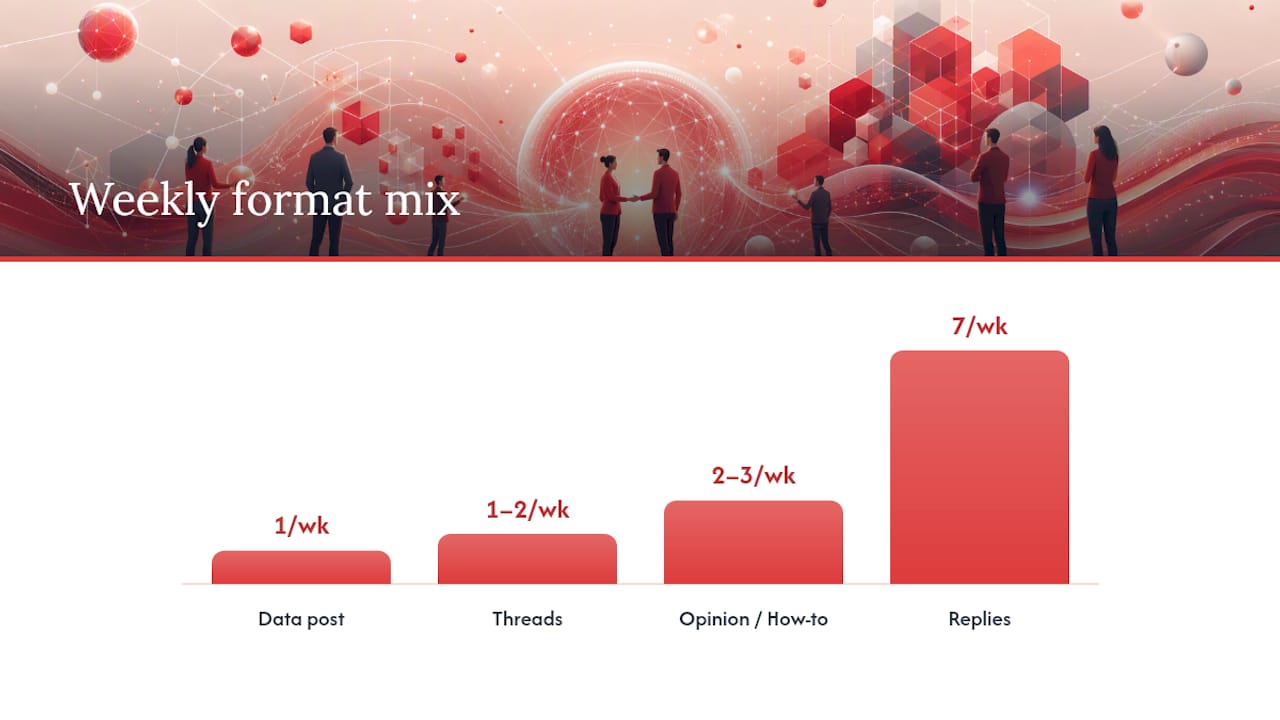
Format mix to aim for weekly:
- One data post or original research snippet
- One to two threads breaking down a technical or strategic point
- Two to three short opinion or how-to posts
- Daily replies (see the next section)
Don’t let a strong thread die after one post. Repurpose it into a LinkedIn post, a newsletter section, or sales collateral the same week you publish it. One good idea should show up in three channels, not one. Nowix’s own content idea library is a useful reference if your team is running dry on angles.
How Do You Turn Replies Into Real Sales Conversations?
Reply-first engagement outperforms broadcast posting for one simple reason: you show up inside conversations your buyers are already having, instead of hoping they stumble onto your feed. Here’s how to run it as a repeatable practice, not a one-off effort:
- Build a target list of 15 to 20 accounts in your buyer segment, using X Lists to group them by role, company size, or industry conversation.
- Reply with a genuine idea, not a compliment. A reply that adds a data point, a counterpoint, or a sharper framing earns far more visibility than “Great post!”
- Follow up within 24 hours if your reply gets a response, and move the exchange toward a DM once it’s clear there’s a real fit or shared interest.
- Use Communities selectively to monitor niche conversations in your category, but treat them as a listening tool first and an engagement venue second.
A well-run reply-first day targets ten to fifteen relevant accounts with idea-forward replies, then invites the strongest exchanges into DMs, where actual sales conversations begin. Nowix’s mention strategy playbook breaks this into a repeatable daily process if you want a template.
Set governance rules before you need them. Decide in advance who approves replies on sensitive topics (competitor mentions, layoffs, controversy) and who owns the account during a reputational flare-up, so nobody is improvising during a crisis.
Pro Tip: Track which of your replies get a profile visit from the person you replied to. That single signal predicts DM conversations better than likes or retweets ever will.
What’s a Realistic Weekly Cadence for a Small Team?
Consistency beats intensity on X. A founder posting daily and replying five to ten times a day will outperform a company account posting three times a week with zero engagement, every time.
Recommended frequencies: founders should aim for one post plus five to ten replies daily; the company account can run on three to five posts weekly, supplemented by real-time coverage of relevant events or announcements. Nowix’s tweet frequency research backs this split for tech and AI brands specifically.
Staffing doesn’t need to be complicated. Three roles cover most of it:
- An editor who plans the weekly content calendar and drafts threads and data posts
- A reactor who owns real-time replies and monitors trending conversations
- A metrics owner who tracks DMs, profile visits, and follower quality weekly
Sample week to copy:
- Monday: publish the week’s main thread; founder replies to 10 accounts
- Tuesday: opinion post; reactor monitors trending topics in the category
- Wednesday: how-to post; reply-first block, 15 minutes
- Thursday: data post or research snippet
- Friday: recap or curiosity post; weekly metrics review
Nowix’s content calendar guide offers a fuller template if you need to formalize this beyond a whiteboard.
Which KPIs Actually Predict Pipeline From X?
Impressions feel good and mean almost nothing. The metrics that correlate with actual business outcomes are DMs started, profile visits, and downstream pipeline influence, not raw reach.
Split your tracking into three tiers:
- Primary: DMs initiated by prospects, profile visits from target accounts, qualified reply conversations
- Secondary: follower growth within your actual buyer segment, engagement rate on threads and data posts
- Exploratory: branded search lift, mentions in industry newsletters or roundups
Tag every link you post with UTM parameters and route them into your CRM so a click on X can be traced to a deal, even loosely. This is the step most B2B teams skip, and it’s why they end up unable to defend the channel’s budget a year later.
| Metric tier | What to track | Why it matters |
|---|---|---|
| Primary | DMs started, profile visits, qualified reply threads | Directly precedes sales conversations |
| Secondary | Follower growth in-segment, thread engagement rate | Signals audience quality, not just size |
| Exploratory | Branded search lift, newsletter mentions | Longer-term brand influence |
Pair native X analytics with a listening tool for competitive and topic monitoring. Nowix’s social listening tools roundup and Prescy’s AI visibility tracking both help here, one for social conversation, one for broader AI-driven visibility signals.
Review monthly. Look for rising profile-visit-to-DM conversion, not just raw follower count, and check whether reply-first days are producing more qualified conversations than scheduled posts.
When Should You Amplify Posts With Creators or Paid Spend?
Amplify only what’s already working. If a thread or data post is generating strong replies and profile visits organically, that’s the signal to put budget behind it, not a guess about what might perform.
Creator and micro-influencer amplification works because it adds credible third-party voices around a post that’s already proving itself, rather than trying to manufacture attention from nothing.
A solid creator brief needs three things:
- The message: the exact point or data claim you want amplified, in one sentence
- The audience: who the creator’s followers need to be for this to matter
- The deliverable: a quote-tweet, a comment, or a short original take, specified up front
For an initial test, split budget conservatively: a small slice on boosted reach for the proven post, a larger slice on a handful of creator amplifications, measured against profile visits and DM starts over two weeks before scaling further.
Disclosure matters here. Any paid or sponsored creator engagement should be clearly identifiable as such, both for platform compliance and for maintaining the trust your reply-first work has built.
Pro Tip: Never brief a creator on a post that hasn’t proven itself organically first. Paid spend on an unproven idea just amplifies mediocrity faster.
How Do Executive Accounts and Employee Advocacy Multiply Reach?
People-led accounts consistently outperform brand accounts in B2B, largely because audiences trust individuals with a track record over anonymous corporate handles. A founder’s take on an industry shift will out-engage the same point posted from the company account almost every time.
The coordination model is straightforward once you assign roles: the founder or a senior executive posts the strongest opinion or thread first, then the company account amplifies it, adds context, and links to any related resource.
A short governance checklist keeps executive accounts safe:
- Agree in advance on topics the executive won’t wade into publicly
- Set a same-day response protocol if a post draws unexpected controversy
- Keep one person (not the executive) monitoring replies for anything requiring escalation
Employee advocacy extends this further. Posts from employees typically outperform brand posts in both engagement and trust, because a real person’s network reacts differently than a corporate follower base. Run it as voluntary: give employees an easy way to see and reshare company content, never mandate posting, and celebrate the people who participate rather than tracking it as a quota.
What Does a 90-Day X Rollout Actually Look Like?
Here’s a week-by-week sequence Nowix uses with tech and AI clients starting from near zero.
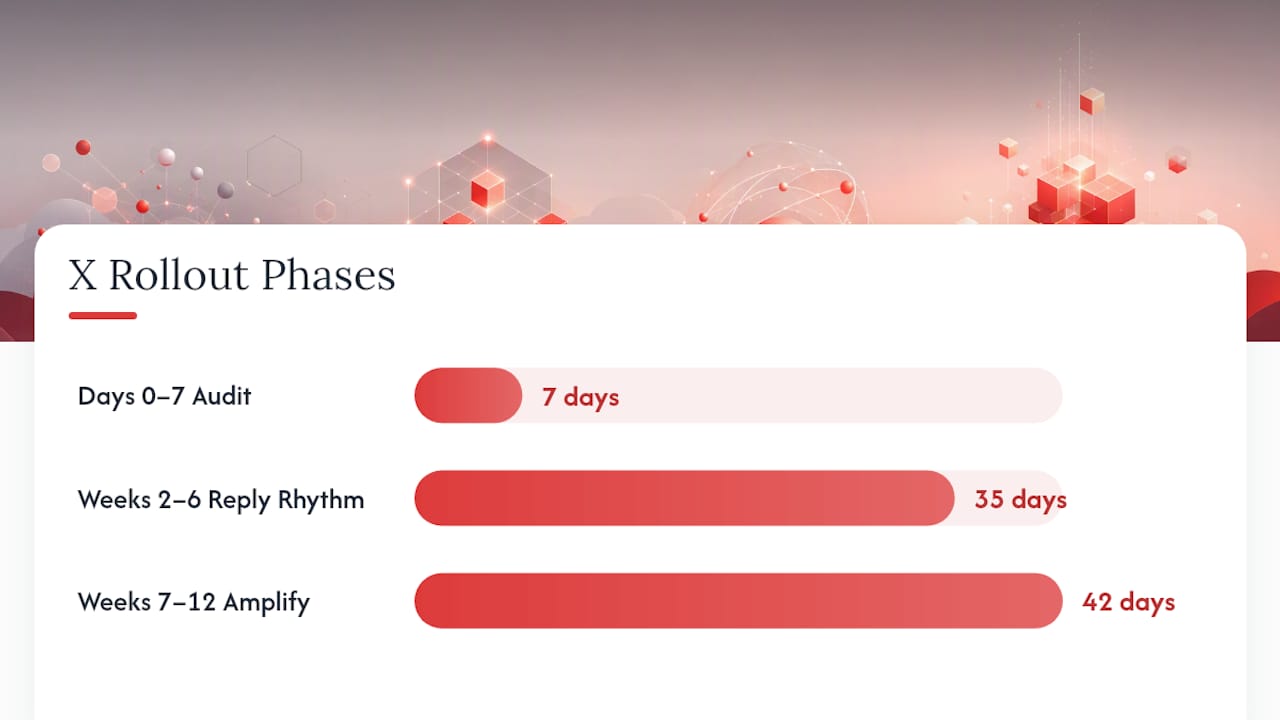
Days 0 to 7: Run the full profile audit, fix bios and pinned tweets on both founder and company accounts, and build the first two weeks of a content calendar. Set baseline metrics before posting anything new.
Weeks 2 to 6: Establish the reply-first rhythm, targeting 10 to 15 accounts daily. Publish one to two threads per week alongside daily short posts. Track profile visits and DM starts weekly against your baseline.
Weeks 7 to 12: Identify the two or three organic posts with the strongest engagement and test creator amplification against them with a small budget. Start tightening the handoff between marketing and sales for any DM conversation that shows buying intent.
Success criteria to check at each milestone:
- 30 days: Profile visits trending up week over week; reply-first rhythm running without gaps
- 60 days: At least one qualified DM conversation traced to a specific post or reply
- 90 days: A repeatable weekly cadence running with minimal oversight, plus a documented handoff process to sales for any X-originated conversation
Handoff checklist for sales: every qualified DM gets logged in the CRM with the originating post, the account’s role, and a next-step owner, so nothing warm gets lost in a personal inbox.
What Do Most B2B Teams Get Wrong About X?
The biggest blind spot is chasing a viral moment instead of building a rhythm. Small, consistent actions, replies, threads, data posts, compound over months. A single viral tweet rarely does, and teams that chase it burn effort chasing an outcome they can’t control.
The second mistake is treating X like a closer. It’s an influence and audition channel: it builds the trust that makes a sales conversation possible, but the close still happens in a DM, a call, or a demo. Expecting a tweet to generate a signed deal misreads what the platform is for.
Set simple governance early, who posts, who approves sensitive replies, who owns crisis response, and revisit it quarterly. Most of the teams that struggle on X aren’t lacking creativity. They’re lacking a process they actually stick to.
— Knowix
When Should You Bring in Nowix for X Management?
Running reply-first days, threads, and creator amplification well takes real hours every week, hours most lean marketing teams don’t have to spare on top of everything else on their plate. Some services are built specifically for tech and AI brands that want such execution handled without hiring a full internal social team.
Full X account management can cover strategy, daily content, replies, and community engagement to help keep your founder’s voice and company account active and consistent. For brands with organic posts proving themselves and seeking to scale reach quickly, a post amplification service can coordinate vetted micro-influencers to quote-tweet and comment on posts that are already working, rather than gambling on unproven content.
Run this in-house if you have someone who can commit real daily hours to replies and content. Hire it out if your team is stretched too thin to be consistent. If you’re ready to see what a managed X presence looks like for your brand, start with a look at Nowix’s services and get a plan built around your launch timeline.
Sources
- B2B marketing on X: what you need to know — Martech
- How to build a B2B social media marketing strategy — Sprout Social
- How Do You Use Twitter Effectively for B2B? — Lilach Bullock
- Twitter/X for business: The complete 2026 guide — Planify
Recommended
- How to Increase Twitter Engagement in 2026
- Go Viral on X: The Engineered Playbook for Tech Brand Dominance in 2026
- X Profile Management for Startups: The 2026 Growth Playbook
- Best Startup Marketing Agencies for X: Tech & AI CMOs
Frequently asked questions
What inputs help Knowix write X content in my voice?
Share the product facts, target reader, writing samples, personal viewpoints you approve and the intended next step. Research and a clear review flow turn those inputs into usable drafts.
How should I judge whether the content is working?
Compare relevant posts over a consistent period and look for useful audience response, website actions and recorded enquiries. Avoid treating one viral post as a complete content strategy.