
An agency-led build-in-public program on X delivers predictable reach, qualified pipeline, and launch momentum by pairing founder proof content with coordinated creator amplification. The fastest path to those outcomes: hire an agency that runs the full stack, from strategy and creator briefs through launch orchestration, amplification, and reporting.
Here is what a complete program delivers:
- Creator launches coordinated across hundreds of micro-KOLs inside a single hour
- Post amplification via controlled QRTs and comments from vetted creators
- Full account management covering daily content, replies, and community engagement
- Measurement tied to qualified DMs, demo requests, and waitlist signups, not vanity impressions
X’s expanded creator monetization and Premium features in 2026 mean brands that plan amplification as a budget line from day one outpace those that treat it as optional. Nowix is built for exactly that moment.
Key Takeaways
Agency-led building in public on X works when it combines founder proof content with coordinated creator amplification, outcome-tied reporting, and pre-negotiated usage rights.
| Point | Details |
|---|---|
| Primary KPI to demand | Require qualified DMs, demo requests, and waitlist signups, not impressions. |
| Minimum proof to require | Ask for a real case study with creative-to-conversion attribution before signing. |
| Timeline reality | Sustained growth compounds over 6–12 months; paid-amplified launches accelerate the launch window. |
| Rights caution | Negotiate amplification and whitelisting permissions in the contract before launch day. |
| Fastest path to start | Book a Nowix launch consult and receive a campaign scope within 48 hours. |
Table of Contents
- What does a full agency build-in-public X program include?
- How does an agency run a build-in-public X campaign, step by step?
- What KPIs, benchmarks, and pricing should you expect?
- What should you ask an agency before signing?
- What proof materials should you request from an agency?
- What should your agency’s reporting template include?
- Why agency-led building in public works for tech and AI brands
- Nowix runs your build-in-public program on X
- Sources
What does a full agency build-in-public X program include?
This is not the indie-maker practice of sharing raw progress notes. For tech and AI brands, building in public on Twitter means a productized agency service with defined deliverables across two commercial models.
Project-based (one-off launch):
- Positioning and messaging strategy for the launch window
- Founder and brand post production (scripts, hooks, proof assets)
- Creator sourcing, vetting, and briefing
- Launch orchestration across a coordinated creator roster
- Paid amplification and QRT distribution
- Post-launch moderation and DM handling
Monthly retainer (ongoing account management):
- Daily content calendar and publishing
- Replies, community engagement, and DM management
- Ongoing creator amplification of top-performing posts
- Weekly reporting tied to business outcomes
Governance is a required deliverable, not an afterthought. FTC disclosure requirements apply to paid creator posts, and a credible agency builds compliant disclosure language into every creator brief.
Pro Tip: Negotiate amplification and whitelisting rights before the contract is signed. Last-minute permission gaps are the most common reason a high-performing post cannot be scaled.
How does an agency run a build-in-public X campaign, step by step?
A well-run campaign follows seven phases. Use this sequence to pressure-test any agency’s methodology during a vendor call.
- Discovery and positioning — ICP definition, audience targeting, competitive audit, and messaging hierarchy
- Content and creative plan — Founder post scripts, proof assets, hook variants, and a content calendar mapped to the launch window
- Creator sourcing and vetting — Prioritize creators with documented conversion signals over raw follower counts; brief each with platform-specific creative direction
- Launch orchestration — Coordinate up to 700 creators inside a 1-HOUR LAUNCH WINDOW for maximum timeline saturation
- Amplification and paid distribution — Amplify winning posts through QRTs and paid formats that preserve creator voice; scale only what proves itself early
- Community management and follow-up — Reply cadence, DM routing, and moderation through the amplification tail
- Measurement and learning — Report on qualified outcomes, attribute conversions, and feed learnings into the next cycle
Timeline from kickoff to first meaningful trend:
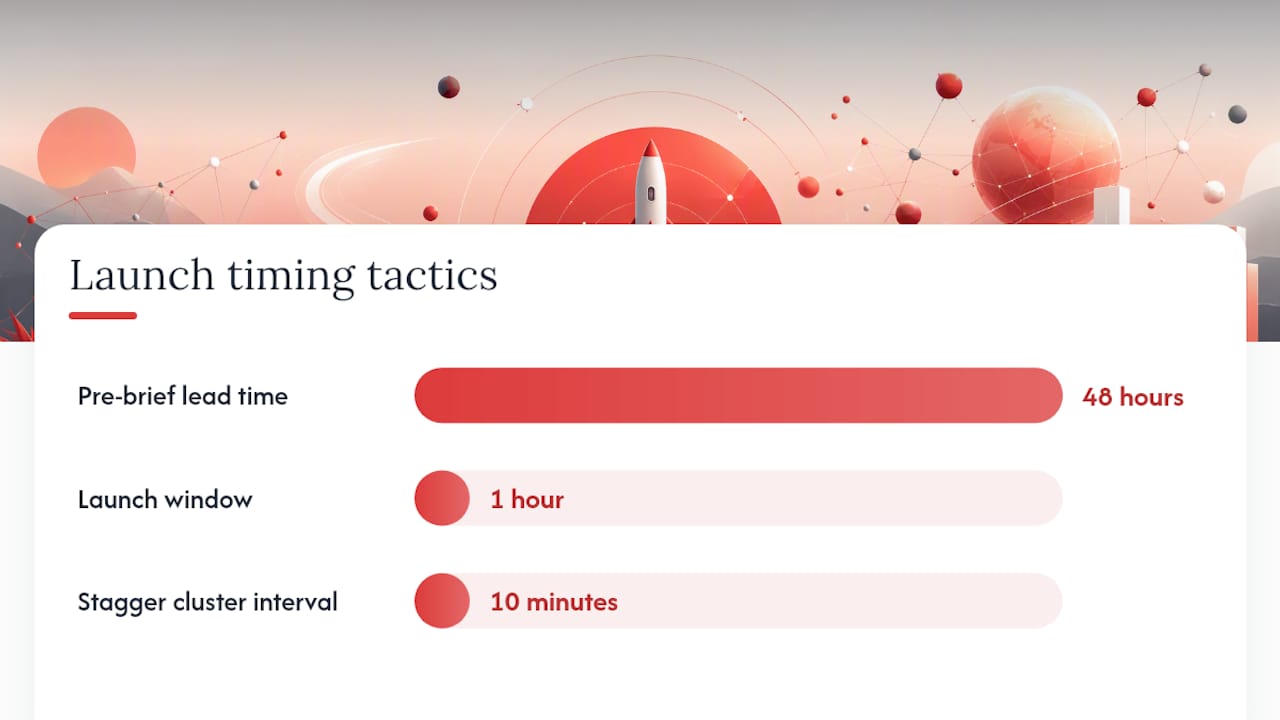
Speed tactics for the launch hour: pre-brief creators 48 hours out, stagger posting in 10-minute clusters, and have moderation live before the first post drops. The risk to guard against is creator non-compliance — agencies with signed contracts and pre-approved content avoid this almost entirely.
What KPIs, benchmarks, and pricing should you expect?
Primary KPIs vs. vanity metrics
Demand these from any agency you evaluate:
- Primary: Qualified DMs, demo requests, waitlist signups, CRM-attributed conversions
- Secondary: Profile visits, follower growth, reply volume
- Vanity (context only): Raw impressions, total likes
Proof-heavy content that shows product outputs and operational trade-offs produces higher-quality leads than generic awareness posts. Build that standard into your KPI agreement.
Timeline to traction
In a sample of bootstrapped apps, many used build-in-public as their primary X format, and meaningful compounding typically appeared after 6–12 months of consistent activity. Paid-amplified launches shorten that curve significantly for the launch window itself, though sustained growth still compounds over months.

Pricing shape
Creator program retainers on social platforms typically run $5,000–$25,000 per month, with price driven by creator scale, amplification spend, and production complexity. One-off viral launches are generally priced as project fees. X Premium subscriptions and creator whitelisting add to the budget but are worth it when amplification is a core deliverable.
What should you ask an agency before signing?
Pre-kickoff assets you need to supply
- Brand guidelines and approved messaging
- Founder X account access (or posting approval workflow)
- Product screenshots, demo video, and customer proof
- Legal contact for contract and disclosure review
Exact questions to ask
- Walk me through your creator sourcing and vetting process.
- How do you handle usage rights and whitelisting before launch?
- What does your creator brief look like, and can I see a sample?
- How do you attribute qualified leads back to specific creator posts?
- What is your moderation and escalation protocol during the launch window?
- What SLAs do you commit to for reporting and issue response?
- Can you show me a before/after metrics report from a comparable campaign?
Red flags
- No documented creator vetting criteria
- Refuses to negotiate amplification rights before signing
- Reports only impressions and likes, no qualified-lead tracking
- Cannot name the FTC disclosure standard they apply
Decision criteria: fit (ICP alignment), speed (time to launch-ready), proof (real case study with attribution), and measurement maturity (outcome-tied reporting).
What proof materials should you request from an agency?
A credible agency supplies these without hesitation:
- Before/after metrics from a comparable tech or AI brand campaign
- Sample creator brief and post creative
- Anonymized creator roster with engagement and conversion benchmarks
- Campaign timeline showing kickoff to trend
- Attribution notes explaining how leads were tracked back to creator posts
How to read a case study for signal vs. noise
Ask for the creative-to-conversion linkage. A case study that shows impressions without tying them to demo requests or waitlist signups is a vanity document. The signal is a named conversion event with a volume attached.
Nowix’s Twitter growth playbook and trending strategy guide are available as internal references for deeper methodology reading.
What should your agency’s reporting template include?
Require these elements in every report:
- Weekly reach and engagement highlights by post
- Creator-level performance (impressions, QRTs, qualified clicks)
- Paid vs. organic lift breakdown
- Qualified leads generated (DMs, demo requests, signups)
- CRM-attributed conversions with UTM or pixel source
Attribution inputs to specify in the contract: UTM parameters on all linked assets, pixel events for demo and waitlist pages, and a clear agreement on last-click vs. view-through attribution windows.
Metrics by engagement model:
Measure qualified DMs and demo requests as the conversion signals from X, not raw impressions. Any agency that cannot segment its report by qualified outcome is not running a business-outcome program.
Pro Tip: Ask your agency to deliver a CSV export of creator-level data after every campaign. That file becomes your benchmark for the next launch.
Why agency-led building in public works for tech and AI brands
The conventional wisdom says founders should post raw progress themselves and let authenticity do the work. That is partly right and mostly incomplete. Founder voice matters. But founder voice without distribution is a tree falling in an empty forest.
The agency model scales both simultaneously. A coordinated creator wave amplifies the founder’s proof content to audiences that would never find it organically, while the agency manages the operational weight of sourcing, briefing, moderating, and reporting. Platform changes in 2026, including expanded creator monetization and X Premium distribution dynamics, favor brands that treat amplification as a planned budget line rather than a hope. DIY posting cannot compete with a 700-creator launch window on a time-bound product release. Influencer-only models without founder proof content produce awareness without trust. The agency-led approach, done correctly, produces both.
Nowix runs your build-in-public program on X
Nowix makes tech and AI brands trend on X. Three service lines cover every stage of the program:
- Go Viral on X: Timeline takeover campaigns with up to 700 creators inside a 1-hour launch window
- Amplify Your Reach: Controlled QRT and comment amplification from vetted micro-KOLs, with whitelisting rights negotiated before launch
- X Management: Monthly retainer for daily content, replies, community engagement, and reporting tied to qualified outcomes
Engagement models match your stage: a one-off launch for a product release, a campaign plus amplification package for a funding announcement, or a monthly retainer for ongoing account growth. Nowix shares sample creator briefs, campaign timelines, and attribution reports on the first call. For broader marketing integration across owned and paid channels, Justin Savage’s marketing resource covers how X programs feed into a full-funnel plan.
Book a launch consult at Nowix and get a campaign scope within 48 hours.
Pro Tip: Negotiate amplification and whitelisting rights before you sign any agency contract. It is the single clause that determines whether a breakout post can be scaled or has to stop at organic reach.
Sources
- An Organic Growth Playbook for Founders on X - Startupik | Startup magazine
- How X Organic Distribution Works for Bootstrapped SaaS Founders | Distribution Base