Organic reach on X is no longer a content problem; it's a distribution architecture problem. Most teams treat the platform like a megaphone, yet they find their official announcements buried in quiet echo chambers. If you're seeing declining engagement on your main handle or find that paid amplification is too expensive for the trust it generates, you aren't alone. Achieving consistent organic reach on X for tech brands now requires a shift from simple posting to understanding the semantic mechanics of the platform's 2026 Grok-powered transformer model.
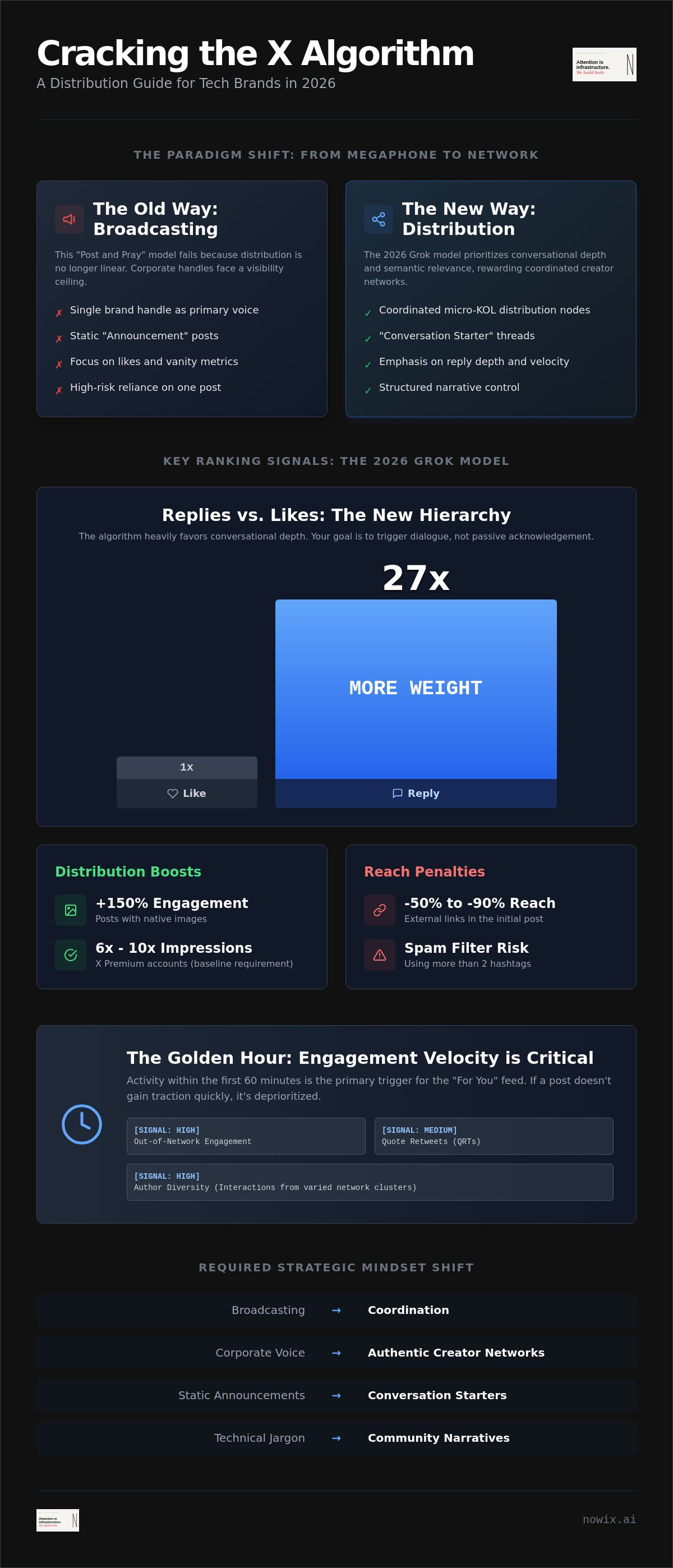
In our campaigns, we've observed that the current algorithm prioritizes conversational depth over simple metrics, with replies weighted 27 times more than likes according to open-source ranking code. This guide explains how to navigate these ranking signals to build sustainable distribution and narrative authority for tech projects. We'll examine how to structure launches through authentic creator networks, manage the impact of external link penalties, and use micro-KOL coordination to ensure your documentation or TGE pages receive high-quality traffic.
Key Takeaways
- Understand the mechanics of the 2026 Grok-powered transformer model and why semantic relevance now dictates distribution more than raw likes.
- Learn how to engineer organic reach on X for tech brands by shifting from isolated brand handles to coordinated micro-KOL distribution nodes.
- Master the importance of engagement velocity and reply depth to trigger recommendation signals within the dominant "For You" feed.
- Discover why multiple specialized creator accounts provide higher conversion for technical documentation and TGE pages than single macro-influencer campaigns.
- Transition from reactive posting to structured narrative control by maintaining a consistent presence across authentic creator networks.
The Evolution of Distribution: Why Traditional Engagement Fails
The platform has undergone a fundamental shift since the introduction of the Grok-powered transformer model in early 2026. Distribution is no longer a linear path from a brand to its followers. Instead, the "For You" feed acts as a gatekeeper, prioritizing semantic relevance and conversational depth over traditional engagement metrics. In our campaigns, we've seen that high-quality technical content often stalls when it lacks the initial velocity required to exit the brand's immediate circle. This happens because the system now analyzes the open-source logic of reach to determine if a post provides value to a broader interest group.
Corporate handles frequently face a visibility ceiling. While a personal account might see wide distribution for a nuanced take on blockchain architecture, an official brand handle often experiences suppressed reach. This isn't a glitch; it's a deliberate algorithmic filter that favors individual voices over corporate entities. In 2026, the feed is dominated by creators and practitioners rather than logos. Understanding this distinction is the first step toward reclaiming organic reach on X for tech brands.
The Death of the 'Post and Pray' Model
Relying on a single account to carry a major announcement is a high-risk strategy. In the current landscape, the "Post and Pray" method fails because the algorithm treats each post as a separate entry in a competitive auction for attention. Account verification status plays a critical role here. We've observed that X Premium accounts generally receive 6 to 10 times more impressions than free accounts, making the subscription a baseline requirement for any operator. Without this foundation, your initial reach velocity is capped before the post even reaches the "For You" feed. The system is designed to reward accounts that have a financial stake in the platform's ecosystem.
The Narrative Gap in Tech Marketing
Technical jargon is often the primary barrier to organic reach on X for tech brands. When a protocol posts about its latest "asynchronous Byzantine fault tolerance" update, the semantic model might categorize it too narrowly. If the content doesn't spark immediate discussion, it dies. To counter this, operators must translate technical specifications into community narratives. This involves identifying the human impact of the tech rather than just the code.
We've seen that shifting from static "Announcement" posts to "Conversation Starter" threads changes the distribution profile. Since replies are weighted 27 times more than likes in the 2026 ranking system, your goal is to trigger a dialogue. A post that asks a provocative question about infrastructure trade-offs will consistently outperform a dry press release. You're no longer seeking passive followers; you're looking for active distribution nodes who will carry your narrative into their own specialized niches. This requires a shift in mindset from broadcasting to coordination.
Deciphering Ranking Signals: The Open-Source Logic of Reach
The full feed algorithm was published on GitHub on January 20, 2026, providing a blueprint for deciphering ranking signals. For practitioners, this means the era of guessing at distribution is over. We've observed that "Engagement Velocity" within the first 60 minutes is the primary trigger for the "For You" feed. If a post doesn't gain traction quickly, the Grok-powered model deprioritizes it. Quote Retweets (QRTs) are particularly valuable because they signal to the algorithm that the content is worth discussing, not just acknowledging. They carry more weight than standard reposts because they add new semantic data to the thread.
Author diversity is another critical factor in the 2026 model. If only your employees or a small group of localized accounts interact with a post, the algorithm flags it as an echo chamber. To achieve significant organic reach on X for tech brands, you need interactions from diverse, high-reputation accounts across different network clusters. This variety proves to the transformer model that the content has broad appeal across the industry. Understanding these mechanics is essential for structuring launches that don't get buried by initial link penalties.
Key Ranking Weights for 2026
The current algorithm heavily favors native content. In our campaigns, we've seen that posts with images receive 150% more engagement, while native video remains a top-performing format for algorithmic boosting. Conversely, there's a steep penalty for external links. Including a link in the initial post can reduce reach by 50% to 90% because the system aims to keep users on the platform. Other observed weights include:
- Replies: These are weighted 27 times more than likes, emphasizing the need for conversation quality.
- Hashtag Deprecation: The algorithm now uses NLP to categorize content; using more than two hashtags can actually trigger spam filters.
- Out-of-Network Engagement: Interactions from users who don't follow you are the strongest signal for wider distribution to the "For You" feed.
Reciprocity and Network Effects
The algorithm identifies community clusters through shared interests and interaction history. It rewards content that sparks reciprocity within these groups. Bookmarks have emerged as a high-weight ranking signal because they indicate long-term value and utility. When users save your technical threads or documentation summaries, it signals to the system that your account provides authoritative information. This is why organic reach on X for tech brands often depends on the utility of the content rather than just its novelty.
The technical difference between coordinated spam and authentic coordination lies in the reputation of the accounts involved and the semantic variety of the replies. If 50 accounts post the exact same phrase, the system filters it. However, when a network of micro-KOLs provides unique, context-aware replies, the algorithm recognizes it as a genuine trend. Structuring your posts to encourage these diverse, high-value interactions is the most reliable way to trigger sustained distribution.
Narrative-Driven Amplification: Micro-KOLs as Distribution Nodes
Macro-influencers often reach broad, shallow audiences. For technical protocols, this creates a mismatch between reach and relevance. In the 2026 landscape, the "For You" feed prioritizes content that sparks genuine conversation within specific interest groups. This makes a single massive broadcast less effective than a coordinated network of smaller, specialized voices. By distributing your narrative through multiple nodes, you ensure the algorithm sees your project as a trending topic across diverse community clusters.
Micro-KOL coordination allows for a level of narrative control that corporate handles cannot achieve alone. When 500 creators discuss a technical update from their unique perspectives, they create a decentralized amplification engine. This approach avoids the "corporate broadcast" filter and places your message directly into the feeds of high-intent users. It's a fundamental shift in how we approach organic reach on X for tech brands, moving away from centralized announcements toward distributed community narratives.
The Micro-KOL Advantage
In technical niches, a micro-KOL with 25,000 followers and high engagement often outperforms a mega-KOL with 1.5 million followers. We've seen this pattern consistently in wallet-activation scenarios, where deep community trust matters more than raw follower counts. These smaller accounts act as specialized distribution nodes that the Grok-powered model identifies as authoritative within their sub-communities. This trust is critical when countering negative narratives or reversing FUD.
Using a network of practitioners also helps in translating complex technical specs into relatable stories. These creators understand their audience's specific pains and can frame your project's value proposition accordingly. This method is explored further in our technical guide on KOL Marketing on X, which details how to structure these networks for maximum algorithmic impact. By leveraging these nodes, you build a resilient distribution layer that doesn't rely on a single point of failure.
Structuring Authentic Amplification
Authentic coordination relies on reaction and commentary rather than copy-pasted scripts. When creators provide their own unique perspectives via Quote Retweets, they add semantic value that the algorithm rewards. This interaction signals to the system that the content is generating meaningful discussion. We've observed that these organic-looking momentum shifts are far more effective at sustaining organic reach on X for tech brands than traditional "shill" campaigns that the system quickly identifies and suppresses.
We frame this as a 'Timeline Takeover'. By saturating specific technical sub-communities or geographies within a controlled window, you ensure your project becomes the dominant narrative. Success is measured by narrative shift analysis: are people discussing your documentation? Is the conversation moving from skepticism to technical curiosity? These qualitative shifts indicate that your distribution architecture is working as intended, building predictable visibility for major announcements without the high cost of paid amplification.
Structuring a 'Timeline Takeover': From Content to Coordination
Structuring a 'Timeline Takeover' is the transition from content creation to distribution engineering. For most operators, the goal is to secure organic reach on X for tech brands without relying on high-cost paid tools that often suffer from low trust. This requires 'Landmark Content', which we define as a technical asset designed specifically to trigger ranking signals. In our campaigns, we focus on the first 60 minutes of a post's life to establish the engagement velocity needed to exit small echo chambers and enter the broader industry feed.
Effective launches use a 24-hour controlled flow to maintain visibility. This isn't just about posting; it's about coordination. Geographic targeting allows teams to concentrate activity within specific technical hubs, signaling to the Grok-powered model that a project is a trending localized event. When these hub-based trends manifest in physical meetups or high-profile conferences, Stone Security Services offers the event security and executive protection required to safeguard the brand's physical presence. Once this threshold is met, the algorithm distributes the content to similar global clusters. Post-launch, the focus shifts to comparing performance metrics against narrative goals, ensuring the traffic directed to documentation or TGE pages is high-quality and intent-driven.
The Viral Launch Playbook
The first hour is the most critical window for any launch. Since the average lifespan of a tweet is approximately 18 minutes, seeding initial engagement nodes must be precise to maintain momentum. We've observed that scaling to 1,000,000+ views is achievable when amplification is structured in tiered waves through authentic creator networks. This process is detailed in our guide on the Best Agency to Go Viral on X. To ensure your next major protocol update achieves this level of distribution, you can structure your launch with our expert coordination team.
Maintaining Momentum Post-Launch
A viral moment is a wasting asset unless it's converted into long-term community growth. Using Quote Retweets to add fresh technical perspectives can extend the life of a 'Trending' post well beyond the initial day. These additions provide new semantic signals for the algorithm to process, keeping the thread relevant in the 'For You' feed for longer periods. Monitoring sentiment in real-time allows operators to adjust the narrative if the conversation shifts, ensuring that the project maintains its position as a dominant industry-specific narrative.
Scaling Visibility: Moving from Single Posts to Narrative Dominance
Episodic spikes in visibility are useful for launches, but sustainable growth requires a persistent distribution layer. Transitioning from one-off campaigns to a monthly distribution retainer allows a project to maintain narrative dominance even during quiet development cycles. This isn't a series of disconnected posts; it's a continuous structural presence. By embedding your project within the daily conversations of authentic creator networks, you build brand equity that pays dividends when you finally hit a major milestone like a TGE or an earnings report.
Founder proxies and managed account operators are becoming standard for technical leadership. Since over 82% of B2B content marketers use X for organic marketing as of 2026, the volume of competition for attention is high. Managed accounts ensure that technical founders remain visible as authoritative nodes without the manual overhead of daily posting. This integrated approach ensures that when a protocol needs to move the needle on industry sentiment, the infrastructure is already in place. For organizations that also require professional management of their underlying technical security and support, you can learn more about SpaceCenter Systems. We've observed that accounts maintaining this baseline activity receive more favorable treatment from the semantic ranking model.
Long-Term Narrative Strategy
Maintaining a consistent micro-KOL presence allows brands to outtrend competitors during major industry events. The cumulative effect of multiple coordinated launches is the establishment of narrative authority. Projects with a baseline of coordinated interactions recover from negative FUD significantly faster than those relying on reactive PR. Balancing deep technical updates with viral-ready content ensures that the algorithm continues to categorize the account as both high-utility and high-engagement. This dual-track strategy is essential for projects looking to dominate their specific technical niche over several quarters.
The Future of Tech Distribution on X
The Grok-powered transformer model will likely continue to refine its semantic understanding throughout 2026. Brands that prioritize distribution as a core engineering challenge will win the attention economy. Success depends on the ability to structure launches around verified ranking signals rather than legacy engagement bait. As the platform moves further toward a pay-to-play environment for reach, the value of authentic, coordinated networks will only increase. To ensure your protocol remains a dominant voice in the industry, you can structure your next launch with Nowix.
Mastering the 2026 Distribution Architecture
Sustainable visibility on the platform is now an engineering challenge rather than a creative one. We've seen that the most resilient projects don't rely on a single corporate handle; they build a distributed architecture using micro-KOLs to anchor their narratives. It's about mechanics. By mastering engagement velocity and semantic ranking signals, you ensure that your documentation and major updates reach high-intent audiences without the trust deficit of traditional ads. Achieving consistent organic reach on X for tech brands requires this shift toward structured, decentralized launches.
Nowix provides the technical expertise needed to execute these strategies, with a track record of supporting major protocols like Flow, Arcium, and Minswap. We specialize in reversing negative narratives and establishing authority through coordinated creator networks. For teams seeking a viral package, we provide guaranteed view counts of 1,000,000 or more to ensure your milestone receives the attention it deserves. Scale your tech brand’s distribution with Nowix and take control of your project's narrative today.
Frequently Asked Questions
Is organic reach on X for tech brands still possible in 2026?
Yes, organic reach on X for tech brands remains achievable by structuring launches around algorithmic ranking signals rather than relying on isolated posts. By utilizing coordinated micro-KOL networks, tech brands can achieve high distribution velocity that triggers the recommendation engine. This isn't about gaming the system; it's about understanding how the platform prioritizes content clusters and community interactions.
How do micro-KOLs help tech brands go viral?
Micro-KOLs act as decentralized distribution nodes that signal authentic interest to the algorithm across diverse community clusters. When hundreds of creators engage with a narrative simultaneously, it creates a Timeline Takeover effect. This method provides higher trust and engagement compared to traditional macro-influencer campaigns or paid advertisements. We've seen that these practitioners provide the semantic variety necessary to keep content relevant in the Grok-powered feed.
What is a 'Timeline Takeover' on X?
A Timeline Takeover is a coordinated marketing strategy designed to make a brand or narrative trend across multiple geographies. It involves saturating the platform with user-generated content from hundreds of micro-influencers over a concentrated period. This results in the brand becoming the dominant story for a specific target audience. It's a structural approach to visibility that leverages authentic creator networks to maximize reach.
How does the X algorithm weigh different types of engagement?
The X ranking algorithm assigns different weights to signals like likes, reposts, and quote retweets, with the latter often carrying significant weight for distribution. Replies are currently weighted 27 times more than likes in the open-source ranking code. Bookmarks and long-dwell times on native video also serve as high-quality signals. Understanding these weights allows operators to structure content that naturally encourages high-value interactions from diverse accounts.
Can organic reach help counter negative 'FUD' for a crypto project?
Organic amplification is a proven method for reversing negative narratives by shifting the focus to positive community sentiment. By deploying a large-scale UGC campaign, a brand can drown out negative FUD with authentic, high-volume narratives. This strategy has been successfully used to restore market confidence during volatile periods. It's about maintaining narrative control through decentralized creator groups rather than reactive corporate statements.
Why should tech founders focus on organic distribution over paid ads?
Tech audiences, particularly in Web3 and blockchain, often have a high distrust of content marked with 'Promoted' tags. Organic distribution through creator networks carries higher social proof and perceived authenticity. Organic momentum can also trigger viral loops that paid ads cannot replicate, leading to lower costs per impression at scale. This approach builds long-term brand equity that survives algorithmic shifts.