
The most effective founder brand strategy on X is simple: publish founder-native content on a consistent cadence and engage deliberately with the right accounts. Do this for 90 days and you generate qualified inbound leads, press interest, and hiring pull, not just followers. Start the test this week with a 15-minute weekly content capture session.
TL;DR:
- Consistently posting two to five times weekly for 90 days and focusing on three content pillars is critical for building inbound leads, press interest, and hiring pull.
- Engaging in targeted replies, quote-retweets, reply threads, and quarterly AMAs helps expand reach and attract qualified followers and potential customers.
- A founder profile that clearly states the product for the specific buyer, with a compelling pinned post and link, converts attention into meaningful inquiries.
- Tracking metrics like reply counts, DMs, and profile views, rather than vanity follower numbers, is essential to measure genuine brand growth.
- External amplification tools, such as timeline takeovers and account management, can accelerate growth after proven organic formats, especially during launch moments.
Table of Contents
- What Content Should a Founder Brand on Twitter Actually Publish?
- How Often Should Founders Post to Build Momentum?
- Which Engagement Tactics Actually Grow a Founder’s Reach?
- How Should a Founder’s X Profile Convert Attention Into Leads?
- What Metrics Actually Prove a Founder Brand Is Working?
- A 90-Day Founder Roadmap for Growing on X
- Why Your Voice Matters More Than Your Content Calendar
- Why Storytelling Builds a Stronger Founder Brand Than Announcements
- Common Mistakes That Stall a Founder’s Twitter Growth
- What Successful Founder Brands on X Actually Do Differently
- Which Tools Actually Help You Manage a Founder Twitter Account?
- When Should a Founder Hand Off the Brand to the Company?
- When It’s Time to Bring in an Amplification Partner
- Sources
What Content Should a Founder Brand on Twitter Actually Publish?
Founder brand Twitter accounts that grow fast almost always run on three or four content pillars, not a grab bag of random posts. Each pillar serves a distinct business purpose, and skipping one usually shows up later as a stalled metric.
- Educational/bookmarkable content. Threads that teach something specific (“how we priced our API in month one”) build the kind of trust that accelerates early credibility and generates media, recruiting, and lead signals. Format: a five-tweet thread with one number in the hook.
- Narrative/build-in-public. Revenue milestones, failed launches, hiring decisions. This is the pillar that makes a founder feel like a person instead of a logo. Format: a single tweet with a screenshot, posted the day it happens, not a week later.
- Engagement/personality posts. Lighter, opinionated takes on the industry, sometimes a joke, sometimes a hot take on a competitor’s product decision. These posts do the algorithmic heavy lifting that pure education can’t.
- Social proof. Customer wins, press mentions, investor quotes. Format: a short reply-thread that adds context to a customer’s own tweet, so it reads as conversation rather than a brag.
Educational content drives trust and inbound DMs. Narrative content drives recruiting applications. Engagement posts drive reach. Social proof closes the loop for anyone checking your profile before they take a meeting.
How Often Should Founders Post to Build Momentum?
A founder account on X doesn’t need daily output to compound. What it needs is consistency long enough for the algorithm, and your audience, to learn your rhythm.
- Days 1 to 30: Post 2 to 5 times per week, plus one longer, pinned weekly piece. Fix your profile and pick your three pillars.
- Days 31 to 60: Double down on whichever pillar and format got the strongest replies (not just likes). Add a second weekly long-form post if reply volume justifies it.
- Days 61 to 90: Consolidate. You should see recurring names in your replies and at least a few unsolicited DMs. That’s the signal a 90-day cadence of 2 to 5 posts per week produces measurable audience signals by day 60 to 90.
The capture routine behind this only needs 15 to 45 minutes a week: record voice notes or jot rough ideas right after customer calls or product decisions, then turn that single session into three or four posts using a scheduling tool like Typefully or X’s native scheduler.
Pro Tip: Batch your week’s posts in one sitting right after your Monday leadership meeting. That’s when you have the most raw material and the least excuse to skip it.
Which Engagement Tactics Actually Grow a Founder’s Reach?
Posting is half the job. The other half is showing up in threads where your future customers, hires, and investors are already paying attention. Founder accounts that plateau almost always stopped engaging outward once they started posting inward.
- Targeted replies. Reply to 5 to 10 accounts a day in your specific niche, not general tech Twitter. Add a genuine data point or counterpoint, never just “great point.”
- High-signal quote-retweets. Quote-retweet a post from a bigger account in your space and add the missing context or a contrarian angle. This is the fastest way to borrow reach without looking like you’re borrowing reach.
- Curated reply threads. When you post a thread, seed the first two or three replies yourself with extra detail. It keeps the thread alive longer and gives late arrivals a reason to keep scrolling.
- Strategic AMAs. Run a quarterly “ask me anything” tied to a launch or milestone. It’s a controlled way to generate a burst of replies you can mine for content later.
Filter which accounts deserve your engagement time by audience fit, not follower count: a 3,000-follower account full of your exact buyer is worth more than a 300,000-follower account of onlookers. Track any DM that comes from a reply in a simple spreadsheet, then route serious ones to your pinned post’s calendar link.
How Should a Founder’s X Profile Convert Attention Into Leads?
Your profile is the funnel, and most founders leave it half-built. A visitor decides in about three seconds whether to follow, click, or leave, so every element has one job.
- Headline: State what you build and for whom, in plain language. “Building [product] for [specific buyer]” beats a vague mission statement every time.
- Bio: One line of proof (revenue, users, notable backer) plus one line of personality. Skip the emoji stack.
- Pinned post: One clear sentence on what you do, one proof point, one call to action. Pick a single link, don’t scatter three.
- Link choice: Route to whichever micro-conversion matters most right now, a newsletter signup, a calendar link, or a specific case study, and change it as your priority shifts.
Pro Tip: Rotate your pinned post’s CTA every two to three weeks based on what you’re actually trying to move that month. A static pinned post from six months ago is a wasted funnel.
What Metrics Actually Prove a Founder Brand Is Working?
Follower count is the metric that flatters your ego and tells you nothing about revenue. The signals that matter are quieter: inbound DMs from qualified accounts, profile views that convert to newsletter signups, and demo requests that mention a specific post.
- Log weekly: reply count on your top three posts, DM volume, and profile visits from your analytics tab.
- Log monthly: newsletter or calendar-link conversions, and any inbound press or job applicant who cites your X presence.
- Run small A/B tests: vary your hook style, posting time, or thread length for two weeks each, then keep whichever version drove more qualified replies, not more likes.
Without a clearly defined target audience, founders end up optimizing for vanity metrics instead of the inbound leads that actually pay the bills. If a metric doesn’t trace back to a business outcome, stop tracking it.
A 90-Day Founder Roadmap for Growing on X
A playbook built around this exact arc lines up closely with what a lean, staged approach to founder branding recommends: fix the fundamentals before spending a dollar on amplification.
- Weeks 1 to 4: Fix your profile headline, bio, and pinned post. Launch your three content pillars. Set a daily 15-minute reply routine.
- Weeks 5 to 8: Double down on whichever pillar and format produced the strongest reply rate. Start logging weekly metrics without exception.
- Weeks 9 to 12: Consolidate your cadence, review the 90-day data, and decide whether organic growth alone is fast enough or whether the moment calls for amplification.
Case work shows what that decision point can look like. For example, with targeted amplification and timeline plays, post views were taken from roughly 97 to 164 views up to 17,500.
The lift didn’t come from posting more. It came from putting the right creator voices behind posts that were already working organically, then letting that paid momentum tip into organic coverage once the algorithm noticed the engagement spike.
Organic signals justify paid amplification once you have proof a format works. Amplifying an untested post just wastes budget faster.
Why Your Voice Matters More Than Your Content Calendar
Founders who copy a competitor’s thread format and just swap in their own numbers usually get a fraction of the engagement, and it’s not a mystery why. Readers on X can tell the difference between a voice and a template within two sentences.
Start by identifying the two or three things only you can say credibly: the specific mistake you made building your first product, the weird industry insight from your last job, the blunt opinion your co-founder keeps telling you to tone down. Those are your actual content pillars, dressed up in whatever format fits that week. A founder who worked in enterprise sales before starting a dev tools company has a different, better angle on pricing threads than a founder who’s never sold anything. Use that angle instead of writing the generic version everyone else already posted.
Tone matters as much as topic. If you’re naturally blunt, don’t soften every post into corporate diplomacy, that mismatch reads as inauthentic even when the content is solid. If you’re naturally analytical, don’t force yourself into hot-take Twitter just because it gets more replies. Founder personal accounts routinely outperform brand accounts on engagement precisely because they carry a specific, recognizable voice a brand account structurally can’t replicate.
Write a few posts in your actual texting voice, the one you use with your co-founder or your first ten customers, and compare the reply rate against your usual polished draft. The gap will tell you which one is closer to your real voice.
Why Storytelling Builds a Stronger Founder Brand Than Announcements
A product launch tweet gets a polite round of likes. A story about the customer call that made you rebuild the onboarding flow at 2 a.m. gets replies, quote-tweets, and screenshots. Story structure does something a feature announcement can’t: it gives the reader a reason to care about the outcome before you tell them what you built.
The mechanics are simple but frequently skipped. Open with tension or a specific, concrete detail, a number, a quote, a moment, not a summary. “We lost our biggest customer over a bug we knew about for three weeks” pulls a reader in further than “We’re improving our QA process.” Resolve the tension with a real decision you made, including the uncomfortable parts. Founders who edit out their own mistakes end up with a story that reads like a press release, and readers can smell that from the first line.
Use storytelling for the moments that actually shifted something, a pivot, a lost deal, a surprising customer request, not for routine updates. Overusing the format on minor news trains your audience to skim past it. Save it for the posts that carry real narrative weight, then let the mundane updates ride on shorter, plainer formats.
The payoff compounds. A well-told founder story gets saved, shared into Slack channels, and referenced in later replies months after you posted it, doing ongoing brand work long after the moment it describes.
Common Mistakes That Stall a Founder’s Twitter Growth
Most stalled founder accounts fail for a handful of repeatable reasons, not bad luck or a broken algorithm.
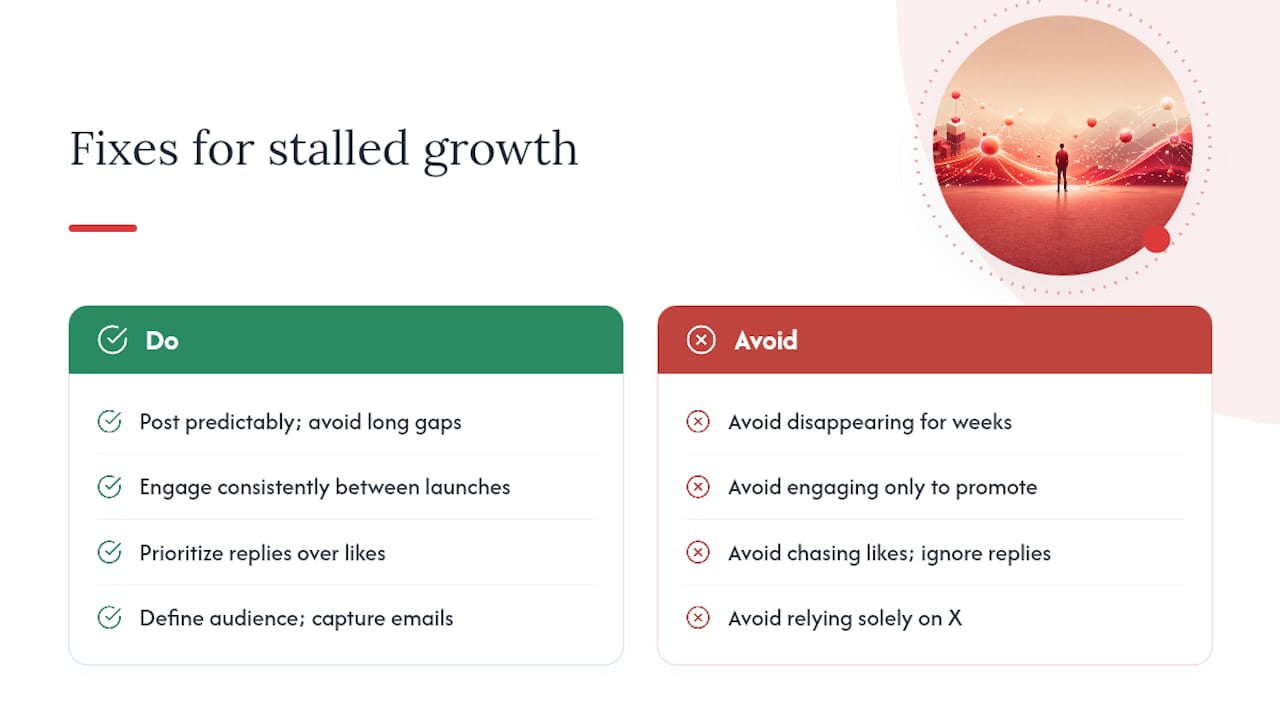
The first mistake is inconsistency disguised as busyness. A founder posts daily for two weeks, disappears for a month during a fundraise, then wonders why engagement resets to zero. The algorithm and your audience both reward predictability, and a gap longer than two or three weeks effectively restarts your momentum.
The second is engaging only when you have something to promote. Replying exclusively during launch week reads as transactional, and audiences notice the pattern fast. Consistent, low-stakes engagement between launches is what makes the launch-week posts land.
The third is optimizing for likes instead of replies. A post that gets 200 likes and no comments is doing far less for your brand than one with 40 likes and 15 substantive replies, because replies are what the algorithm treats as a stronger relevance signal and what actually turns into DMs.
The fourth is skipping audience definition entirely. Founders who post whatever crosses their mind without a clear sense of who should be reading end up with an account that reaches nobody in particular, which is exactly the audience-clarity gap that leads straight to vanity-metric chasing.
The fifth, and most avoidable, is treating X as the only home for your audience. Platform dynamics shift, and past staffing and ownership changes at the platform are a reminder that a founder who never routes followers to an owned channel, like an email list, is building on rented land.
What Successful Founder Brands on X Actually Do Differently
The founder accounts that grow fastest share a pattern more than a personality type. They post specific numbers instead of vague claims, they reply to critics instead of blocking them, and they treat their pinned post as a living asset instead of a static bio extension.
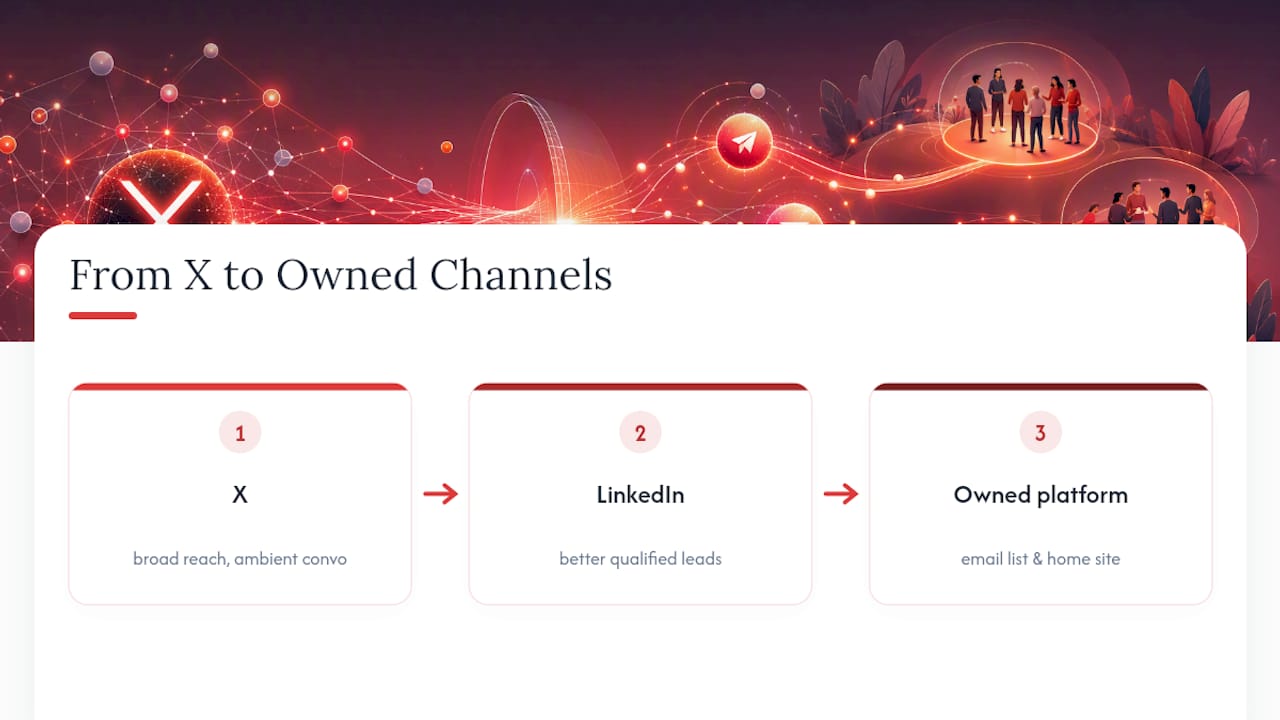
Look at how B2B tech founders typically use the platform: X tends to maximize reach and open, ambient conversation, while a platform like LinkedIn often converts better into qualified sales leads for the same audience. That’s why the strongest founder accounts treat X as a reach-focused satellite rather than a standalone funnel, feeding a home platform or an owned email list rather than trying to close every deal inside a reply thread.
The common thread across strong founder brands isn’t a follower count, it’s a recognizable point of view repeated consistently enough that people start recommending the account to their own network before you ever ask for a share.
Which Tools Actually Help You Manage a Founder Twitter Account?
You don’t need an elaborate stack to run a consistent founder presence, but a few categories of tools remove the friction that kills consistency in week three.
Scheduling and drafting tools like Typefully or X’s own native scheduler let you batch a week’s posts in one sitting instead of scrambling daily. Analytics dashboards built into X, plus a simple spreadsheet, are enough to track the weekly and monthly metrics that actually matter, reply counts, DM volume, profile-to-signup conversions. For voice capture, a notes app or voice memo tool turns a five-minute post-meeting thought into raw material you shape into posts during your weekly batch session.
For amplification once your organic testing has proven a format works, agencies that specialize in creator-driven campaigns, including case examples like the customer growth results documented by Apptenium, show what coordinated amplification can look like across a broader growth program, not just on X specifically.
The point of any tool in this stack is removing friction from the parts of the routine most likely to get skipped when things get busy: capture, scheduling, and measurement. Everything else is optional polish.
When Should a Founder Hand Off the Brand to the Company?
Founder-led branding wins early because people trust a person faster than a logo, but that advantage has a shelf life. Once your account becomes the single point of failure for every launch and every hire, that’s the signal to start building a company-level presence alongside it. The right move isn’t stepping back entirely. It’s training a teammate to run the brand account, documenting your voice guidelines, and letting the founder account narrow toward strategic moments rather than daily upkeep. Founder visibility should build early traction, then transition deliberately so the company doesn’t stay dependent on one person’s timeline.
— Knowix
When It’s Time to Bring in an Amplification Partner
Amplification services exist for the moment your 90-day organic test proves a format works and you need it to scale faster than your own reply time allows. Instead of guessing which creators to court or spending weeks building relationships from scratch, there are three specific plays: timeline takeovers that put your launch in front of a large number of vetted creators within an hour, organic post amplification that adds controlled quote-retweets and comments to posts already performing, and full X account management for founders who need daily content and community replies handled without losing their own voice.
Consider hiring out this work once your organic tests show a format that reliably earns replies, but your posting or engagement time can’t keep pace with the demand. That’s exactly the gap amplification-focused campaigns are built to close, and it’s also when a timeline takeover makes sense for a specific launch moment. If your daily cadence itself is the bottleneck, ongoing account management keeps the voice consistent while freeing your calendar. Book a consult to see which of the three fits your current stage.
Sources
- How to build your founder brand (Scale Venture Partners resources)
- How To Build The Founder’s Brand To Drive Business Success — Forbes
- How to develop your brand strategy — StartupFundraising
- How to build a personal brand as a founder in 2026 (CaptureFlow)
Recommended
- X Profile Management for Startups: The 2026 Growth Playbook
- X Launch Campaign for Tech Startup: The Engineered Distribution Playbook (2026)
- Twitter Growth Playbook for Tech Brands 2026
- How to Grow X Account Fast: The 2026 Distribution Playbook
Frequently asked questions
What inputs help Knowix write X content in my voice?
Share the product facts, target reader, writing samples, personal viewpoints you approve and the intended next step. Research and a clear review flow turn those inputs into usable drafts.
How should I judge whether the content is working?
Compare relevant posts over a consistent period and look for useful audience response, website actions and recorded enquiries. Avoid treating one viral post as a complete content strategy.