
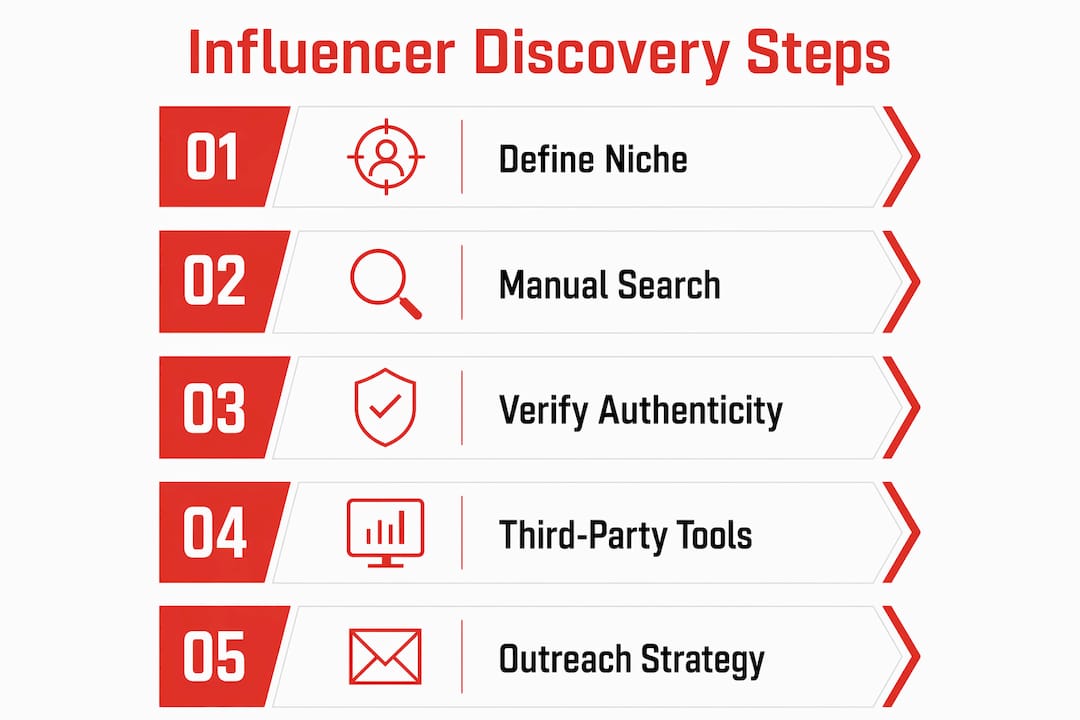
Twitter influencer discovery is the process of identifying creators with relevant audiences and genuine engagement who can amplify your brand’s message on X. For social media marketers and brand managers, getting this right separates campaigns that trend from campaigns that disappear. The difference comes down to three things: niche alignment, authentic engagement, and a repeatable process to find twitter influencers who actually move the needle. This guide covers every step, from defining your search parameters to sending your first outreach message.

How to find Twitter influencers: start with your niche and goals
The single biggest mistake brands make is searching for influencers before defining what they need. Vague goals produce vague results. Before you search, lock down three things:
- Your niche. Be specific. “Tech” is not a niche. “AI developer tools for early-stage startups” is. The tighter your niche, the more relevant your results. A B2B SaaS brand targeting CTOs needs different creators than a consumer app targeting Gen Z.
- Your campaign goal. Are you driving awareness, signups, or community growth? Each goal points to a different type of creator. Awareness campaigns favor creators with broad reach. Conversion campaigns favor micro-KOLs with tight, loyal audiences.
- Your audience profile. Define the demographics, interests, and behaviors of the people you want to reach. If your audience is US-based developers aged 25–40, you need influencers whose followers match that profile, not just influencers who post about tech.
Specificity is not a constraint. It is a filter that saves you weeks of wasted outreach. Niche relevance and engagement consistently outperform raw follower counts for B2B conversions and ROI. That finding should anchor every decision you make in the discovery phase.
What are the best manual methods to search Twitter influencers?
Native X features are underused and genuinely powerful. You do not need a paid platform to start. Here is a repeatable four-step process for manual Twitter influencer discovery:
- Search niche hashtags. Type your core topic hashtag into X search and filter by “People.” Look for accounts that post consistently under that hashtag, not just once. Consistency signals an active creator, not a casual user.
- Use X Advanced Search operators. Twitter’s advanced search lets you filter by keyword, location, language, and engagement thresholds. Operators like
min_faves:20andfilter:mediasurface active visual content creators who generate real interaction. Combine operators to narrow results fast. - Explore public X Lists. Other brands and journalists have already curated lists of top voices in most niches. Search for Lists related to your topic, then browse the members. This is one of the fastest ways to locate niche influencers that larger platforms overlook.
- Vet recent activity before saving any name. Check the last 20 tweets of every candidate. Look at reply behavior, tone consistency, and how they engage with followers. A creator who posts great content but never replies is not building community. That matters for your campaign.
Pro Tip: Apply the 20-tweet rule to every influencer you consider. The last 20 tweets reveal engagement tone, content quality, and whether the creator actually talks to their audience. This single check eliminates most bad fits before you spend time on outreach.
Manual discovery works best for finding authentic micro-influencers who fly under the radar of big platforms. It takes more time, but the quality of fit is higher.
How do third-party platforms scale Twitter influencer discovery?
Manual search has limits. When you need to evaluate hundreds of creators quickly, third-party influencer platforms close the gap. These tools offer filtered databases, engagement analytics, and audience quality scores that would take weeks to compile manually.
The market for these platforms ranges from entry-level tools to enterprise-grade systems. Specialized influencer platforms host hand-verified databases of over 100 million creator profiles, with pricing starting at around $79/month for filtered access. That entry price gives you keyword filters, niche categories, location targeting, and basic engagement metrics.
| Feature category | What to look for |
|---|---|
| Database verification | Manual, hand-checked profiles vs. automated scraping |
| Filtering options | Niche, location, follower range, engagement rate |
| Audience quality scoring | Bot detection, follower authenticity signals |
| Export and CRM integration | CSV export or direct CRM sync for outreach tracking |
| Pricing transparency | Clear tier limits, no hidden per-contact fees |
The most important feature is verification quality. Verification teams of 15 or more people manually check US-based creators to filter out bots and fake engagement. Automated tools alone cannot catch sophisticated fake accounts. Demand transparency about how a platform verifies its database before you pay for access.
Pro Tip: Before committing to any platform subscription, ask specifically how they handle bot detection. Platforms that rely solely on follower-to-engagement ratios miss coordinated fake engagement rings. Manual verification is the 2026 standard. If a platform cannot explain its verification process, move on.
For brands running organic growth campaigns, combining a verified platform database with manual spot-checks produces the most reliable creator shortlists.
How do you vet Twitter influencers for authenticity and brand fit?
Discovery gets you a list. Vetting turns that list into a shortlist worth your budget. These are the signals that matter:
- Engagement rate benchmarks. Micro-influencers with 5,000–50,000 followers often post engagement rates between 1.5% and 4%. That range is more valuable for conversions than the sub-1% rates common on accounts with millions of followers. If a creator has 30,000 followers and averages 50 likes per post, something is wrong.
- Content originality. Scroll through at least two weeks of posts. Does the creator have a consistent point of view? Do they produce original takes, or do they mostly repost others? Original thinkers build loyal audiences. Aggregators do not.
- Follower overlap analysis. The most underused vetting method is follower overlap, which reveals how much of an influencer’s audience already intersects with your brand’s followers or target demographic. High overlap means the creator reaches people you actually want.
- Audience signals. Look at who replies to their posts. Are the replies substantive or generic? Generic replies like “great post!” at scale often indicate bot activity or engagement pods.
- Red flags to cut immediately. Sudden follower spikes, engagement that does not match content quality, and profiles with thousands of followers but almost no replies are all signs of artificial inflation.
Vanity metrics are easy to fake. Genuine community interaction is not. Manual inspection combined with a third-party audit gives you the clearest picture of real influence. Understanding influencer marketing ROI starts with getting this vetting step right.
What is the right way to reach out and engage Twitter influencers?
A strong shortlist means nothing if your outreach gets ignored. Most brand DMs fail because they lead with the brand’s needs instead of the creator’s value. Here is a process that works:
- Engage before you pitch. Reply to two or three of the creator’s recent posts with genuine, substantive comments. Not “great content!” but an actual reaction to what they said. This puts your brand name in their notifications before any DM arrives.
- Send a short, direct DM. Keep it under 100 words. State who you are, what you noticed about their content specifically, and what you are proposing. Vague pitches get deleted. Specific pitches get read.
- Lead with their value, not your needs. Explain what the creator gets: compensation, exposure, early product access, or co-created content rights. Make the value proposition clear in the first two sentences.
- Set transparent terms upfront. Include the deliverable, timeline, and measurement goal in your initial message. Creators who work with professional brands expect this. It signals you are serious and organized.
- Build the relationship, not just the deal. One-time posts produce one-time results. Brands that treat creators as long-term partners get better content, more authentic promotion, and repeat collaboration at lower negotiation cost.
The goal of outreach is not to close a deal in one message. It is to start a conversation that leads to a partnership worth repeating.
Key Takeaways
Effective Twitter influencer discovery combines niche specificity, manual vetting, and authentic outreach to produce partnerships that drive real engagement, not just impressions.
| Point | Details |
|---|---|
| Define niche before searching | Specific niche and audience profiles produce far more relevant influencer shortlists. |
| Use X Advanced Search operators | Filters like min_faves and filter:media surface active creators faster than keyword search alone. |
| Prioritize engagement over follower count | Micro-influencers with 1.5%–4% engagement rates convert better than large accounts with low interaction. |
| Demand verified databases | Platforms with manual verification teams filter out bots that automated tools miss. |
| Engage before pitching | Commenting on recent posts before sending a DM increases response rates significantly. |
What I have learned about finding influencers that most guides skip
Most influencer discovery guides treat follower count as a starting filter. That is backwards. Follower count is the last thing you should look at, not the first.
The most effective discovery process I have seen starts with community mapping. You identify the two or three accounts your target audience already follows and trusts, then you map who those accounts interact with. That network of mutual engagement reveals the real influencers in a niche, not the loudest accounts, but the most connected ones. Follower overlap analysis is the technical version of this, and it consistently surfaces creators that keyword searches miss entirely.
The second thing most guides skip is the cost of skipping manual vetting. Platforms are useful, but no algorithm catches everything. A creator can have a clean engagement rate and still be running an engagement pod where a group of accounts agree to like and reply to each other’s posts. The 20-tweet rule catches this. Read the replies. If they all sound like the same three people saying the same things, that is a pod, not a community.
The brands that win on X treat influencer discovery as an ongoing research practice, not a one-time campaign task. They build shortlists continuously, track creator momentum before they need them, and reach out from a position of genuine familiarity. That preparation is what makes outreach feel authentic instead of transactional.
— Nowix
Nowix puts your brand in front of the right X audiences
Nowix makes tech and AI brands trend on X. The practitioner-led team at Nowix runs the full process: identifying the right creators, managing outreach, and coordinating amplification campaigns that build momentum fast.
The organic post amplification service puts your content in front of verified, niche-relevant audiences on X, using the same manual vetting standards this article describes. For brands that want to go further, the timeline takeover campaigns coordinate creator waves that turn a single post into a trending moment. If you want results you can measure, not just impressions you cannot, Nowix is built for that.
FAQ
What is Twitter influencer discovery?
Twitter influencer discovery is the process of identifying creators on X whose audiences and engagement align with your brand’s campaign goals. It combines manual search, advanced filters, and audience analysis to build a shortlist of relevant creators.
How do I find niche influencers on Twitter without a paid tool?
Use X Advanced Search with operators like min_faves:20 and niche hashtags to surface active creators. Public X Lists curated by journalists or industry accounts are another fast, free method for locating niche voices.
What engagement rate should I look for in a Twitter influencer?
Micro-influencers with 5,000–50,000 followers typically post engagement rates of 1.5%–4%. That range signals a genuinely active audience and outperforms the lower rates common on larger accounts.
How do I know if a Twitter influencer’s followers are real?
Check for sudden follower spikes, generic reply patterns, and engagement that does not match content quality. Platforms with manual verification teams provide an additional layer of bot detection beyond what automated tools catch.
How should I first contact a Twitter influencer?
Engage with two or three of their recent posts before sending a DM. When you do reach out, keep the message under 100 words, reference their specific content, and state the value proposition clearly in the first two sentences.