
Twitter engagement is defined as the sum of likes, retweets, replies, clicks, and profile visits a post generates relative to its impressions. The engagement rate formula is (likes + retweets + replies + clicks) / impressions × 100, with the platform average sitting at 0.046% and 3–5% considered excellent for smaller accounts. For social media managers and marketers, knowing how to increase Twitter engagement is not optional. It determines whether your content reaches hundreds or hundreds of thousands of people. The tactics that move the needle are specific, testable, and repeatable. This article covers the ones that actually work.
How to increase Twitter engagement with stronger hooks
The hook is the first 5–7 words of your tweet. It functions as a pattern interrupt, stopping the scroll before a reader decides whether to tap or keep moving. Most marketers underestimate this. They open with context instead of a claim, and the algorithm never gives the post a second chance.
Specific hooks consistently outperform generic ones. Replacing a vague opening with a specific outcome hook produces a 35–50% average engagement increase. That is not a marginal gain. It is the difference between a post that dies at 200 impressions and one that compounds.
Strong hooks share four characteristics:
- Numbers or data: “3 posts killed our reach. Here’s what we changed.”
- Named outcomes: “We went from 97 views to 17,500 in one week. The fix was simple.”
- Direct questions: “Why do most Twitter threads fail on the first tweet?”
- Counterintuitive claims: “Posting more often is hurting your account.”
Each of these formats creates a gap the reader wants to close. Generic openers like “Here are some tips” or “Thought I’d share this” create no gap. They signal low value before the reader even processes the content.
Pro Tip: Write your hook last. Draft the full tweet or thread, then go back and rewrite the first line as if your audience has never heard of you and owes you nothing.

What are the optimal posting times to maximize engagement?
Timing is not about posting when you feel like it. The first 30 minutes after posting determine a tweet’s reach and viral potential. Posts that collect strong early engagement get amplified by X’s ranking algorithm. Posts that sit quiet get buried.
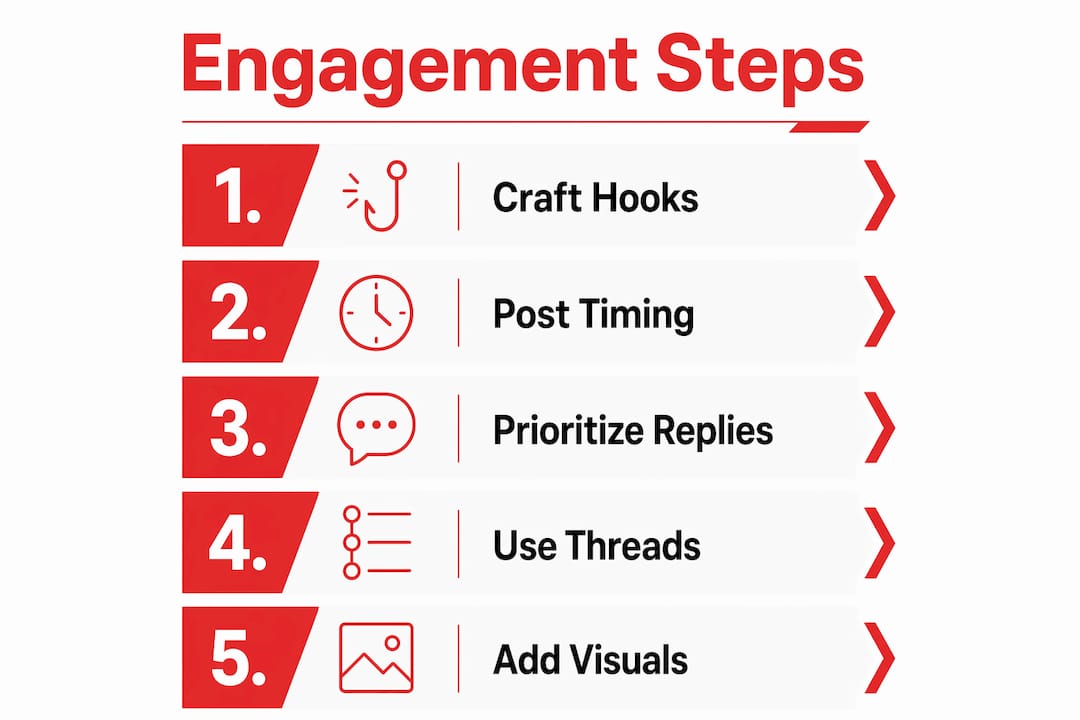
The recommended posting windows are 8–10 AM and 7–9 PM in your audience’s time zone. These windows align with peak mobile usage before and after the workday. Posting outside these windows does not guarantee failure, but it reduces the probability of early traction.
Posting frequency matters just as much as timing. Follow this framework:
- Post 1–4 times daily. Accounts under 10,000 followers grow fastest at 2–4 posts per day.
- Space posts properly. Avoid clustering multiple posts within the same hour.
- Cap at 5 posts per day. Posts beyond 5 daily cannibalize each other’s reach and reduce follower conversion.
- Audit your own data. Pull your top 10 performing posts and identify the time patterns. Your audience may behave differently from the average.
The 60-30-10 content balance rule also applies here. 60% educational, 30% curated with added perspective, and 10% promotional posts produce the most sustained growth. This mix prevents your feed from becoming a broadcast channel and keeps followers engaged over time.
Pro Tip: Plan your content calendar one week ahead. Consistency signals reliability to both the algorithm and your audience. Accounts that post sporadically lose momentum fast.
Why are replies the most underrated Twitter engagement tactic?
Most social media managers spend 90% of their time creating posts and 10% on replies. That ratio should be reversed. Replying to every comment within the first 30–60 minutes of posting can double total engagement counts. The algorithm reads reply activity as a signal that the post is worth amplifying.
Replies also drive profile visits. Joining conversations early on popular posts generates thousands of impressions and profile visits that no amount of self-promotion can replicate. A single well-placed reply on a trending thread can outperform a week of original posts.
The quality of replies matters as much as the speed. Effective replies follow these principles:
- Add new information. Extend the original point with a stat, example, or case study.
- Challenge a perspective. Respectful disagreement creates conversation and draws in other readers.
- Ask a clarifying question. This invites the original poster and their audience to engage further.
- Avoid generic praise. “Great post!” and “This is so true!” generate zero visibility. Strategic replies must add value by contributing something the original post did not say.
The reply-to-impression ratio is one of X’s top ranking signals. A post with 10 replies on 500 impressions outranks a post with 2 replies on 5,000 impressions. That math should change how you allocate your time.
Pro Tip: Set a 15-minute daily block dedicated to replying in your niche. Target accounts with 5,000–50,000 followers where your reply will be seen but not buried. This is one of the fastest ways to grow your audience without paid promotion.
What content formats drive the highest engagement rates?
Format is a multiplier. The same idea packaged differently produces dramatically different results. Here is how the major formats compare:
| Content type | Engagement lift | Notes |
|---|---|---|
| Single tweet | Baseline | Works best with strong hooks and clear CTA |
| Thread (4–7 tweets) | 3.2x higher | Keeps users on platform longer, increases shares |
| Tweet with image or video | 18–30% higher | Authentic visuals outperform stock images |
| Poll | Moderate | Drives replies when the question is genuinely interesting |
| Text-only tweet | Baseline or below | Can perform well with exceptional hooks |
Threads are the most reliable format for sustained engagement. Threads of 4–7 tweets drive 3.2x higher engagement than single posts. They keep users on the platform longer, which X’s algorithm rewards directly.
Visuals work when they are authentic. Charts, screenshots, and personal photos outperform generic stock images. The algorithm does not distinguish between authentic and stock visuals, but your audience does. Authentic visuals build trust and increase the likelihood of saves and shares.
Polls and questions work when they are genuinely interesting. Asking “What’s your biggest challenge with Twitter growth?” to a marketing audience will generate real answers. Asking “Do you prefer cats or dogs?” is engagement bait. The algorithm can detect low-quality engagement patterns over time, and your audience will disengage faster than you expect.
Tweet length also matters. The sweet spot sits between 70 and 150 characters for single tweets. Very short tweets under 20 characters rarely provide enough context. Very long tweets over 280 characters often lose readers before the key point lands. For threads, each tweet should be able to stand alone while building toward a conclusion. Understanding audience engagement techniques across formats helps you identify which combinations work best for your specific niche.
Key Takeaways
Increasing Twitter engagement requires mastering hooks, timing, replies, and content format as four distinct, measurable levers.
| Point | Details |
|---|---|
| Hook quality drives reach | Replacing generic openings with specific outcome hooks produces a 35–50% engagement increase. |
| Post 1–4 times daily | Exceeding 5 posts per day reduces reach as posts compete with each other for impressions. |
| Replies double engagement | Responding to every comment within the first 30–60 minutes can double total engagement counts. |
| Threads outperform single posts | Threads of 4–7 tweets generate 3.2x higher engagement than standalone tweets. |
| Use the 60-30-10 content rule | A mix of 60% educational, 30% curated, and 10% promotional posts sustains long-term growth. |
What actually moves the needle on Twitter growth
The most common mistake I see from social media managers is treating Twitter as a broadcast channel. They schedule posts, check the numbers, and wonder why nothing compounds. The platform is a conversation graph, not a feed. The accounts that grow fastest are the ones that reply more than they post.
The second mistake is chasing aggregate metrics. Watching overall impressions go up feels good, but it tells you nothing about what is actually working. Improving one engagement lever at a time produces measurable, sustainable growth. Test your hook format for two weeks. Then test your posting time. Then test your reply volume. You will learn more from that process than from six months of posting without a framework.
The third mistake is volume without quality. Professionals who focus on content mix and audience utility consistently outperform accounts that post five times a day with nothing to say. One post that teaches something real will outperform ten posts that fill space.
The accounts I have seen grow the fastest share one habit: they treat every reply as a piece of content. A great reply on a high-traffic thread is a distribution channel. It puts your name in front of an audience that already trusts the original poster. That is earned reach, and it compounds in a way that paid impressions never will.
— Nowix
How Nowix helps tech and AI brands build real momentum on X
Nowix works with tech and AI brands to turn X into a growth channel, not just a presence. The work covers organic post amplification, reply strategy, hook testing, and timeline takeover campaigns built around the tactics covered in this article.

The Unfungible case study shows what this looks like in practice: a founder account went from 97–164 views per post to 17,500 views through structured engagement tactics and coordinated amplification. The X management service handles posting schedules, reply workflows, and content mix so your team can focus on building the product. If you want results that are repeatable, not random, Nowix is built for that.
FAQ
What is a good Twitter engagement rate?
An engagement rate of 0.046% is the platform average, while 3–5% is considered excellent for accounts under 10,000 followers. Engagement rate is calculated as (likes + retweets + replies + clicks) / impressions × 100.
How often should I post on Twitter to grow my account?
Post 1–4 times daily, spaced properly throughout the day. Accounts under 10,000 followers grow fastest at 2–4 posts per day, and posting more than 5 times daily reduces reach as posts compete with each other.
Why do replies matter more than original posts?
Replies within the first 30–60 minutes of posting can double total engagement counts by signaling the algorithm to amplify the post. Early, high-value replies on popular threads also generate thousands of impressions and profile visits.
What is the best content format for Twitter engagement?
Threads of 4–7 tweets generate 3.2x higher engagement than single posts. Tweets with authentic images or videos outperform text-only tweets by 18–30%.
How do I write a hook that stops the scroll?
Use the first 5–7 words to deliver a specific outcome, number, or counterintuitive claim. Specific hooks produce a 35–50% average engagement increase compared to generic openings.