Best Social Listening Tools for Marketing Teams in 2026

The right social listening tool depends on one thing: what you plan to do with the signal. Here is the shortlist by need.
- Enterprise intelligence with historical depth: Brandwatch or Talkwalker — both index billions of sources, support deep Boolean queries, and carry years of historical data. Brandwatch wins on raw source breadth; Talkwalker leads on visual recognition.
- All-in-one publishing + listening without a second vendor: Sprout Social — clean AI-assisted interface, plain-language query support, and integrated publishing workflows in one platform. G2 reviewers consistently cite its time-to-value as a differentiator.
- Budget-friendly real-time monitoring for small teams: Brand24 — real-time alerts across 25 million online sources, straightforward setup, and pricing that does not require a sales call.
- Visual listening and logo detection: YouScan — purpose-built image recognition that catches brand mentions in photos and videos that text queries miss entirely.
- Social data inside your own stack via API: Octolens — API-first, transparent pricing, and built for teams that want social signals in their BI pipelines rather than another dashboard.
- Rapid campaign activation on X from listening signals: Nowix — not a monitoring dashboard, but the activation partner that turns what you find into a creator wave on X, with up to several hundred creator activations in a single launch window.
Most teams pick the wrong tool because they optimize for dashboard features instead of time-to-action. The sections below give you the comparison table, per-tool profiles, a procurement playbook, and a workflow for converting signals into campaigns.
Table of Contents
- How the top social listening tools compare at a glance
- Tool-by-tool profiles: what each platform actually does best
- How to choose a social listening tool for your team
- What modern social listening tools actually do and which features matter most
- How AI is changing social listening in 2026 and how to evaluate vendor claims
- Primary use cases for social listening and the KPIs that prove impact
- Turning listening signals into campaigns: a workflow that actually works
- Pricing tiers, trial guidance, and how to compare total cost of ownership
- Key Takeaways
- What Nowix sees in the market and why activation speed wins
- Nowix turns your listening signals into X campaigns that move fast
- Useful sources and further reading
How the top social listening tools compare at a glance
| Tool | Best for | Pricing / trial | Data coverage | AI features | Visual listening | Integrations | Ease of setup | Reporting / export |
|---|---|---|---|---|---|---|---|---|
| Nowix | Tech/AI brands activating X campaigns from signals | Project / retainer; custom quote | X (Twitter) focused; creator network | Signal-to-campaign routing; creator matching | — | X API, CRM on request | Fast; managed onboarding | Campaign performance reports |
| Sprout Social | Unified publishing + listening teams | $249+/mo; free trial | Major social networks; news | AI plain-language queries; sentiment summaries | Limited | Salesforce, HubSpot, Slack | Fast | Strong dashboards; CSV/PDF export |
| Brandwatch | Enterprise analysts needing historical depth | Custom / sales-only | 100M+ sources; years of history | Advanced sentiment; trend detection | Limited | Salesforce, Tableau, APIs | Weeks to configure | Highly customizable |
| Talkwalker | Cross-media + visual listening | Custom / sales-only | Social, news, blogs, TV, radio | Anomaly detection; AI summaries | Industry-leading image/video recognition | Hootsuite, Salesforce, APIs | Moderate | Enterprise-grade dashboards |
| Sprinklr | Global enterprise CX workflows | Custom / sales-only | 30+ channels; broad | Unified AI across CX suite | Moderate | Full CX stack; enterprise APIs | Complex; months | Governance-level reporting |
| Meltwater | PR teams monitoring earned media + social | Custom / sales-only | News, social, broadcast | Sentiment; media analytics | Moderate | PR tools, Slack, APIs | Moderate | Strong PR-focused reports |
| Brand24 | Startups and SMBs on a budget | From $99/mo; free trial | Social, news, blogs, forums, podcasts | AI sentiment; anomaly alerts | Basic | Slack, Zapier, APIs | Very fast | Standard dashboards; CSV |
| YouScan | Visual brand mention detection | Custom / sales-only | Social + image-heavy platforms | Image AI; sentiment | Market-leading | APIs; limited native integrations | Moderate | Visual analytics reports |
| Keyhole | Hashtag campaigns and influencer tracking | From $79/mo; free trial | Social networks; hashtag-focused | Sentiment; influencer scoring | Basic | APIs; limited | Fast | Campaign and influencer reports |
| BuzzSumo | Content trends and competitive shares | From $199/mo; free trial | Web content; social shares | Content trend detection | None | APIs; limited | Fast | Content performance reports |
| Mention | SMBs wanting simple alerting | From $41/mo; free trial | Social, news, blogs | Basic sentiment | None | Slack, Zapier | Very fast | Standard reports |
| Awario | Boolean precision on a budget | From $29/mo; free trial | Social, news, blogs | Basic sentiment | None | APIs | Fast | Standard dashboards |
| Hootsuite / Lumen | Existing Hootsuite users adding listening | Lumen: custom; Hootsuite plans vary | Social networks; news | Moderate AI features | Moderate | Full Hootsuite suite | Fast for existing users | Integrated with Hootsuite |
| Digimind | Market intelligence + competitive analysis | Custom / sales-only | Social + market data | Trend correlation | Moderate | APIs; BI tools | Moderate | Market intelligence reports |
| NetBase Quid | Enterprise research and dataset correlation | Custom / sales-only | Social + structured datasets | Advanced analytics | Moderate | APIs; enterprise BI | Complex | Research-grade exports |
| HubSpot Social | HubSpot CRM users wanting basic monitoring | Included in Marketing Hub plans | Major social networks | Basic | None | Native HubSpot | Very fast | CRM-integrated reports |
| Konnect Insights | Omnichannel listening + CRM ticketing | Custom / sales-only | Social + review platforms | Sentiment; ticketing AI | Moderate | CRM, ticketing systems | Moderate | Omnichannel dashboards |
| Dash Social | Visual-first brands on Instagram and TikTok | Custom / sales-only | Instagram, TikTok, Pinterest | Visual analytics | Strong for visual platforms | APIs; limited | Fast | Visual performance reports |
| Later | Small teams on Instagram and visual social | From $18/mo; free trial | Instagram, TikTok, Pinterest | Basic | None | Limited | Very fast | Basic publishing reports |
| Octolens | Social data in BI pipelines via API | Transparent / self-serve | API-driven; configurable | API-delivered signals | Via API | Full API/webhook stack | Fast for developers | Raw data export; custom |
| Mentionlytics | SMB brand monitoring across channels | From $69/mo; free trial | Social, news, blogs | Sentiment | Basic | APIs; Zapier | Fast | Standard dashboards |
| All Ears | Niche forum and community monitoring | Limited public pricing | Forums, Reddit, niche communities | Basic | None | Limited | Fast | Basic |
| Exolyt | TikTok-specific analytics and monitoring | From $59/mo; free trial | TikTok-focused | TikTok sentiment | TikTok video | Limited | Fast | TikTok reports |
| X advanced search | Free real-time X query monitoring | Free | X only; limited history | None | None | None | Instant | None |
| X Pro (TweetDeck) | Free multi-column X monitoring | Free (X Premium required) | X only | None | None | None | Instant | None |
| Google Alerts | Free web mention alerting | Free | Web, news, blogs | None | None | None | Instant | Email digest |
| Answer the Public | Search-intent and question discovery | From $9/mo; free trial | Search data; limited social | Trend detection | None | Limited | Fast | CSV export |
| Perch by Hootsuite | SMB competitive monitoring | Included in some Hootsuite plans | Social networks | Basic | None | Hootsuite suite | Fast | Basic |
| Lumen by Talkwalker | Broad media monitoring via Hootsuite | Custom | Social, news, broadcast | Talkwalker AI engine | Talkwalker image recognition | Hootsuite + Talkwalker stack | Moderate | Enterprise-grade |
| Sprinklr Insights | Enterprise-grade insight layer within Sprinklr | Part of Sprinklr suite | 30+ channels | Advanced AI; anomaly detection | Moderate | Full Sprinklr CX stack | Complex | Governance reporting |
| BrandMentions | Simple cross-channel brand tracking | From $49/mo; free trial | Social, news, blogs | Basic sentiment | None | APIs; limited | Fast | Standard dashboards |

Pricing note: Self-serve tools (Brand24, Awario, Keyhole, Mention) publish starting prices and offer free trials. Enterprise platforms (Brandwatch, Talkwalker, Sprinklr, Meltwater, NetBase Quid) require a sales conversation. Always confirm seat limits and historical-data fees before signing.
Tool-by-tool profiles: what each platform actually does best
Nowix
Nowix is not a monitoring dashboard. It is the activation layer that sits on top of whatever listening tool your team already uses. When your Brand24 alert fires or your Brandwatch query surfaces a trending conversation, Nowix converts that signal into a coordinated creator wave on X — up to 700 micro-KOLs activated within a single hour. The service covers viral launch campaigns, post amplification via controlled quote-retweets and comments from vetted creators, and full X account management including daily content, replies, and community engagement.
Best for: Tech and AI brands that have listening coverage but lack the bandwidth or creator network to act fast on signals.
- Strengths: Speed of activation, vetted creator network, managed execution with no internal headcount required
- Consideration: Focused on X; not a cross-channel monitoring tool
Sprout Social
Sprout Social earns its place on most shortlists because it collapses the publishing-and-listening stack into one interface. The AI-assisted query builder lets you ask questions in plain language rather than constructing Boolean strings, which cuts research time from hours to minutes. Coverage spans the major social networks plus news sources, and the Salesforce and HubSpot integrations are native, not bolted on.
- Pros: Fast setup, clean UI, integrated publishing, strong AI summaries, solid G2 ratings
- Cons: Less historical depth than Brandwatch; enterprise-scale source coverage costs more
Brandwatch
Brandwatch is the tool analysts reach for when they need to go back years, not days. It has an extremely large source index, and its Boolean query engine is among the most precise in the market. The trade-off is setup time: G2 review patterns across enterprise platforms show buyers regularly underestimate configuration complexity. Expect weeks, not days, before queries are tuned.
- Pros: Unmatched historical depth, massive source index, strong analyst tooling
- Cons: Sales-only pricing, long onboarding, requires dedicated analyst resources
Talkwalker
Talkwalker runs AI models for sentiment analysis, visual and logo recognition, and anomaly detection across billions of data points in real time. Its image and video recognition is a genuine differentiator: a large share of brand mentions in visual content carry no text, so text-only tools miss them entirely. Talkwalker’s historical archives and cross-media indexing (social, news, blogs, TV, radio) make it the go-to for brands that need the full picture.
- Pros: Best-in-class visual listening, broad media coverage, strong anomaly detection
- Cons: Enterprise pricing, complex setup, overkill for teams that only need social coverage
Sprinklr / Sprinklr Insights
Sprinklr is built for global enterprises that need listening, engagement, publishing, and customer service governance in a single platform. Sprinklr Insights is the dedicated analytics layer within that suite, offering advanced AI, anomaly detection, and reporting across 30+ channels. The power comes with a cost: implementation typically takes months, and the platform requires dedicated admin resources.
- Pros: Unified CX platform, enterprise governance, deep AI across the full suite
- Cons: Highest complexity and cost on this list; not suitable for teams without dedicated platform admins
Meltwater
Meltwater is the natural choice for PR teams that need traditional earned-media monitoring alongside social listening. Its press and broadcast coverage is stronger than most pure-social tools, and its media contact database adds outreach capability. Social coverage is solid but not as deep as Brandwatch on raw source volume.
- Pros: Strong earned-media and press monitoring, media contact database, PR-workflow integrations
- Cons: Social-only teams pay for PR features they may not use; pricing is custom and sales-led
Brand24
Brand24 tracks mentions across 25 million online sources in real time, including social media, news, blogs, forums, podcasts, and reviews. It is the fastest tool to set up on this list and the most accessible on price, with published plans starting at $99/month and a free trial available. AI sentiment scoring and anomaly alerts are included at all tiers.
- Pros: Real-time alerts, broad source coverage, fast setup, transparent pricing, free trial
- Cons: Less historical depth than enterprise tools; limited Boolean complexity
YouScan
YouScan is purpose-built for visual listening. Its image recognition detects brand logos and product appearances in photos and videos across social platforms, capturing mentions that text queries cannot reach. G2 reviewers highlight detection accuracy as a key differentiator. Pricing is custom and sales-led, which puts it out of reach for smaller teams.
- Pros: Market-leading image recognition, strong visual analytics, good for CPG and retail brands
- Cons: Custom pricing, limited native integrations, overkill for text-heavy monitoring needs
Keyhole
Keyhole focuses on hashtag analytics and influencer tracking, making it the right pick for teams running event campaigns or influencer programs. Starting prices are published and a free trial is available. Coverage is social-network-focused rather than broad-web.
- Pros: Strong hashtag and event monitoring, influencer scoring, transparent pricing
- Cons: Limited source breadth beyond social; less suited for brand-wide reputation monitoring
BuzzSumo
BuzzSumo is a content-intelligence tool first and a social listening tool second. It excels at identifying which content formats and topics drive shares and engagement, making it valuable for content and PR teams tracking competitive performance. It does not cover social conversations in the way Brand24 or Brandwatch do.
- Pros: Content trend discovery, competitive share analysis, strong for editorial planning
- Cons: Not a full social listening platform; limited sentiment and conversation monitoring
Mention
Mention is a straightforward monitoring and alerting tool aimed at SMBs. Setup takes minutes, Slack and Zapier integrations are included, and published pricing starts at $41/month with a free trial. It covers social, news, and blogs but lacks the depth or AI sophistication of enterprise tools.
- Pros: Very fast setup, simple UI, affordable entry price
- Cons: Limited Boolean complexity, basic sentiment, no visual listening
Awario
Awario delivers Boolean-driven precision at a price point that undercuts most competitors, with plans starting at $29/month. It is the right pick for teams that need granular query control without paying for enterprise features. Coverage spans social, news, and blogs.
- Pros: Strong Boolean search, low starting price, free trial
- Cons: Smaller source index than enterprise tools; basic AI features
Hootsuite / Perch / Lumen by Talkwalker
Hootsuite’s listening story has three layers. Perch is the built-in competitive monitoring feature available on some Hootsuite plans, suited for SMBs already in the Hootsuite ecosystem. Lumen, powered by Talkwalker’s AI engine, is Hootsuite’s enterprise listening product, offering broad media monitoring, image recognition, and anomaly detection through the Talkwalker stack. If you are already a Hootsuite customer, adding Lumen is the fastest path to enterprise-grade listening without switching platforms.
- Pros: — Integrated with Hootsuite publishing, Lumen brings Talkwalker’s AI to the Hootsuite interface
Digimind
Digimind blends social listening with competitive market intelligence, making it useful for strategy teams that need to correlate social signals with market trends. Pricing is custom and sales-led.
- Pros: Market intelligence layer, competitive benchmarking, trend correlation
- Cons: Not a pure social listening tool; setup complexity; custom pricing
NetBase Quid
NetBase Quid targets enterprise research teams that need to correlate social data with structured datasets, financial signals, or patent data. Its analytics depth is research-grade. Expect a long sales cycle and complex onboarding.
- Pros: Advanced analytics, dataset correlation, research-grade outputs
- Cons: Highest complexity on this list alongside Sprinklr; not suited for agile marketing teams
HubSpot Social
HubSpot Social is the monitoring layer built into HubSpot’s Marketing Hub. It covers major social networks and feeds directly into the HubSpot CRM. For teams already on HubSpot, it is the zero-friction option. For teams that need deep listening, it is too limited.
- Pros: Native CRM integration, no additional cost for HubSpot users, fast setup
- Cons: Basic monitoring only; no Boolean depth, no visual listening, limited source coverage
Konnect Insights
Konnect Insights combines social listening with CRM ticketing, making it a fit for customer service teams that need to route social mentions into support workflows. Coverage spans social and review platforms.
- Pros: Ticketing integration, omnichannel coverage, customer service workflow support
- Cons: Custom pricing; less known in the US market
Dash Social
Dash Social is a publishing-first platform with strong visual analytics for Instagram, TikTok, and Pinterest. Its listening features are secondary to its scheduling and analytics capabilities. Best for visual-content teams, not brand-wide monitoring.

Later
Later is a publishing tool with light listening features. It suits small teams managing Instagram and TikTok content calendars. Not a serious monitoring option for brand managers who need conversation coverage.
Octolens
Octolens takes an API-first approach: instead of locking social data inside a proprietary dashboard, it delivers signals via API and webhooks directly into your BI tools, data warehouse, or CRM. Pricing is transparent and self-serve. For growth teams that want to own their data pipeline, it is the cleanest option on this list.
- Pros: API/webhook delivery, transparent pricing, no dashboard lock-in, developer-friendly
- Cons: Requires technical resources to implement; no out-of-the-box dashboards
Niche and free tools: Mentionlytics, All Ears, Exolyt, X advanced search, X Pro, Google Alerts, Answer the Public, BrandMentions
These tools fill specific gaps rather than replace a full listening platform.
- Mentionlytics and BrandMentions are SMB-friendly monitoring tools with published pricing and free trials, covering social, news, and blogs with basic sentiment.
- All Ears monitors niche forums and developer communities that larger tools often miss.
- Exolyt is TikTok-specific, useful for brands running TikTok campaigns who need dedicated video analytics.
- X advanced search and X Pro (formerly TweetDeck) are free, native X tools. Advanced search lets you run real-time Boolean queries on X; X Pro gives you multi-column monitoring. Neither offers historical data beyond a few days or sentiment analysis, but both are instant to set up.
- Google Alerts delivers free email digests for web and news mentions. It misses most social content but is a useful baseline for brand name monitoring.
- Answer the Public surfaces the questions people are searching around a topic, making it useful for content planning rather than brand monitoring.
Pro Tip: Run X advanced search and Google Alerts in parallel during your trial period. They cost nothing and reveal the baseline mention volume your paid tool should be capturing — any paid tool that misses mentions these free tools catch is a red flag.
How to choose a social listening tool for your team
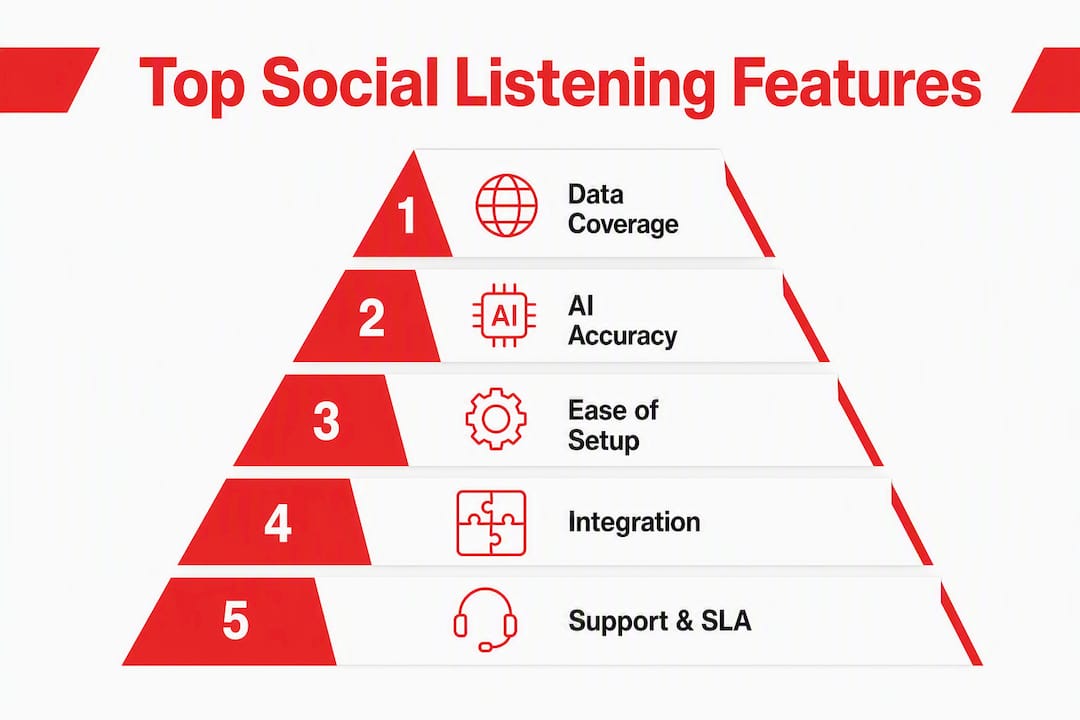
The decision comes down to five criteria, in this order.
1. Data coverage first
Ask every vendor: which networks do you cover, how deep is your historical archive, and which languages do you support? A tool that misses Reddit, Hacker News, or non-English conversations may leave critical signals invisible. Running identical queries across two or three tools for seven days is the fastest way to expose coverage gaps before you commit.
2. AI accuracy over AI marketing
Every vendor in 2026 claims AI-powered sentiment and trend detection. What matters is precision: how many false positives does the sentiment model generate on your brand’s specific vocabulary? Test this during the trial by comparing outputs on identical queries across tools. Ask vendors for their model retraining cadence and whether human-in-loop controls exist for edge cases.
3. Time-to-value vs. setup complexity
G2 review patterns show that enterprise platforms often require months to configure while lighter tools offer faster time-to-value. If your team lacks a dedicated analyst, a tool that takes three months to tune will sit unused. Match complexity to your actual resources.
4. Integrations and data ownership
Tools that provide API access and webhooks let you own your data and route signals into CRM, BI, or ticketing systems. Platforms that lock data inside proprietary dashboards create silos. Ask vendors: can I export raw data? Is API access included in my plan or a paid add-on?
5. Support and SLAs
Enterprise tools typically offer dedicated customer success managers and defined SLAs. Self-serve tools rely on documentation and community support. Match the support tier to your team’s technical confidence.
Vendor question checklist for demos:
- What is your source index size and how often is it updated?
- How do you handle non-English sentiment normalization?
- What is the historical data depth included in my plan vs. available at extra cost?
- Is API access included or a paid add-on?
- What is the typical onboarding timeline for a team of our size?
- Can you show false-positive rates on a sample query using our brand name?
Red flags that disqualify a vendor fast:
- Opaque pricing with no indication of starting bands
- No API access or data export at standard tiers
- Historical data limited to 30 days or less
- No language support beyond English
- Inability to demonstrate sentiment accuracy on a test query during the demo
Typical deployment timeline:
- Self-serve tools (Brand24, Awario, Mention): live within one day; tuned within one week
- Mid-market tools (Sprout Social, Keyhole, BuzzSumo): live within one week; tuned within two to four weeks
- Enterprise platforms (Brandwatch, Talkwalker, Sprinklr): onboarding four to twelve weeks; full configuration three to six months
What modern social listening tools actually do and which features matter most
Social listening and social monitoring are related but distinct. Monitoring tracks direct mentions of your brand name. Listening goes further: it captures conversations about your category, competitors, and adjacent topics, then applies AI to surface patterns, sentiment shifts, and emerging trends. The distinction matters because monitoring tells you what happened; listening tells you what it means.
Core features to evaluate:
- Boolean search and query building: — The precision of your query determines the quality of your data. Strong Boolean support (AND, OR, NOT, proximity operators) lets you filter noise and surface relevant signals. Plain-language AI query interfaces, now offered by Sprout Social and others, reduce the skill barrier but can sacrifice precision.
- Visual and logo recognition: — Detects brand logos and product appearances in images and videos. Talkwalker’s AI models handle sentiment, visual recognition, and anomaly detection across billions of data points in real time. YouScan leads on pure image recognition precision.
“Successful brands use social intelligence to inform product development and marketing strategy, integrating insights company-wide — not just monitoring mentions in a dashboard.” — Talkwalker
Realistic expectations: no sentiment model is 100% accurate on brand-specific slang, sarcasm, or industry jargon. Human review remains necessary for high-stakes decisions like crisis escalation or product pivots. Use AI to triage volume; use humans to validate the signal before acting.
How AI is changing social listening in 2026 and how to evaluate vendor claims
AI has shifted social listening from keyword matching to contextual understanding. The practical changes are concrete.
What AI now does in leading platforms:
- Sentiment normalization: Models trained on large social datasets classify tone with greater nuance than rule-based systems, handling sarcasm, emojis, and slang more accurately.
- Anomaly and trend detection: Algorithms flag statistically unusual spikes in mention volume or sentiment before a human analyst would notice them, compressing crisis response time.
- GPT-style summarization: Vendors now advertise AI assistants that answer complex research questions in plain language, turning hours of query-building into minutes of conversational research.
- Image and video recognition: Computer vision models detect logos, products, and brand assets in visual content, capturing a category of mentions that text queries cannot reach.
- Automated insight generation: Some platforms generate narrative summaries of weekly listening reports, reducing analyst time for routine reporting.
How to test AI claims during trials:
- Run the same query in two tools and compare the mentions each captures. Coverage gaps reveal the limits of each platform’s AI indexing.
- Submit a sample of 50 brand mentions with known sentiment labels and measure each tool’s accuracy. A tool that misclassifies 30% of your sarcastic mentions is not production-ready for crisis monitoring.
- Ask the vendor for their model retraining cadence. A model trained on 2023 data will underperform on current slang and platform-specific language.
- Test AI summaries for hallucination: ask the tool to summarize a topic you know well and check whether the output introduces facts not present in the underlying data.
Evaluation checklist for AI claims:
- What is the provenance of the sentiment model? Proprietary, third-party, or open-source?
- How often is the model retrained on new data?
- Are human-in-loop controls available for edge cases?
- Is API access to raw signals available, or are you limited to processed outputs?
- Can the vendor provide precision and recall metrics for sentiment on a sample dataset?
The brands that get the most from AI-driven listening are the ones that treat AI outputs as a first-pass triage layer, not a final verdict. AI narrows the signal; your team decides what to do with it.
Primary use cases for social listening and the KPIs that prove impact
| Use case | Key features needed | KPIs to track |
|---|---|---|
| Reputation and crisis monitoring | Anomaly detection, real-time alerts, sentiment analysis | Sentiment delta, mention spike volume, response time |
| Campaign measurement | Hashtag tracking, share of voice, sentiment | Engagement lift, share of voice change, campaign reach |
| Product feedback and feature discovery | Topic clustering, trend detection, forum coverage | Feature request volume, sentiment by product area |
| Influencer discovery and outreach | Influencer scoring, reach metrics, engagement data | Influencer engagement rate, audience overlap, outreach conversion |
| Competitive intelligence | Boolean queries, share of voice, sentiment benchmarking | Competitor share of voice, sentiment gap, topic ownership |
| Trend spotting for content planning | Topic detection, search intent data, emerging hashtags | Content engagement lift, topic velocity, share growth |
| Customer support escalation | Real-time alerts, ticketing integration, sentiment | Issue resolution time, escalation rate, CSAT impact |
Reputation and crisis monitoring is the use case where tool choice matters most. Anomaly detection that fires 20 minutes after a spike breaks is not fast enough. Test alert latency during your trial by posting a test mention and measuring how long the tool takes to surface it.
Campaign measurement requires consistent share-of-voice tracking before, during, and after a campaign. Establish a baseline in the two weeks before launch; otherwise, you have no denominator for your lift calculation.
Influencer discovery via listening tools surfaces authors who are already talking about your brand or category organically. These are higher-conversion outreach targets than cold influencer lists. Pair listening-identified creators with a Twitter influencer outreach framework to move from signal to contact fast.
Turning listening signals into campaigns: a workflow that actually works
Most teams collect signals and write reports. The brands that win act on signals within hours, not weeks. Prioritizing platforms that integrate listening and activation workflows shortens the insight-to-action loop — and for teams that cannot build that integration internally, an activation partner fills the gap.
The five-step workflow:
- Detect: Listening tool surfaces a spike, sentiment shift, or trending topic relevant to your brand or category.
- Validate: A team member (or AI summary) confirms the signal is real and relevant, not a false positive or irrelevant noise.
- Prioritize: Triage rules determine whether the signal warrants a rapid response, a content play, or a creator campaign. Example triage rule: any sentiment spike above 2x baseline volume triggers a creator brief within 60 minutes.
- Act: Execute the response. For X, this means publishing a post, activating a creator wave, or launching a quote-retweet amplification campaign. Nowix’s timeline takeover service is built for this step: up to 700 creators activated within one hour of a brief being issued.
- Measure: Track engagement lift, sentiment delta, and share-of-voice change against the pre-signal baseline.
Roles and responsibilities:
- Listening analyst: Monitors dashboards, tunes queries, validates signals. Requires 5–10 hours per week for a mid-market brand.
- Content or campaign lead: Receives validated signals, writes briefs, approves creator content.
- Activation partner (e.g., Nowix): Executes creator campaigns from brief to live posts within the response window.
“High-growth tech and AI brands should prioritize tools that bridge listening and doing — platforms or partners that enable immediate outreach, influencer amplification, or campaign activation from signals.” — Brandjet.ai
Pro Tip: Build a triage rule document before your tool goes live. Define three signal tiers: Tier 1 (act within 1 hour), Tier 2 (act within 24 hours), Tier 3 (log and review weekly). Without triage rules, every signal feels equally urgent and nothing gets acted on fast.
For teams running micro-influencer campaigns on X, the detect-to-act window is the competitive advantage. A brand that responds to a trending conversation with 200 creator posts within 90 minutes captures the moment; a brand that responds with a single post 48 hours later does not.
Pricing tiers, trial guidance, and how to compare total cost of ownership
| Tier | Tools | Typical starting price | Trial available | Notes |
|---|---|---|---|---|
| Free / freemium | Google Alerts, X advanced search, X Pro | $0 | Always on | No sentiment, limited history, no analytics |
| Self-serve budget | Awario, Mention, Later, Answer the Public | $9–$41/mo | Yes | Fast setup; limited source depth |
| SMB subscription | Brand24, Keyhole, Mentionlytics, BuzzSumo, Exolyt | $59–$199/mo | Yes | Real-time alerts, moderate AI, published pricing |
| Mid-market | Sprout Social, Octolens | $249+/mo | Yes | Integrated workflows, API access, stronger AI |
| Enterprise custom | Brandwatch, Talkwalker, Sprinklr, Meltwater, YouScan, Digimind, NetBase Quid, Konnect Insights, Dash Social | Custom / sales-only | Demo only | Full feature set; months to configure |
Running a meaningful trial:
- Set identical keywords and Boolean queries in each tool you are testing. Variation in query setup is the most common reason trial comparisons produce misleading results.
- Run the trial for 7–14 days. Shorter periods miss weekly patterns; longer periods delay your decision without adding proportional insight.
- Define success signals before the trial starts: mention capture rate, sentiment accuracy on a labeled sample, alert latency, and analyst hours required to tune queries.
- Test API access and export functionality on day one. A tool that locks data behind a dashboard becomes a liability when you need to route signals into your CRM or BI stack.
- Log the analyst hours required to tune queries and validate outputs. That number predicts your ongoing resource cost more accurately than the subscription price.
Hidden costs to surface before signing:
- Historical data beyond the default archive window (often charged per query or per month of additional history)
- Additional user seats above the plan default
- Premium integrations (Salesforce, Tableau, Slack) sometimes require a higher plan tier
- Onboarding and professional services fees for enterprise platforms
- API call limits and overage charges
Key Takeaways
The best social listening tool is the one your team will actually act on. Matching data coverage, AI accuracy, and time-to-value to your team’s real resources is what separates a useful platform from an expensive dashboard.
| Point | Details |
|---|---|
| Match tool complexity to team resources | Enterprise platforms take months to configure; self-serve tools like Brand24 go live in a day. |
| Test coverage with identical queries | Run the same keywords across two tools for 7–14 days to expose gaps before committing. |
| AI accuracy beats AI marketing claims | Test sentiment precision on your own brand vocabulary during the trial, not on vendor demos. |
| Act on signals, not just reports | The insight-to-action gap is where most teams lose. Build triage rules before your tool goes live. |
| Nowix closes the activation gap | For tech and AI brands on X, Nowix turns listening signals into creator campaigns within one hour. |
What Nowix sees in the market and why activation speed wins
The pattern Nowix sees repeatedly with tech and AI brands is this: the listening tool is set up, the dashboard is clean, the alerts are firing, and nothing happens. A signal surfaces at 9 AM. By noon, someone has written a Slack message about it. By the following week, a content brief is in draft. The moment is gone.
The brands that win on X in 2026 are not the ones with the most sophisticated listening stack. They are the ones with the shortest detect-to-act window. When a trending conversation breaks in your category, the first three to five brands to flood the timeline with coordinated creator posts own the narrative. Everyone who arrives later is reacting to a story someone else wrote.
Nowix works with tech and AI brands specifically because this category moves fast and the stakes of a missed launch window are high. A product announcement that trends on X for 90 minutes generates organic coverage that a paid campaign cannot replicate. That momentum, when it tips from paid creator activation into organic quote-retweets and replies, compounds in ways that scheduled content simply does not.
The tools on this list are excellent at detection. The gap is always execution. Full X account management closes that gap for teams that need a practitioner running the account, not just a dashboard running reports.
Nowix turns your listening signals into X campaigns that move fast
Most listening tools give you a signal. What you do with it in the next 60 minutes is what separates a trending brand from a brand that almost trended.
Nowix is the activation partner for tech and AI brands that need to move from insight to creator wave without building an internal influencer operation. When your listening tool surfaces a trending conversation, Nowix deploys up to 700 vetted micro-KOLs on X within a single launch window, coordinating quote-retweets, comments, and original posts from a creator brief you approve. The result is a timeline takeover that turns paid momentum into organic coverage.
You keep the listening tool you already use. Nowix handles the execution layer.
When an activation partner is the right call:
- Your team has listening coverage but no creator network to act on signals
- You need to move from brief to live posts in under 90 minutes
- You are launching a product or feature and need coordinated X coverage on day one
- Your internal team lacks the bandwidth to manage creator outreach and approvals at speed
Amplify your reach on X or book a timeline takeover campaign to see how Nowix turns your next listening signal into a moment that trends.
Useful sources and further reading
- Sprout Social: Social Media Listening — Sprout’s feature documentation covers its AI query interface and plain-language summarization capabilities. Read this before your Sprout trial to understand what the AI assistant can and cannot do.
- Talkwalker: Social Media Listening — Talkwalker’s platform overview explains its visual recognition models and anomaly detection architecture. Useful for evaluating enterprise visual listening claims.
- Octolens: 21 Best Social Listening Tools in 2026 — A practical comparison that covers API-first tools and includes a trial methodology for comparing coverage gaps. Strong on the enterprise-vs-lightweight trade-off.
- Brand24 — Brand24’s site includes documentation on its 25-million-source index and AI sentiment features. Start here if you are evaluating budget-friendly real-time monitoring.
- Nowix: How to Find Twitter Influencers for Your Brand in 2026 — Practical framework for bridging listening signals to influencer outreach on X. Read alongside your listening tool trial.
- Nowix: Twitter Trending Strategy 2026 — The engineered playbook for tech brands using trend detection to plan timeline takeovers. Directly applicable to the detect-to-act workflow covered in this article.
- Nowix: Best B2B Social Media Agencies for Tech and AI on X — Overview of how AI-driven listening fits into full X marketing strategies and how to evaluate agency partners for execution support.