
Pause every scheduled tweet the second a crisis signal appears, alert your crisis response team, and get an empathetic holding statement live as soon as possible. That sequence, in that order, is the difference between a controlled story and a runaway one. Everything else, fact-gathering, monitoring, message polish, comes after those three moves are locked in.
TL;DR:
- Trigger a pause on all scheduled tweets and alert your crisis response team immediately when a severe signal appears.
- Triage based on three severity tiers: low, moderate, and severe, and respond with escalating measures accordingly.
- Assign defined roles for drafting, approval, and monitoring, aiming for rapid internal decision-making within minutes.
- Verify facts before responding publicly and craft short, empathetic messages with clear next steps and timestamps.
- Track key metrics such as sentiment trends, correction reach, and response times to measure recovery and inform future responses.
Table of Contents
- What Is an Effective Twitter Crisis Response Checklist?
- How Do You Monitor Twitter for Early Crisis Signals?
- What Should You Do in the First 30 to 60 Minutes?
- How Do You Write a Crisis Tweet That Doesn’t Backfire?
- How Do You Handle Misinformation and Influencer Amplification?
- Who Should Own Each Step of Your Crisis Response?
- How Do You Measure Recovery After a Twitter Crisis?
- What Tech and AI Brands Get Wrong About Twitter Crises
- How Nowix Supports Your Twitter Crisis Response
- Sources
What Is an Effective Twitter Crisis Response Checklist?
The first two hours decide whether your brand controls the narrative or chases it. Build your checklist around three tiers of severity, because not every angry thread deserves an executive statement.
Define your tiers first:
- Tier 1 (low): isolated complaints, no velocity spike, no influencer pickup.
- Tier 2 (moderate): rising mention velocity, a mid-tier account amplifying, potential brand damage.
- Tier 3 (severe): legal exposure, verified influencer or journalist involvement, coordinated pile-on.
Then triage in this order:
- Pause all scheduled and promotional posts immediately.
- Assign roles: who drafts, who approves, who monitors.
- Gather verified facts before writing a single word.
- Draft a holding statement using acknowledgement, concern, and a timeline for updates.
- Set an approval SLA target as quickly as possible, aiming to minimize delays for Tier 2 and 3 events.
This one-page structure works because it removes debate in the moment. Practitioner guides built around exactly this sequence, detect, pause, hold, consistently outperform improvised responses.
How Do You Monitor Twitter for Early Crisis Signals?
Crisis detection lives or dies on five signals: mention velocity, source visibility (who’s talking, not just how many), coordination patterns (bot-like timing, copy-paste phrasing), trending hashtags, and untagged brand mentions that standard alerts miss entirely.
Configure your listening tools around thresholds, not gut feeling. Set spike alerts when mention volume crosses two or three times your baseline in under an hour. Layer in sentiment-drop triggers and dedicated alerts for verified or high-follower accounts entering the conversation, since one credible voice can outweigh a thousand anonymous ones.
- Track velocity against your account’s normal hourly average, not against an arbitrary number.
- Flag coordination: near-identical wording across multiple accounts within minutes of each other.
- Watch for untagged mentions using brand nicknames, product codenames, or misspellings.
- Build a recurring risk summary answering three questions: what changed, which narrative is spreading, what action is required now.
Nowix’s own real-time trend monitoring playbook walks through exactly how to structure these alert thresholds for fast-moving tech audiences.
Pro Tip: Attach one representative post to every crisis-watch summary you send leadership. A screenshot communicates narrative risk faster than any mention-count chart, and it forces a decision instead of a discussion.
What Should You Do in the First 30 to 60 Minutes?
This window sets the tone for everything that follows. Move fast, but move in this order:
- Activate your escalation map. Legal joins at any hint of liability. PR and your exec sponsor join if a verified account or journalist is involved.
- Draft the holding statement. Structure it as acknowledgement, then concern, then a concrete investigation timeline with a timestamp for the next update.
- Apply your deletion decision tree. Delete only content that is factually false, offensive, or legally risky, and say so openly when you do. Correct rather than delete anything that’s simply unflattering or incomplete.
- Publish, then log. Timestamp every public reply and internal decision for the post-mortem.
Practitioner guidance consistently favors visible correction over silent deletion, because a quietly scrubbed tweet almost always resurfaces as a screenshot with a worse caption than the original.
- Never respond publicly before facts are verified internally.
- Never let a junior team member publish without at least one approval layer, even under time pressure.
- Never ignore a Tier 3 signal because “it’ll blow over.”
How Do You Write a Crisis Tweet That Doesn’t Backfire?
Structure every crisis message the same way: empathy first, verified facts second, next steps with a specific timestamp third. Skip the empathy line and you sound like a legal filing. Skip the timestamp and you sound evasive.
CIPR’s crisis guide frames this with a memorable mnemonic: the five Cs, Concern, Clarity, Control, Confidence, Competence. Map your draft against those five words before you hit publish, and weak spots become obvious fast.
- Use a single tweet for the initial holding statement, keep it under 200 characters if possible.
- Thread when the explanation needs technical detail, especially for outages, security issues, or model behavior questions.
- Pin the thread so it’s the first thing any visitor to your profile sees.
- Link out to a longer status page or blog post only once you have something substantive to say.
For tech and AI brands specifically, tone matters more than volume. Overly casual language during a security incident reads as dismissive; overly corporate language during a minor bug reads as evasive. Nowix’s guide on tone of voice for tech and AI accounts breaks down how to calibrate that register before you’re under pressure to guess.
Pro Tip: Write your holding statement, then read it out loud. If it sounds like it was written by a lawyer instead of a person, rewrite the first sentence.
How Do You Handle Misinformation and Influencer Amplification?
Correcting misinformation fast matters more than correcting it perfectly. A visible, factual reply linking to your official statement, posted within the first hour, stops far more spread than a polished correction posted six hours later.
- Reply directly to the highest-visibility false claim, don’t just post a general statement and hope it surfaces.
- Tag or mention credible third parties, journalists, partners, or platform accounts, sparingly and only when it genuinely adds authority.
- Preserve context when correcting a claim; don’t just delete and hope nobody noticed.
- Reserve paid amplification or partner quote-retweets for post-crisis recovery, not for the acute phase, where it can read as tone-deaf. Consider how Instagram Ads adapt messaging across channels in such scenarios.
Coordinating with higher-visibility accounts extends your reach through their existing audience, a pattern documented in disaster-response research showing that mentions of established accounts significantly increase message reach during fast-moving events.
Who Should Own Each Step of Your Crisis Response?
Every crisis response needs five defined roles before the crisis happens, not during it: a crisis lead who makes final calls, a social lead who drafts and posts, legal counsel, a PR contact, and a subject matter expert who can verify technical claims fast.
- Crisis lead: final approval authority, no exceptions.
- Social lead: drafts, monitors replies, escalates upward.
- Legal: reviews anything touching liability, security, or user data.
- PR: manages media inbound and cross-platform consistency.
- Subject matter expert: verifies technical facts before they go public.
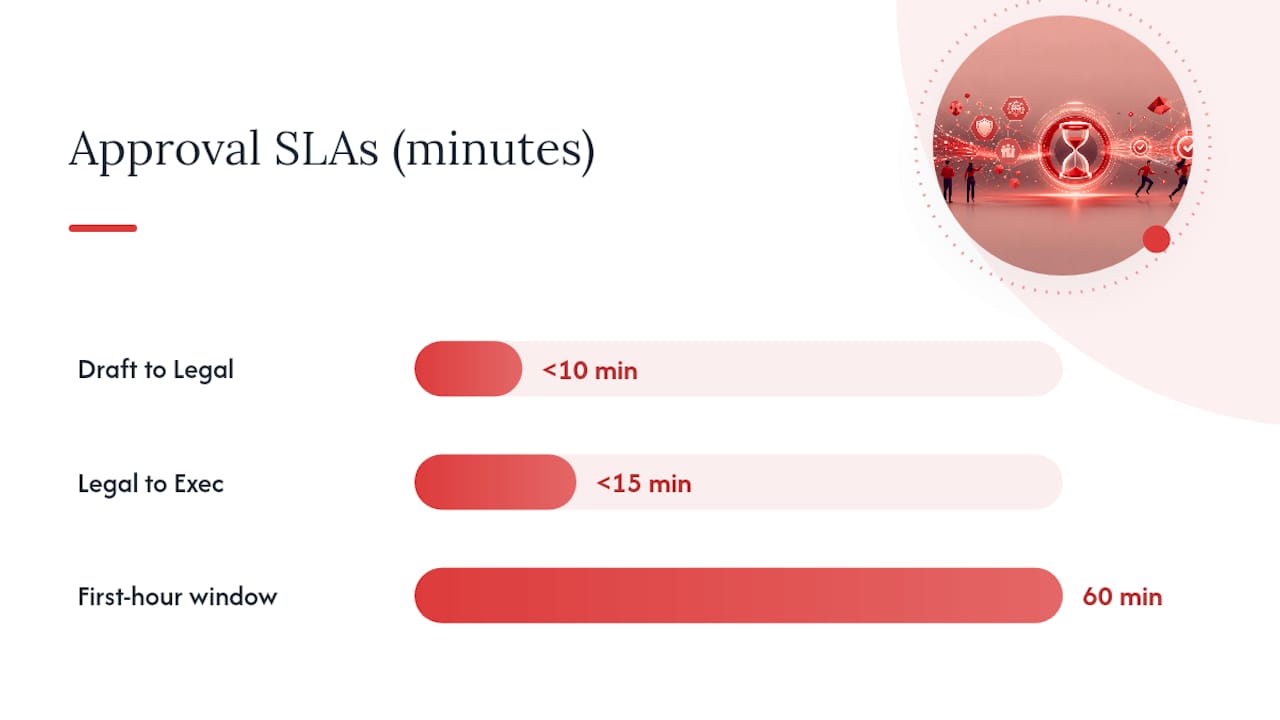
Set approval SLAs in minutes, not hours: draft to legal review in under 10 minutes, legal to exec sign-off in under 15, for any Tier 2 or 3 event. Documented response-time SLAs for agency-managed accounts show why these windows matter, delay compounds fastest in the first hour, when the story is still being written by someone else.
Pro Tip: Log every approval timestamp, even the ones that feel too minor to matter. Your post-mortem is only as good as the record you kept during the fire.
How Do You Measure Recovery After a Twitter Crisis?
Recovery isn’t a feeling, it’s a set of numbers: sentiment trend over the following 72 hours, average response time per reply, reach of your corrective posts versus the original false claim, and any media pickup of your official statement.
- Track sentiment recovery daily for at least a week, not just the first 24 hours.
- Compare correction reach against original misinformation reach to see what actually landed.
- Run a short post-mortem within 48 hours: what triggered it, what worked, what took too long.
- Update your holding-statement templates and SLA targets based on what the post-mortem reveals.
- Schedule a drill using the revised playbook within the next quarter.
Academic reviews of crisis response on Twitter increasingly favor adaptive protocols over rigid scripts, because public expectations shift between incidents even when your template doesn’t.
What Tech and AI Brands Get Wrong About Twitter Crises
Most crisis playbooks were written for consumer brands facing PR complaints, not for tech and AI companies facing a security disclosure, a model behaving unpredictably, or a developer community turning hostile overnight. The instincts that work for a retail apology tweet often fail here.
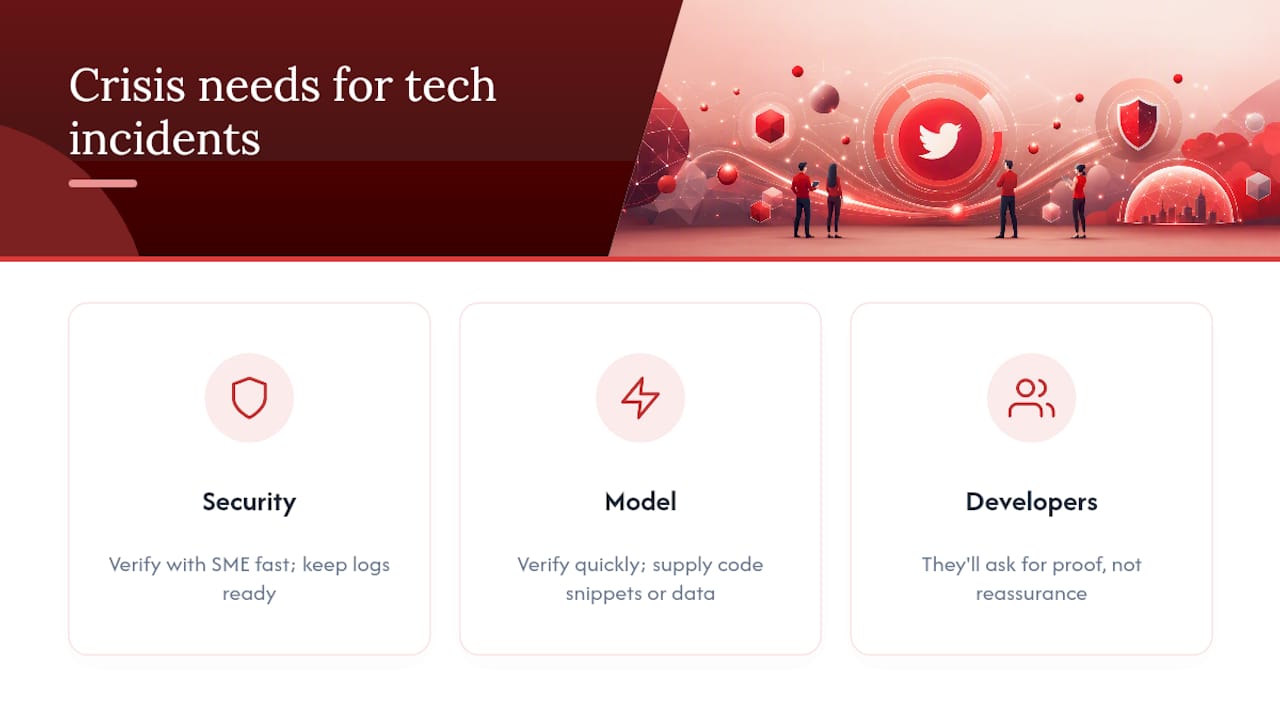
Two adjustments matter most. First, verify with your subject matter expert fast, developer and technical audiences spot a vague or evasive statement within minutes, and they’ll say so publicly. Second, keep logs, code snippets, or incident data ready for fact-checking before you publish anything, because a technical community will ask for proof, not reassurance.
Some agencies specialize in helping tech and AI brands trending on X, which means watching these exact dynamics daily: how fast a developer thread turns hostile, how quickly a credible account can flip a narrative back. That pattern recognition shapes every recommendation above.
— Knowix
How Nowix Supports Your Twitter Crisis Response
The gap most teams hit isn’t knowing what to do, it’s having the monitoring and hands on deck to do it fast enough. Some agencies run real-time trend monitoring, coordinate rapid-response drafting, and manage the post-crisis amplification phase once your correction needs credible reach.
Internal teams often lack the bandwidth to watch mention velocity around the clock or hit a 15-minute approval SLA during a live event. Some agencies offer account management services that build response capacity directly into your X presence, so escalation doesn’t wait on whoever happens to be online. Once the acute phase passes, organic post amplification through vetted micro-influencer quote-retweets helps your corrective message actually outrun the misinformation it’s replacing, instead of trailing behind it. If you’re rebuilding momentum after a rough stretch, a timeline takeover campaign can reset the conversation entirely. Reach out to a specialized agency to map your crisis response gaps before the next spike hits.
Sources
- Crisis Communication and Social Media Best Practice Guide (CIPR)
- A social constructionist approach to crisis management on X; the Spanish Football Association case study
- Twitter use in disaster/crisis communication (systematic case study review)
- Real-Time Crisis Management on Twitter: A Guide (5WPR)
Recommended
- For Tech & AI Teams: Twitter Tone of Voice, Prove It in One Tweet
- Twitter Brand Safety for Tech and AI Marketers
- Twitter Verification: Logo, Billing & Affiliates for Tech & AI Brands
Frequently asked questions
Does this guide mean Nowix offers X customer support or community management?
No. This is informational content. Nowix’s services cover X content, publishing and marketing campaigns; reply handling, moderation, customer support staffing and DM management are outside the offer.
How should a brand define responsibilities around sensitive conversations?
Agree an internal approval owner, escalation route and verified facts before publication. Keep marketing content responsibilities separate from customer support and moderation responsibilities.