
What do Twitter influencer rates actually look like in 2026?
Twitter influencer rates vary widely depending on follower count and other factors, ranging from modest fees for nano creators to very high rates for mega accounts with millions of followers. That spread is wider than any other major platform, and follower count alone does not explain it. Engagement quality, niche, content format, and X Premium status all move the number significantly.
Here are the baseline benchmarks you need for initial budget planning:
Influencer pricing varies by follower tier, with smaller accounts charging below mid-range fees and larger accounts commanding significantly more, influenced by engagement and content format.

Those are baseline tweet rates. Threads, X Spaces, and video tweets all carry their own multipliers on top. A sponsored thread generally commands higher rates than a single tweet due to increased production effort and sustained audience engagement.
Professional niches such as fintech, venture capital, AI, and B2B SaaS often command higher influencer rates compared to general entertainment accounts with similar follower counts. The reason is straightforward: their audiences include decision-makers with high customer lifetime values, and brands pay for that access.
Pro Tip: Before you lock in a budget, check the influencer’s average impressions across their last 20���30 posts, not just their follower count. Impressions are the real pricing input.

How do Twitter influencer pricing calculators estimate sponsorship rates?
Pricing calculators for X influencer sponsorships use a CPM benchmark adjusted by multipliers for engagement, niche, content format, and account status. The output is a low-to-high rate range, not a single number, which gives you room to negotiate.
Pricing calculators consider factors such as follower count, engagement rate, content type, niche, X Premium status, and deal type to estimate influencer rates.
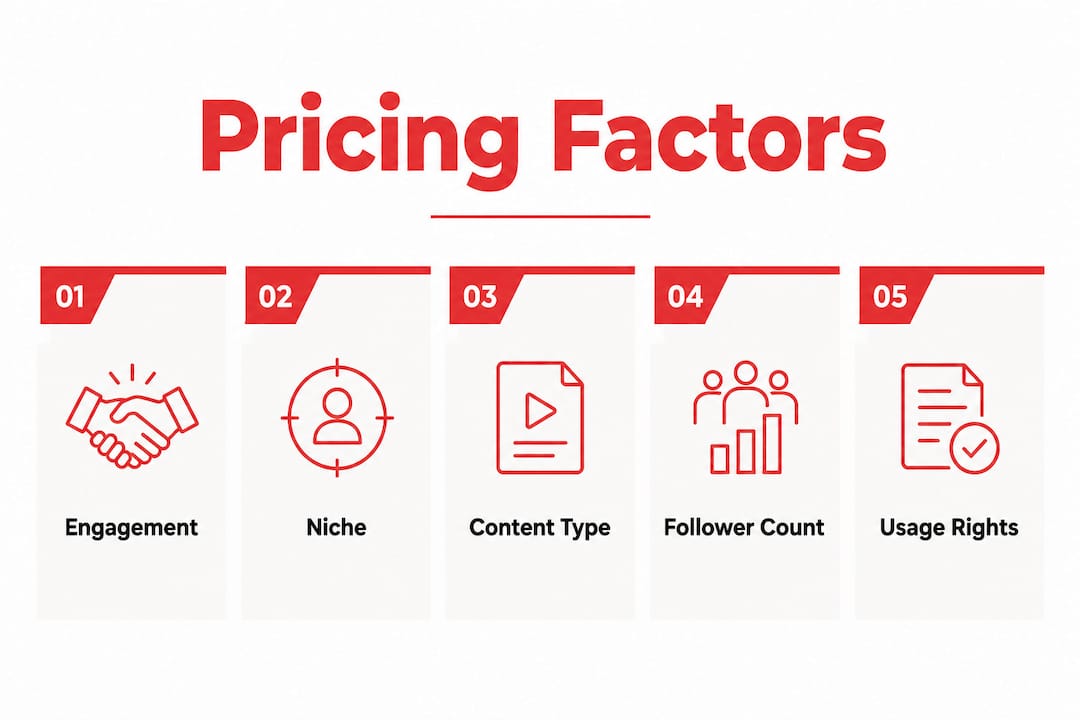
Impressions matter more than raw follower count in this calculation. Two creators with 100,000 followers can have wildly different average impressions depending on how often they post and how the algorithm surfaces their content. Calculators that pull from actual impressions data produce far more accurate estimates than those relying on follower count alone.
Usage rights and exclusivity sit on top of all of this. If your brand needs the tweet for paid amplification or wants category exclusivity, add 25–100% to the base fee depending on reach and duration.
Pro Tip: Ask the creator for a screenshot of their X Analytics showing average impressions per post over the last 30 days. That single number will calibrate any calculator estimate more accurately than their follower count.
Pricing breakdown by follower tier for Twitter influencers in 2026
The table below reflects current market rates across deliverable formats. Engagement quality and niche can push any figure higher; treat these as the starting point for your negotiations.
| Follower tier | Sponsored tweet | Sponsored thread | X Spaces | Monthly retainer |
|---|---|---|---|---|
| Nano (1K–10K) | $25–$150 | $50–$300 | $50–$300 | $100–$500 |
| Micro (10K–100K) | $50–$500 | $100–$1,000 | $200–$600 | $300–$2,000 |
| Mid-tier (100K–500K) | $300–$2,500 | $700–$5,000 | $700–$2,500 | $1,500–$5,000 |
| Macro (500K–2M) | $1,500–$12,000 | $3,000–$20,000 | $3,000–$10,000 | $5,000–$25,000 |
| Mega (2M+) | $8,000–$80,000 | $15,000 and up | Custom | Custom |
A few things the table does not capture. Mid-tier and macro creators in fintech or AI will price at the top of their range or above it. Nano and micro creators in general entertainment often price at the bottom. X Premium status adds another 15–25% across every tier.
Monthly retainers for multiple posts can provide tech and AI brands a consistent presence on the timeline and often offer better per-post value than one-off deals. For brands building long-term credibility in a niche, that consistency compounds.
How to estimate and negotiate Twitter influencer rates effectively
Rate cards are starting points. Most creators, especially at the nano and micro level, expect negotiation. Here is how to approach it without leaving value on the table.
Before you finalize any rate, check these factors:
- Engagement rate relative to follower count (1–3% is solid on X; above 5% justifies a premium)
- Audience composition: are the followers in your buyer persona, or general interest?
- Content format: are you buying a single tweet, a thread, or a bundled package?
- Analytics transparency: can the creator provide impressions, link clicks, and past campaign data?
Negotiation tactics that work:
- Start 20–30% below the listed rate for nano and micro creators. They expect it, and most will meet you in the middle.
- Bundle deliverables. A post plus a thread, or a tweet plus an X Spaces mention, costs less per unit than buying each separately.
- Negotiate usage rights separately. Buy the organic post first. If performance justifies paid amplification, negotiate that add-on after you see results.
- Propose a performance-based structure: a lower base fee with bonuses tied to engagement or conversion thresholds. This reduces your risk and motivates the creator to produce their best work.
- For mid-tier and macro creators, request impressions data and link click reports from previous brand deals. If they cannot produce it, price accordingly.
Flat fee per post is the most common model for nano and micro creators. CPM-based pricing makes sense when the creator can provide reliable impressions data and your goal is reach. Performance-based pay works best when you have tracking links in place and a clear conversion event to measure.
How do Twitter influencer costs compare to other platforms?
Twitter influencer marketing costs tend to run lower than Instagram and TikTok for equivalent follower counts, but the ROI story is more nuanced than the sticker price suggests.
For B2B and tech brands, X often delivers more commercially valuable reach per dollar than a larger Instagram account. The platform’s audience skews toward professionals, founders, and decision-makers. That concentration is what makes X the right channel for AI product launches, fintech campaigns, and developer-focused brands.
Platform cost comparison at a glance:
- X (Twitter): $50–$500 per post for micro influencers; CPM of $5–$20 for influencer posts; CPC around $0.74 for paid ads
- Instagram: Rates run 20–40% higher than X for equivalent follower counts; stronger for visual and consumer brands
- TikTok: Higher engagement rates (3–10% organic) but shorter content lifespan; better for consumer product launches
- LinkedIn: CPC of $5–$8, making it 7–10x more expensive than X for paid ads; strongest for enterprise B2B lead generation
For most ecommerce and direct-to-consumer brands, Instagram or TikTok will outperform X on raw conversion volume. For B2B SaaS, AI, and fintech brands, X’s professional audience concentration and lower CPM create a real cost advantage. The right platform depends entirely on where your buyers actually spend time.
Understanding influencer marketing ROI across platforms helps you allocate budget to the channel that matches your campaign goal, not just the one with the lowest sticker price.
Why engagement quality matters more than follower count on X
Follower count is the weakest pricing signal on X. Two accounts with 50,000 followers can produce completely different campaign results depending on who those followers are and how they interact.
Standard engagement rates on X are typically low, but creators with significantly higher engagement can command premium rates. A creator whose posts generate substantive replies and quote-retweets is driving real conversation, not passive scrolling.
The types of engagement matter too. Replies and quote-retweets (QRTs) signal genuine influence. Likes are passive. For B2B and tech brands, a post that generates 50 thoughtful replies from founders and engineers is worth far more than one with 500 likes from a general audience. That distinction is what separates a $200 micro-influencer deal that converts from one that does not.
X Premium status provides prioritized content placement, which can justify a moderate premium on influencer rates.
Hidden pricing factors worth tracking:
- Content format multipliers: Threads earn 1.8x a single tweet; video tweets earn 1.4x
- Niche authority premium: True thought leaders in a field can add 50–200% to base benchmarks
- X Premium status: 15–25% uplift across all tiers
- Exclusivity and usage rights: Add 25–100% on top of the base fee
For tech and AI brands, X influencer marketing leverages creator voice and credibility within niche communities, offering unique value compared to visual platforms. That is the core value proposition of X influencer marketing for B2B brands.
How to evaluate Twitter influencer ROI and justify the rates you pay
ROI on X influencer campaigns is measurable when you set up the right tracking before the campaign goes live. The mistake most brands make is treating influencer spend as a brand awareness line item with no accountability.
Start with a clear conversion event. For tech and AI brands, that might be trial signups, demo requests, or app installs. For awareness campaigns, track impressions, profile visits, and follower growth during the campaign window. Every campaign needs at least one number it is accountable to.
Using UTM parameters allows attribution of clicks and conversions from influencer posts, enabling comparison of cost efficiency against paid ads benchmarks.
Engagement metrics tell you about content quality. Conversion metrics tell you about audience quality. You need both. A post with high engagement but zero conversions usually signals an audience mismatch, not a bad creator. A post with low engagement but strong conversions signals a highly targeted audience that acts quietly. Neither is automatically better; the right metric depends on your campaign goal.
For brands running timeline takeover campaigns with multiple creators simultaneously, aggregate reach and share-of-voice metrics matter more than any single post’s performance. The goal is momentum across the timeline, not one viral tweet.
Pro Tip: Run a small test with three to five micro-influencers before committing to a macro deal. The data from a $1,500 test tells you more about your audience’s response than any rate card.
Key Takeaways
Twitter influencer rates in 2026 are driven by engagement quality, niche, and content format far more than follower count alone.
| Point | Details |
|---|---|
| Baseline rate ranges | Nano creators charge $25–$150 per tweet; mega accounts charge $8,000–$80,000 per sponsored post. |
| Engagement is the biggest lever | Accounts above 5% engagement can command roughly double the standard rate on X. |
| Niche multipliers are real | Fintech, AI, and B2B SaaS creators charge significantly more than general entertainment accounts at the same follower count. |
| X Premium adds a premium | X Premium status adds 15–25% to rates across every tier due to algorithmic prioritization. |
| Test before you scale | A $1,000–$5,000 test across multiple micro-influencers produces better ROI data than a single macro deal. |
Ready to put these rates to work on X?
You now have the benchmarks. The next step is execution. Nowix specializes in making tech and AI brands trend on X, from coordinated creator wave launches with up to 700 micro-KOLs activated within one hour, to post amplification through vetted QRT networks, to full X account management.
If you want to see what coordinated creator momentum looks like in practice, the Unfungible case study shows how a single founder post went from 97 views to 17,500 views through structured amplification. No luck involved.
When you are ready to move beyond rate research and into actual campaign execution, Nowix’s amplification service puts your posts in front of the right niche audiences on X, with measurable results and no wasted spend.
Recommended
- Nowix | Go Viral on X, Amplification & X Management
- Go Viral on X: Timeline Takeover Campaigns | Nowix
- Amplify Your Reach on X: Organic Post Amplification | Nowix
- Unfungible case study: founder posts from 97-164 views to 17,500 views | Nowix
Frequently asked questions
What changes the price of an X creator campaign?
Audience fit, deliverables, formats, usage rights, exclusivity, campaign timing and coordination can affect the quote. Separate creator fees from planning and reporting.
Is a larger influencer always better than a smaller one?
No. Relevant expertise, audience and content quality matter alongside reach. Compare the intended action and reporting rather than choosing only by follower count.