Why does a technically superior protocol often lose the visibility battle to a project with half the utility but better distribution? You've likely spent months shipping code only to see your launch tweet die in the feed because the developer community is naturally allergic to anything that smells like a traditional ad. Effective twitter marketing for developers in 2026 is no longer about buying reach; it's about understanding the specific ranking signals that govern the timeline.
We agree that the current environment is difficult, especially with the 2026 API shifts that have increased the cost of sharing URLs to $0.20 per post and removed automated engagement features from self-serve tiers. This article explains how to bridge the gap between technical innovation and algorithmic visibility by using coordinated amplification. You'll learn the mechanics of narrative distribution, moving beyond simple posts to structured launches that capture the attention of high-signal technical audiences without triggering their skepticism. We will examine how to engineer these flows to ensure your engineering milestones achieve the reach they deserve.
Key Takeaways
- Learn how to optimize technical content for X's ranking signals to ensure your proof of work reaches high-signal audiences instead of being buried.
- Shift from posting raw code to engineering narrative flows that distribute your project's story across hundreds of independent accounts.
- Master the mechanics of twitter marketing for developers by replacing legacy paid ads with coordinated reaction strategies that build authentic trust.
- Execute a Timeline Takeover by aligning the timing of your technical announcements to achieve simultaneous visibility across multiple geographies.
- Utilize decentralized Micro-KOL networks to establish social proof and overcome the natural skepticism of the global developer community.
The Architecture of Attention: Why X Remains the Primary Protocol for Developers
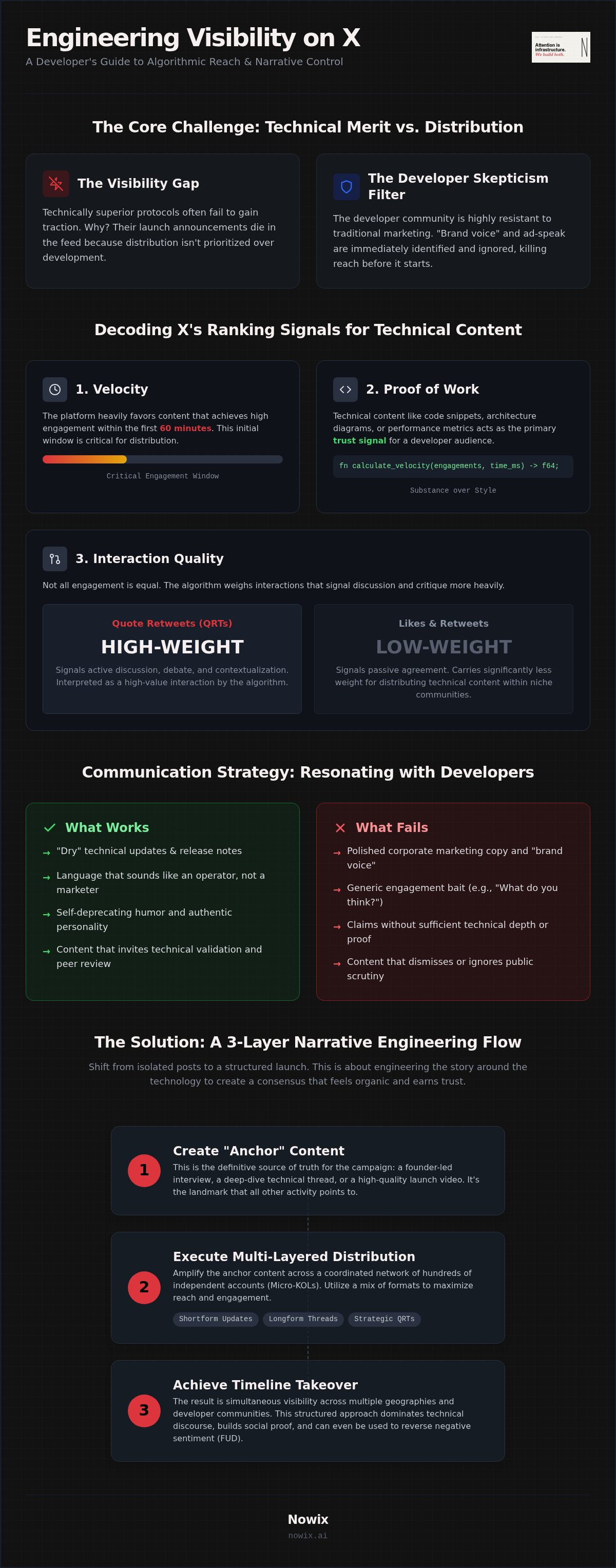
X functions as the live documentation layer for the global engineering stack. While other platforms prioritize general entertainment, the technical niche on X operates on a set of specific ranking signals that reward utility and velocity. Effective twitter marketing for developers requires an understanding of how these signals translate into visibility. In our campaigns, we've seen that technical "proof of work" content, such as code snippets or architecture diagrams, serves as the primary trust signal for this audience. It validates the legitimacy of the project before a single line of marketing copy is read.
Velocity is the most critical variable for distribution. The platform mechanics favor content that achieves high-velocity engagement within the first 60 minutes of posting. If a post fails to gain traction within this window, the algorithm typically deprioritizes it in the "For You" feed. This makes the initial distribution phase vital for any technical announcement. Projects that cannot generate immediate peer-level interaction often find their most important updates buried under less relevant content.
Understanding Developer Ranking Signals
The X algorithm distinguishes between generic engagement bait and technical discourse. Based on our observations, the system weights technical keywords and specific syntax higher when the posting account has an established reputation score within the developer niche. This score is built through consistent interaction with other verified engineering accounts. It's a localized authority signal that tells the algorithm the content is relevant to a specific subset of the 544.5 million global users.
Quote Retweets (QRTs) carry significantly more weight than simple likes or standard retweets for technical threads. A QRT signals that the content is being discussed or critiqued; the algorithm interprets this as a high-value interaction. When scaling reach through influencer marketing, focusing on QRTs from peer-level developers ensures the content stays within the relevant engineering circles. This isn't about raw numbers; it's about the quality of the nodes in the network reacting to your deployment.
The Developer Skepticism Filter
Developers are trained to identify and ignore corporate marketing language. Standard "brand voice" often fails to trigger algorithmic amplification because it lacks the linguistic markers that the community respects. We've seen that "dry" technical updates or self-deprecating humor often outperform polished marketing copy. The goal is to sound like an operator, not a salesperson.
The community uses X as a peer-review mechanism for new protocols and libraries. A single thread can act as a stress test for a project's claims. Twitter marketing for developers must lean into this reality by providing enough technical depth to survive public scrutiny. If the content lacks substance, the skeptical filter of the audience will prevent it from reaching the velocity needed for wider distribution. Success depends on presenting information that invites technical validation rather than dismissing it.
Narrative Engineering: Moving from Code Snippets to Viral Distribution
Technical specifications are the foundation of any project, but they rarely move the needle in isolation. This isn't just about posting code; it's about engineering the story around the technology. Narrative distribution is the process of seeding a specific perspective across hundreds of independent accounts to build a consensus that feels organic. This method is a core component of a modern Developer Marketing Strategy, as it prioritizes technical education and peer validation over traditional sales tactics.
In our campaigns, we've observed that high-stakes moments require a transition from passive engagement to active narrative building. For instance, the Arcium case study demonstrated how amplifying a founder-led interview allowed a project to dominate technical discourse for an entire weekend. By coordinating a network of nodes to contextualize the discussion, the project achieved a level of visibility that a single brand account couldn't sustain. This shift is particularly vital during a Token Generation Event (TGE), where the sheer volume of noise requires a structured approach to maintain narrative control.
Building the Launch Narrative
A successful launch relies on "anchor" content that serves as the definitive source of truth for the campaign. This landmark content is supported by a multi-layered distribution strategy involving shortform updates, longform technical threads, and strategic Quote Retweets (QRTs). We've seen that integrating high-quality assets, such as launch videos, significantly increases the visual stop-rate on the timeline. These layers work together to ensure that twitter marketing for developers remains grounded in technical reality while achieving the reach of a viral event.
Narrative Control and FUD Reversal
One of the most effective uses of coordinated distribution is reversing negative sentiment, often referred to as FUD (Fear, Uncertainty, and Doubt). In the Solstice case study, we saw how shifting a negative narrative through high-volume amplification was instrumental in securing major exchange listings. When a project faces criticism or competing geopolitical news, a coordinated wave of creator content can provide the necessary counter-narrative to regain momentum.
Managing these high-stakes events requires a deep understanding of ranking signals and community sentiment. If you're looking to structure a technical launch with precision, working with an operator-led agency can provide the distribution mechanics needed to cut through the noise without compromising technical integrity.
Coordinated Amplification vs. Legacy Ads: Solving the Developer Skepticism Gap
Legacy advertising on X often hits a wall of technical skepticism. While standard X ads have a Cost Per Engagement (CPE) between $0.50 and $2.00, their effectiveness for engineering audiences is limited by high rates of ad-blocker usage and mental "banner blindness." Successful twitter marketing for developers requires a shift from paid placement to coordinated reaction. By utilizing micro-KOLs to react to existing content, you mimic real community interest rather than forcing a corporate message into the feed. This isn't just about buying impressions; it's about engineering the social proof required to bypass the community's natural defense mechanisms.
In our campaigns, we've observed that Quote Retweet (QRT) campaigns from peer-level accounts generate higher click-through rates for technical documentation than traditional promoted accounts. This occurs because a recommendation from a peer serves as a primary trust signal. When a developer sees a peer analyzing a code snippet or a protocol architecture, they're more likely to engage with the underlying documentation. This peer-to-peer validation is something that a standard "Promoted" tag cannot replicate.
Why Micro-KOLs Outperform Macro-Influencers
The trust gap in technical marketing is significant. A developer is far more likely to investigate a new protocol if it's discussed by a peer with a similar reputation score than by a celebrity influencer. We've seen that a "700-creator wave" provides the necessary density to impact trending algorithms across specific geographies. This density creates a sense of inevitability around a technical story. You can learn more about how to amplify posts on X using these coordinated networks to build authentic reach without the friction of traditional ad formats.
Comparing Distribution Models
Legacy models rely on platform-driven targeting that often misses the nuance of technical sub-communities. Coordinated distribution uses pre-curated groups of operators to deliver speed. This eliminates the need for lengthy briefing phases, allowing for immediate reaction to market events or protocol launches. The following table compares the two approaches based on our internal observations of twitter marketing for developers campaigns.
| Metric | Standard X Ads | Coordinated Amplification |
|---|---|---|
| Trust Level | Low (Marked as "Sponsored") | High (Peer-to-Peer Reaction) |
| Delivery Speed | Variable (Ad Review Period) | Instant (Pre-curated Networks) |
| Narrative Control | Limited to Static Ad Copy | Dynamic, Distributed Perspectives |
| Audience Fit | Broad Algorithmic Targeting | Niche Engineering Communities |
Ready to scale your technical reach? Explore our Amplification packages to see how we structure launches for maximum distribution.
Executing a Technical Launch: The Mechanics of a Timeline Takeover
A "Timeline Takeover" is a synchronized distribution strike designed to make a technical project trend across multiple geographies simultaneously. Unlike the slow build of organic growth, this method focuses on achieving high density within a compressed timeframe. In high-velocity sectors like Web3, waiting for the algorithm to discover your code is a liability. Effective twitter marketing for developers requires a structured approach to ensure your landmark content achieves immediate visibility before the news cycle shifts. We have seen success in using networks of 600+ influencers to outtrend major exchange news, proving that coordinated volume can overcome even the most crowded feeds.
Timing is the most critical variable in this process. A launch that isn't optimized for the first 60 minutes of the X algorithm's ranking window rarely recovers its momentum. The goal is to move from a single post to a platform-wide narrative by layering engagement signals that the system interprets as a breakout event. This requires preparing your technical thread to be "algorithm-ready" long before the first post goes live.
The 24-Hour Launch Cycle
The execution follows a three-step progression. First, we focus on content optimization, ensuring the technical thread uses the specific syntax and visual assets that maximize stop-rates. Second, the initial wave triggers the first 100,000+ views through boosted posts from high-reputation accounts. This creates the foundational reach needed to enter the "For You" feeds of the broader engineering community. Finally, we deploy trending escalation by using Quote Retweets (QRTs) from niche-relevant accounts. This final layer is what signals the platform to grant trending status in key tech hubs, cementing the project’s presence on the global timeline.
Case Study: The Flow Blockchain Staking Campaign
In our work with Flow Blockchain, we utilized a Timeline Takeover to promote a 210% APR staking mechanism. By coordinating distribution across multiple technical sub-communities, the campaign achieved multi-geography trending status. This visibility had a direct impact on protocol Total Value Locked (TVL), as the narrative reached the specific user groups most likely to participate in the staking protocol. You can explore our Twitter trending strategy for a deeper look at the technical mechanics behind these engineered launches.
Success in twitter marketing for developers depends on the ability to command attention at scale without sacrificing the technical legitimacy of the project. If your protocol is approaching a major milestone, you can execute your next timeline takeover with an operator-led team that understands these ranking signals.
Scaling Narrative Reach via Micro-KOL Networks for Web3 Projects
Scaling a technical narrative in 2026 requires moving beyond the limitations of a single brand account. While building an internal following is a long-term asset, it lacks the immediate leverage needed for high-stakes events. Effective twitter marketing for developers now relies on the ability to tap into decentralized creator networks. These micro-KOLs provide the social proof that engineering audiences require before they engage with a new protocol. By distributing your message across hundreds of independent nodes, you create a consensus that feels like a genuine market shift rather than a top-down corporate broadcast.
This approach is particularly effective for decentralized exchanges (DEXs), blockchain protocols, and projects approaching a Token Generation Event (TGE). In our campaigns, we've seen that technical visibility requires a predictable floor. Our "Trending" package provides this by guaranteeing 300,000+ views, ensuring that your technical milestones aren't left to the mercy of organic discovery. This isn't about hope; it's about engineering a baseline of distribution that allows your project's utility to be seen by the right operators.
Leveraging Ecosystem Grants and Networks
Strategic projects often utilize ecosystem grants to fund these distribution efforts. We've observed projects like Minswap and Cardano successfully using grant allocations for KOL services to strengthen their network's presence on X. Utilizing a "Timeline Takeover" for earnings reports or major protocol upgrades ensures that the entire ecosystem is aware of the progress. You can see our guide on X marketing for tech brands to understand how we structure these decentralized networks to support ecosystem growth.
Measuring Performance Beyond Vanity Metrics
Success in twitter marketing for developers is measured by narrative dominance and sentiment shifts, not just likes or retweets. We look at how the community's perspective changes after a coordinated wave of amplification. This involves comparing the technical discourse before and after the campaign to ensure the desired narrative has taken hold. When you move the needle on sentiment, you secure more than just impressions; you secure the project's position in the engineering stack.
The mechanics of distribution have changed, and the speed of the 2026 market doesn't allow for slow, traditional growth strategies. If you're ready to secure your project's place on the timeline, contact Nowix.ai to engineer your next Timeline Takeover. We provide the distribution infrastructure needed to bridge the gap between technical innovation and algorithmic visibility.
Engineering the Future of Technical Distribution
The transition from legacy advertising to engineered distribution marks a fundamental shift in how protocols capture attention. Success now depends on your ability to overcome community skepticism by utilizing peer-to-peer validation and high-velocity ranking signals. We've seen that mastering twitter marketing for developers is less about the size of your brand account and more about the coordination of the network around it. By structuring your launches around narrative flows rather than static posts, you ensure your technical innovation isn't lost in the noise.
Nowix.ai provides the infrastructure to turn these mechanics into predictable outcomes. Whether you need a full-service delivery from briefing to reporting or a proven narrative reversal like the one seen with Solstice, our viral packages are built for scale. We offer a guaranteed 1,000,000+ views to provide the distribution floor your project requires. It's time to move beyond hope and start building for visibility. Launch your Timeline Takeover with Nowix.ai today and secure your project's place on the global timeline.
Frequently Asked Questions
How can a technical brand go viral on X?
Technical brands go viral by combining optimized technical content with mass amplification through coordinated micro-influencer networks. High-volume coordination in the first hour of a post is the primary factor for triggering ranking signals. This allows technical documentation to move beyond an existing follower base into the broader developer ecosystem. Our observations suggest that density of peer-level reactions is more effective than broad-interest engagement for technical audiences.
What is the best way to handle a TGE launch on Twitter?
The most effective way to handle a TGE launch is by utilizing large-scale user-generated content (UGC) campaigns to establish a consistent narrative leading up to the event. By coordinating hundreds of independent posts, projects achieve a Timeline Takeover that makes the launch the dominant story on the platform. This visibility is vital for attracting both developers and liquidity providers. It ensures the protocol's story remains at the top of the feed.
How do you counter negative press or FUD on X?
Countering negative press is achieved by using amplification services to rapidly shift the narrative through a high volume of peer-level content. As seen in the Solstice case study, this coordinated effort can reverse negative sentiment and assist in securing critical business outcomes like exchange listings. It's about out-trending the negativity with authentic developer-led distribution. This provides the community with a clear technical counter-narrative that the algorithm recognizes as high-signal.
What are the benefits of using micro-KOLs for developer marketing?
Micro-KOLs provide higher levels of trust and authenticity because they are perceived as peers by other software engineers. Unlike macro-influencers, their engagement is technical and less likely to be dismissed as a paid advertisement. Coordinated waves of micro-KOLs provide the necessary volume to hit trending status. This is a core part of twitter marketing for developers, as it leverages peer-to-peer validation to build authority across the network.
Does Nowix.ai provide asset creation for campaigns?
Yes, asset creation is available as an optional add-on service to produce high-quality deliverables such as launch videos. These assets are specifically designed to increase the stop-rate and engagement of technical posts on X. Combining high-quality assets with our amplification services ensures that the takeover has the maximum possible visual impact. These assets help translate complex technical concepts into formats optimized for current visual ranking preferences.
How long does it take to start an amplification campaign?
Our amplification services are designed for speed and often require no lengthy briefing or recruiting phase. By utilizing pre-curated creator groups, we can react to existing content almost instantly. This makes the service ideal for responding to earnings reports, breaking news, or sudden market opportunities that require immediate narrative distribution. Projects can shift their story quickly without the friction found in traditional agency models or manual outreach.