What if your next product launch didn't depend on the hope of a viral moment, but on the precise orchestration of engagement velocity within the first sixty minutes? Most tech brands struggle with declining organic reach on X, often watching high-quality announcements fall flat despite significant effort. You've likely noticed that traditional influencer "shills" are becoming cost-prohibitive and less effective as the platform shifts toward authentic conversation. To break through, you need a twitter trending strategy that prioritizes ranking signals over raw volume.
We've observed that the current algorithm rewards conversation quality, with replies reportedly weighted 27 times more than simple likes. It's no longer about hashtag stuffing, which can actually trigger spam filters in 2026; it's about understanding SimClusters and how to group your content within specific topic nodes. This article explains how to engineer these launches by leveraging coordinated creator waves to drive distribution without relying on expensive promoted trends.
You'll learn the mechanics of structuring a launch to avoid the 50% reach penalty associated with external links and how to maximize the critical 30 to 60 minute window. We're moving past the "black box" era to a period where distribution is a matter of technical execution and network coordination.
Key Takeaways
- Focus on engagement velocity rather than raw volume, as the 2026 algorithm prioritizes how quickly conversations ignite relative to their baseline.
- Master the "Golden Hour" framework to synchronize internal and external networks for a high-impact blast within the first sixty minutes of a launch.
- Implement a decentralized twitter trending strategy by deploying creator waves that remove the single point of failure inherent in traditional macro-influencer campaigns.
- Utilize a 24-hour execution roadmap to seed your narrative and finalize technical synchronization with your engagement teams.
- Leverage managed creator networks to scale your distribution through a precise understanding of ranking signals and topic clusters.
The Anatomy of an X Trend: How the 2026 Algorithm Works
A trend on X isn't just a high number of posts. Technically, it's a statistical anomaly where the frequency of a specific keyword or phrase spikes significantly above its historical baseline within a narrow window. In 2026, the algorithm has shifted away from rewarding raw volume. You can no longer brute-force your way into the sidebar with thousands of low-quality posts. Instead, the system looks for "Engagement Velocity," which measures how quickly a conversation is accelerating across different nodes of the network.
Your account reputation acts as a multiplier for this velocity. Our internal observations suggest that 100 high-reputation, verified tech accounts carry more weight than 10,000 unverified or bot-like profiles. This is because the algorithm utilizes SimClusters to group users into 145,000 distinct topic clusters. If your content gains traction within a relevant cluster, such as "SaaS Infrastructure" or "AI Development," the platform amplifies it to similar users, creating a legitimate distribution wave. Understanding X's trending topics feature requires moving past 2024 tactics and focusing on these high-signal interactions.
Velocity vs. Volume: The New Ranking Metric
Velocity is the primary driver of modern discovery. In our campaigns, we've seen that 500 tweets published within a 10-minute window often outperform 5,000 tweets spread across five hours. The algorithm is looking for a "flashpoint." This isn't about total count; it's about concentration. When you're building a twitter trending strategy, you must synchronize your network to hit the platform simultaneously. Direct shares and quote tweets are weighted more heavily than standard retweets because they signal a higher level of intent. A successful launch focuses on the first 30 to 60 minutes, which is the critical period for the algorithm to decide if a topic deserves a spot in the trending sidebar.
The 2026 Sentiment Filter
X now uses advanced Natural Language Processing (NLP) to analyze the quality of the discourse surrounding a trend. If the algorithm detects "shill-bot" patterns—repetitive phrasing, lack of unique commentary, or low-quality replies—it suppresses the topic's reach. Meaningful discourse is the goal. Because replies are weighted approximately 27 times more than likes, your strategy must encourage active discussion. Quote tweets with unique, technical commentary provide the longevity needed to stay trending. The sentiment filter ensures that only authentic, conversation-heavy topics survive the initial spike, filtering out "forced" trends that lack real human engagement.
The Velocity Framework: Mastering the First 60 Minutes
The first sixty minutes following your post are the most critical for any twitter trending strategy. Synchronize your signals. If the algorithm doesn't detect a specific acceleration rate during this "Golden Hour," your content will likely settle into the standard decay curve of organic reach. Achieving a trend requires moving beyond hope and into the precise coordination of internal and external networks to hit the platform at the exact same moment.
The Pre-Launch Warmup
Start seeding your narrative at least 24 hours before the primary announcement. This involves engaging with existing conversations in your specific topic cluster to prime your account's relevance score. If you're launching a dev tool, interact with threads in the "Software Engineering" SimCluster. You should also verify that your "notification squad"—a group of high-authority accounts in your niche—is ready to provide immediate, high-quality replies the moment your anchor tweet goes live.
Executing the 60-Minute Blitz
Your anchor tweet needs to be the focal point of the launch. Use high-resolution media or video to increase dwell time, but avoid including external links in the initial post. Research indicates that external links can reduce reach by as much as 50%. Instead, place your call-to-action in the first reply. Once the anchor is live, your coordinated network of micro-KOLs should begin providing unique commentary rather than simple retweets.
This isn't just about volume; it's about the density of high-signal interactions. Because replies are weighted 27 times more than likes, your team must manage the reply section to maintain a 1:1 engagement ratio. If you want to see how these mechanics scale in a live environment, you can explore how managed creator networks automate these signals. Monitoring real-time analytics during this spike allows you to adjust amplification. If velocity slows, you can trigger additional creator waves to sustain interest.
Maintaining specific keyword density is the final step in the blitz. X's Natural Language Processing (NLP) identifies the core topic by analyzing the text in your tweet and the subsequent replies. If the conversation remains focused on your target keywords, the platform is more likely to categorize it as a trending topic. Use real-time dashboards to track topic velocity and ensure the discourse hasn't drifted into irrelevant clusters, which can dilute your ranking signals.
Coordinated Creator Waves: The 700-KOL Advantage
Relying on a single macro-influencer creates a single point of failure. If that account's engagement patterns appear unnatural or fail to spark immediate replies, your momentum stalls. A decentralized twitter trending strategy distributes this risk across 700 distinct nodes. By utilizing a wave of micro-KOLs, you ensure that the conversation remains resilient even if individual accounts underperform. This creates a chorus of authentic voices rather than a solitary, vulnerable megaphone.
These smaller creators are effective because they bypass the "ad filter" users apply to celebrity endorsements. When a technical peer recommends a tool, it triggers a friend-to-friend trust loop that is difficult to replicate with traditional advertising. Our observations indicate that micro-creators often generate three times the quote tweet impact of macro-influencers. This high-signal engagement is essential for a twitter trending strategy because quote tweets provide the unique commentary that modern sentiment filters require for trend longevity.
Micro vs. Macro: The ROI Comparison
Cost efficiency is another primary driver for this decentralized approach. Building a wave of 700 micro-KOLs is often more economical than a single post from a high-tier celebrity. You're securing concentrated attention within the specific SimClusters where your tech brand needs to establish authority. This ensures your resources are spent on relevant reach rather than broad, low-conversion impressions. The result is a higher density of technical discourse that aligns with the algorithm's current ranking signals.
Managing the 700-Creator Wave
Successful execution requires strict logistical control over brief distribution for your twitter trending strategy. You can't provide a single script to hundreds of people; the platform's NLP will flag the repetition as low-quality content. Each creator must receive a narrative pillar that allows them to add their own technical perspective. When one node discusses API performance and another focuses on developer experience, the system sees a multi-faceted discussion. Decentralized waves trigger the "Organic Interest" flag by simulating widespread, multi-nodal conversation rather than a centralized, scripted broadcast.
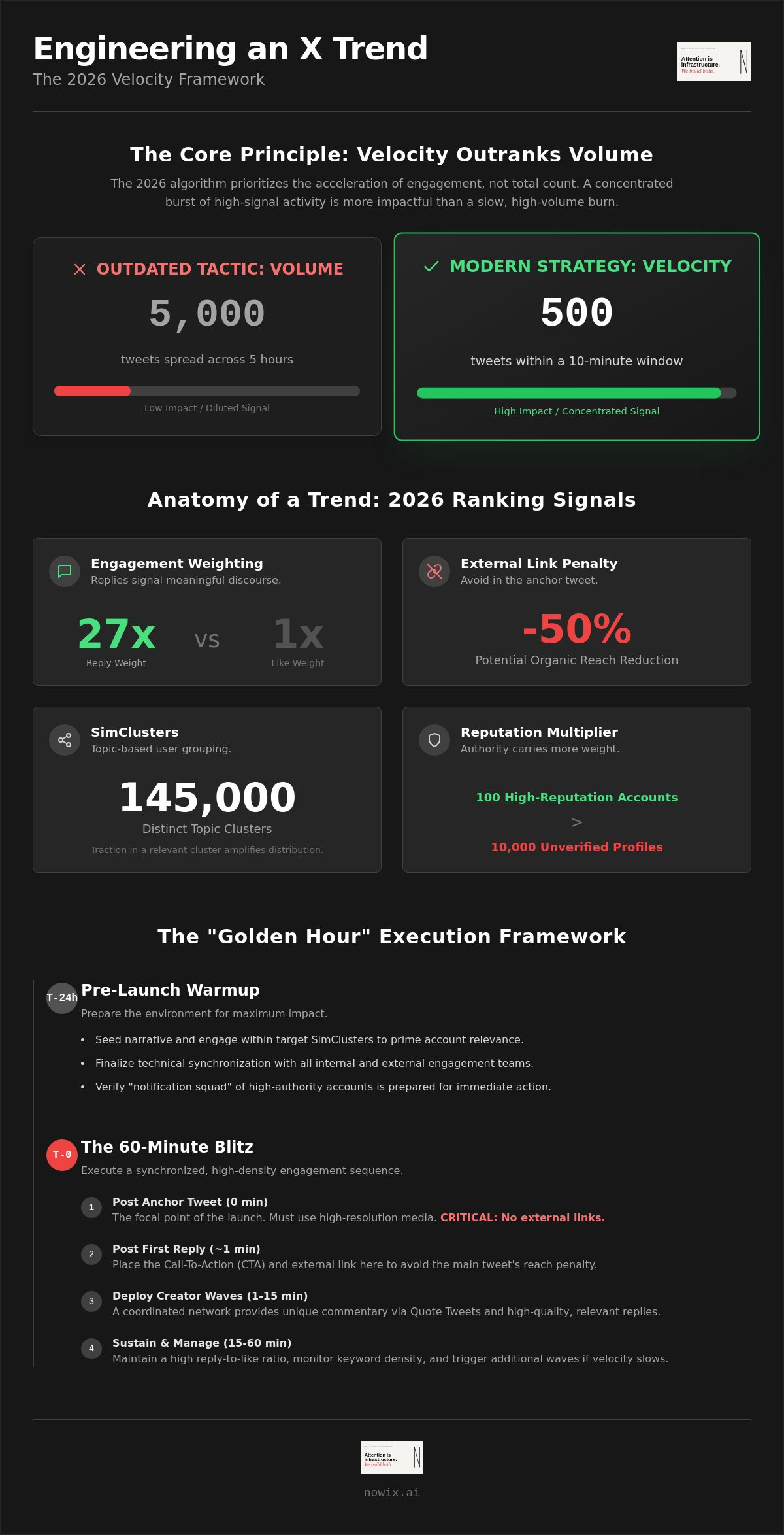
Building Your Trending Roadmap: A 24-Hour Execution Plan
Execution requires a disciplined timeline. While the "Golden Hour" is the peak of the operation, the foundation is laid exactly 24 hours prior. We've seen that campaigns without a formal seeding phase often struggle to hit the required velocity thresholds because the account's relevance score hasn't been primed within the target topic cluster. Your twitter trending strategy should be viewed as a sequence of technical triggers rather than a single event.
The Narrative Seeding Phase
Start by identifying the primary tech-community hubs where your target audience resides. Twenty-four hours before the main blast, publish teaser threads that hint at the technical breakthrough without revealing the full asset. This builds anticipation and encourages high-reputation accounts to interact early. Hosting an X Space during this window can further build audio-based momentum, as the algorithm often promotes live audio to the top of the timeline, increasing your account's visibility before the text-based launch.
T-minus 60 minutes is the final synchronization point. At this stage, your engagement teams and creator networks must confirm they're ready for the zero-hour blast. This is the time to finalize assets and ensure no external links are present in the main post to avoid the 50% reach penalty. If you want to automate this level of coordination, you can onboard your brand to a managed creator network to handle the technical labor.
Sustaining the Momentum
A trend that dies after two hours is a wasted opportunity. To prevent the conversation from falling off after the initial spike, you need to implement targeted engagement boosts. This involves having secondary waves of creators enter the thread at hour three and hour six to refresh the "Recent" tab and maintain high reply velocity. You can find more details on scaling these mechanics in our guide on how to Go Viral on X: The Engineered Playbook.
The goal is to convert this transient traffic into permanent assets. As the trend persists, ensure your first reply contains a clear path to a newsletter signup or a product demo. By maintaining a high 1:1 engagement ratio in the replies, you signal to the algorithm that the discourse is still active, which can extend your presence in the trending sidebar for up to 24 hours. Monitor your real-time analytics to identify when the velocity begins to dip and deploy your final engagement wave to stabilize the reach.
Scaling Virality with Nowix: Beyond Manual Tweeting
Manual trending attempts usually fail because founders don't have the bandwidth to sync hundreds of creator nodes. A robust twitter trending strategy requires a technical infrastructure that founders can't build on the fly while managing a product roadmap. We've developed a system that replaces guesswork with controlled engagement flows, ensuring visibility across target clusters without the manual labor. This approach allows your brand to maintain a presence in the trending sidebar while your team stays focused on core development tasks.
Our campaigns have demonstrated that a coordinated wave can secure a top-three trending spot within forty-five minutes. We achieve this by using a pre-configured twitter trending strategy that uses high-reputation accounts to hit ranking signals at the right time. These flows provide a 24-hour window of visibility that manual efforts can't sustain, especially when dealing with the platform's global nature. By automating the timing and distribution of these signals, we ensure that your announcement doesn't just spike and disappear, but maintains a high level of velocity throughout its lifecycle.
Professional X Account Management
Maintaining a high reputation score is an operational task that goes beyond simple posting. An Account Operator ensures your brand engages with technical threads 24/7, keeping your profile active within its primary SimClusters. This consistency prevents your profile from being categorized as a "broadcast-only" node, which the algorithm often penalizes with reduced reach. We focus on building long-term equity by participating in meaningful discourse, which warms up your account for future launches and establishes you as a consistent authority in your niche.
The role of an operator includes managing the "emotion maps" and "topic velocity" that X's analytics now provide. By monitoring these metrics in real-time, we can adjust the tone and frequency of engagement to match the current platform mood. This proactive management ensures that your account reputation remains high even during quiet periods, providing a stronger foundation for when you need to trigger a high-velocity trending wave.
The Nowix 700-Creator Network
Accessing a pre-vetted network of tech and crypto micro-KOLs is the core of our model. We handle the velocity mechanics so your team can focus on shipping code. Our network is trained to provide the unique commentary that modern filters demand, which is a key component of any successful twitter trending strategy. Each creator is selected based on their specific technical niche and their established reputation score, ensuring that every post adds legitimate value to the discourse.
This decentralized approach removes the single point of failure found in traditional influencer marketing. If one node in the network underperforms, the remaining 699 accounts maintain the momentum. We coordinate these waves to ensure that the narrative remains consistent but the content remains unique, satisfying the algorithm's requirements for authentic, human-centric interaction. Ready to own the conversation? Explore our X Trending Placement services.
Executing Your Network-Led Distribution
Dominating the X sidebar in 2026 requires a technical shift from volume to velocity. As we've explored, success depends on the precise synchronization of high-reputation accounts and the elimination of single points of failure. Implementing a robust twitter trending strategy is no longer about brute-force posting; it's about understanding SimClusters and ranking signals to trigger distribution waves. By mastering the first sixty minutes and maintaining conversation quality through unique technical commentary, tech brands can secure lasting visibility.
Operating at this level of coordination requires a specialized infrastructure that most internal teams don't possess. Our managed 700+ creator waves and proprietary velocity frameworks are designed specifically for the high-stakes environment of Tech and Web3 launches. If you're ready to move beyond manual attempts and deploy an engineered twitter trending strategy, scale your tech brand on X with Nowix. Your product's growth depends on a distribution engine that's as sophisticated as the technology it promotes. Let's build that momentum together.
Frequently Asked Questions
How many tweets does it take to trend on Twitter in 2026?
Trending depends on engagement velocity relative to a baseline rather than a fixed number of posts. In our campaigns, we've seen that concentrated bursts of 500 to 1,000 high-quality interactions within a 60-minute window are more effective than high-volume, low-velocity surges. The algorithm prioritizes how quickly a conversation accelerates across specific topic nodes rather than just the total count of tweets.
Can I get banned for using a coordinated trending strategy?
No, provided the coordination focuses on authentic creator networks and legitimate distribution. Platform moderation systems target automated spam and repetitive behavior that lacks human nuance. By utilizing a decentralized twitter trending strategy that encourages unique technical commentary from real accounts, you maintain compliance with platform standards while maximizing your brand's visibility in the trending sidebar through organic-looking signals.
Do hashtags still matter for trending on X?
Hashtags are largely redundant in 2026 because the platform uses Natural Language Processing (NLP) to categorize content semantically. Using more than two hashtags can actually trigger spam filters and reduce your reach by as much as 50%. It's more effective to focus on keyword density within the text of your post and the subsequent replies to land in the correct topic clusters.
How long does a topic usually stay on the trending sidebar?
A topic typically remains in the trending sidebar for 2 to 24 hours depending on its engagement decay rate. Sustaining a trend requires "Long Tail" engagement, where secondary waves of creators enter the conversation every few hours to refresh the data. This maintenance ensures the algorithm continues to see the topic as a current, active discussion rather than a one-time spike that quickly loses momentum.
What is the difference between a 'Promoted Trend' and an organic trend?
A Promoted Trend is a paid advertisement that appears at the top of the trending list, whereas an organic trend is earned through engagement velocity. While paid spots offer guaranteed placement, organic trends often carry higher trust among technical audiences. This isn't a matter of budget versus effort; it's about whether you want a labeled ad or an authentic community conversation that builds long-term brand equity.
How does the X algorithm detect bot-driven trending attempts?
The algorithm uses AI-driven sentiment analysis and pattern recognition to identify repetitive phrasing and low-reputation account activity. If a surge lacks unique commentary or quote tweets with technical substance, it's often flagged as forced and suppressed. Authentic distribution relies on human-centric interactions and varied technical perspectives to satisfy these quality-ranking signals and ensure the trend remains visible to real users.
Is it better to trend globally or in a specific region like the US or UK?
Trending in specific regions is often more valuable for tech brands targeting localized markets or specific industry hubs. Geographic relevance helps your content land in the personalized sidebars of relevant users within those territories. A global trend offers higher raw numbers, but a regional twitter trending strategy ensures your reach is concentrated where your potential customers and technical peers actually reside.
How much does a professional trending campaign cost for a startup?
Costs for professional distribution services vary based on the scale of the creator network and the duration of the campaign. Industry observations from 2026 suggest that high-volume social media coordination projects require significant initial setup and ongoing management fees to maintain network quality. Startups should evaluate these costs against the potential ROI of achieving high-velocity visibility within their target technical topic clusters.