
A viral launch campaign is an engineered distribution play, not a lucky break. It works because a repeatable viral loop, hook, payload, proof, and pass, gets built into the content before launch, then paired with disciplined seeding and hard measurement gates. Treat virality as a product feature you design, test, and scale, not a hope you post and pray on.
TL;DR:
- The success of a viral launch depends on a repeatable process that includes building a strong hook, payload, proof, and pass, paired with disciplined seeding and measurement.
- Testing multiple hook variants, matching creator format to platform behavior, and securing specific share reasons significantly increase the chances of organic sharing and reach.
- Seed nodes should be selected based on their audience’s trust and engagement, with outreach involving calendar-based coordination and clear briefs to maximize pass triggers.
- Key metrics such as share multiplier, share velocity, and sentiment ratio within 48 hours determine whether to amplify or cut a campaign, emphasizing early organic signals over paid reach.
- Avoid common pitfalls like chasing paid reach without organic proof, ignoring format fit, or skipping post-mortem analysis, as these undermine viral growth and sustainability.
Table of Contents
- What Makes a Viral Launch Campaign Actually Work?
- How Do You Build a Viral Launch Campaign Step by Step?
- Who Should You Seed First, and How Do You Recruit Them?
- What Metrics Decide Whether You Amplify or Kill a Launch?
- Engineered Viral Launches on X: A Platform-Specific Playbook
- What Do Real Viral Launches Teach You About What Actually Works?
- What Legal and Ethical Risks Go Beyond Basic Disclosure Rules?
- What Psychological Triggers Make Content Spread?
- How Should a Viral Launch Fit Into Your Broader Marketing Strategy?
- What Mistakes Sink Most Viral Launch Campaigns?
- How Do You Segment and Target Audiences for Viral Content?
- Knowix Perspective: Common Launch Mistakes and Overlooked Levers
- Run Your Next Viral Launch With Nowix
- Sources
What Makes a Viral Launch Campaign Actually Work?
Every viral loop breaks into four parts, and skipping any one of them is why most launches fizzle at 40,000 impressions instead of 4 million. The loop runs hook, payload, proof, pass, and each piece has a job.
The hook is the first line, frame, or visual that stops a scroll in under two seconds. The payload is the actual value: the demo, the joke, the data point, the reveal. Proof is the signal that this is real and worth trusting, screenshots, a name-brand mention, a number that seems too specific to be made up. The pass is the explicit reason someone shares it forward, not just likes it.
Here’s a micro-example of the loop in action. A founder posts: “We built an AI tool that reads legal contracts in 4 seconds. Here’s what it flagged in Apple’s 2025 terms of service.” The hook is the specific number and the recognizable brand. The payload is the actual screenshot of flagged clauses. The proof is that anyone can verify it against Apple’s public document. The pass trigger is built in, because the post gives readers a reason to tag a friend who works in legal or compliance.
Distribution has to be designed the same way a product feature is designed. That means matching format to platform behavior (a thread performs differently than a single image post), matching creator fit to audience intent (a build-in-public founder account reaches a different crowd than a meme account), and paying attention to watch-time signals on video content, since platforms reward completion rate more than raw views. InfluencerDB’s 2025 playbook frames this directly: distribution is a product feature, and format and creator fit are what primarily determine algorithmic reach, not budget.
Three rules make this repeatable instead of accidental:
- Write a one-sentence share reason before you write the post. If you can’t finish “someone will share this because ___,” the payload isn’t strong enough yet.
- Build a hook bank of 8 to 12 opening lines per campaign and test them in small batches before committing spend to any single one.
- Make the pass mechanic explicit. “Tag someone who needs this” outperforms a vague “thoughts?” close because it removes the friction of deciding how to share.
Pro Tip: Write your proof element before your hook. If you can’t back the claim with a screenshot, a number, or a verifiable source, the hook you’re about to write is going to overpromise.
Practitioner testing data shows hook-bank testing and creator-batch experiments are what separate teams who get repeatable lift from teams who get one lucky post and then silence for six months.
How Do You Build a Viral Launch Campaign Step by Step?
A viral launch isn’t one big swing. Its a sequence of small, gated decisions, and each gate has a deliverable that either earns you the next step or sends you back to iterate.
- Define the goal and success metric. Pick one number, waitlist signups, app installs, branded search lift, before you write a single hook.
- Draft the hook bank. Write 8 to 12 opening lines or thumbnails targeting the same payload from different angles.
- Build the payload and proof assets. Finalize the demo clip, the screenshot, the stat, whatever backs the claim.
- Identify seed nodes. Map 15 to 50 accounts (depending on scale) whose audience overlaps with your target buyer.
- Recruit and brief creators. Send calendar invites for launch-day timing, not just a one-off DM.
- Run a small batch test. Post 3 to 5 hook variants to a limited list or low-stakes account to see which gets share velocity, not just likes.
- Launch with the winning hook. Coordinate the first wave, creators, seed accounts, founder post, within the same 30 to 60 minute window.
- Monitor the 48-hour window. Track share multiplier and sentiment hourly for the first day, then daily.
- Amplify or kill. Put paid budget behind whatever clears your share multiplier threshold; cut spend on what doesn’t.
- Run the post-mortem. Document which hook, which creator cohort, and which proof element drove the actual pass behavior.
InfluencerDB’s guidance on building a reusable “library of wins,” hooks, proof elements, and calls-to-action that get retested, is exactly what step 10 should produce. Skip the post-mortem and you’re rebuilding the hook bank from zero every single launch.
Two timeline templates
The 7-day sprint fits a smaller product update or a feature launch. Days 1 to 2: draft hook bank and payload. Day 3: recruit 10 to 15 seed accounts. Day 4: batch test 3 hooks internally. Day 5: finalize creative and brief creators. Day 6: launch. Day 7: amplify winners, document results.
The 6 to 8 week build fits a full product launch or a funding announcement. Weeks 1 to 2: strategy and payload production. Weeks 3 to 4: creator recruitment and contracting. Week 5: batch testing across formats. Week 6: launch. Weeks 7 to 8: amplification, scaling, and post-mortem.
Testing rules that actually hold up
- Test hooks in batches of 3 to 5, never one at a time, so you’re comparing options instead of guessing against a single data point.
- Hold the payload and posting time constant while testing hooks; hold the hook constant while testing creator cohorts. Changing two variables at once tells you nothing.
- A batch test needs at minimum a few hundred impressions per variant before you can trust the share rate difference. Below that, you’re reading noise.
For teams building this workflow from scratch, Nowix’s practitioner’s guide to engineering X launches walks through the same gates with platform-specific detail. Startups running their first launch can also lean on the startup checklist for a viral campaign on X to skip the trial-and-error phase entirely.
Who Should You Seed First, and How Do You Recruit Them?
Seed nodes are not your biggest followers. They’re the accounts whose audience is most likely to re-share, not just view, because their followers trust their taste. A 20,000-follower account with a highly engaged, niche audience often outperforms a 500,000-follower account with passive followers who scroll past everything.
Pick target sharers by looking at three signals: does their audience overlap with your buyer, do they historically quote-tweet or reply rather than just like, and have they shared similar products before. Once you’ve mapped 15 to 50 of these accounts, the recruitment mechanic matters as much as the list itself.
- Send a calendar invite for the exact launch window, not just a DM asking “can you help.”
- Follow up with a short reminder 24 hours before launch and again 1 hour before, since creators forget commitments buried in old DMs.
- Give each creator a one-line brief: the hook, the link, and the exact ask (quote-tweet, reply, or original post).
- Confirm disclosure requirements upfront, especially for paid placements, so nobody has to scramble mid-launch.
Contracting matters more than most teams expect. Modular rights, meaning you can reuse a creator’s post for paid amplification or repost it on other channels, need to be negotiated before launch, not after a post goes well. Ask for proof of posting (a screenshot or a direct link) as part of the deliverable, and get disclosure compliance confirmed in writing so a launch doesn’t get flagged after the fact.
Format fit decides who gets on your list in the first place. A creator whose audience responds to long-form threads is the wrong fit for a launch built around a 15-second demo clip, and vice versa. Match the creator’s historical post-format performance to your payload format before you ever send an outreach message.
Pro Tip: Ask creators for their last three posts’ engagement breakdown before you brief them. A creator who gets replies but no quote-tweets has an audience that discusses, not shares, and that changes how you should brief the ask.
What Metrics Decide Whether You Amplify or Kill a Launch?
The first 48 hours determine almost everything downstream, and the decision has to be mechanical, not emotional. American Guerrilla Marketing recommends seeding nodes 24 to 48 hours before launch, then amplifying only once organic sharing metrics clear a set threshold, so paid budget never chases content that was never going to move on its own.
Six metrics matter, and each one answers a different question:
| Metric | What it tells you |
|---|---|
| Share multiplier | Shares divided by original reach; above 1 means the audience is expanding itself |
| Share velocity | How fast shares accumulate in the first 6 hours versus the next 42 |
| Watch time / completion rate | Whether the payload holds attention past the hook |
| Save/share rate | Intent signal distinct from passive likes |
| Sentiment ratio | Positive-to-negative reply ratio, catches backlash early |
| Branded search lift | Whether the campaign drove people to look you up directly |
Below that threshold, iterate the hook or kill the creative rather than spending to prop up a post that isn’t moving on its own. Calculate share multiplier by dividing total organic shares by initial seed-account reach, then compare that ratio hour over hour.
Attribution is where most teams undercount their own results. Shopify’s analysis of viral campaigns makes the point directly: reach without a conversion path measured alongside it tells you almost nothing about business value. Combine direct-response tracking (click-throughs, signups tied to UTM parameters) with brand-lift measures like branded search volume and follower growth rate, because a campaign that drives 2 million views but zero search lift and zero signups didn’t actually move the business, no matter how good the screenshot looks.
Engineered Viral Launches on X: A Platform-Specific Playbook
X rewards concentrated velocity in a tight window more than any other major platform, which is why a launch strategy built for Instagram or TikTok rarely translates without changes. The hook and payload both need to land inside 30 to 60 seconds of read or watch time, because the algorithm weighs early engagement velocity heavily when deciding how far to push a post into other timelines.
Okara documents a tactical sequence that Nowix runs for tech and AI clients directly: a one-page press release or FAQ published ahead of time, a recruited base of roughly 50 committed supporters, and a thread-first launch coordinated to the minute.
Here’s the sequence broken into pre-launch and launch-day phases:
- Draft the one-page press release/FAQ. This becomes the source document creators and supporters pull quotes from, so everyone’s messaging stays consistent without sounding scripted.
- Recruit around a few dozen supporters. Mix founders, early users, and micro-influencers whose audiences overlap with your buyer, not just whoever follows you back.
- Send calendar invites, not casual DMs. Lock the exact launch time into supporters’ calendars a week out, with a reminder 24 hours before.
- Build the launch thread with a hook-first opening. The first tweet in the thread carries the entire hook; if it doesn’t stop the scroll, the rest of the thread never gets read.
- Ping supporters at the exact launch minute. A coordinated ping, not a slow trickle, produces the concentrated quote-retweet and reply velocity the algorithm favors.
- Run follow-up waves at hour 2 and hour 6. A second and third wave of replies and quote-tweets from a fresh set of accounts extends the window instead of letting momentum die after the first hour.
- Route every click to a conversion-ready landing page. Clean UTM tracking and a fast-loading page matter more on launch day than any other day of the year.
Nowix runs exactly this sequence for clients, coordinating up to 700 creators within a single one-hour launch window and layering in controlled quote-retweets and comments from vetted micro-influencers to sustain velocity past the first spike. That’s the difference between one good hour and a launch that compounds into 48 hours of organic pickup.
- Keep the press release/FAQ under one page so supporters can actually read it before launch day.
- Stagger follow-up waves so the timeline never looks empty, since gaps in activity read as a launch that’s already cooled off.
- Audit your landing page load time and form length before launch day, not during it.
For teams that want the full mechanics of timing a timeline takeover, Nowix’s breakdown of coordinated X marketing campaigns covers the minute-by-minute sequencing in more depth.
What Do Real Viral Launches Teach You About What Actually Works?
Four anonymized patterns show up again and again across engineered launches, and each one points to a specific test worth running before you commit a full launch budget.
- The verifiable-number reveal. A hook built around a specific, checkable stat (“we processed 40,000 requests in our first week”) outperformed a generic feature announcement by a wide margin, because proof was baked into the hook itself. Test this first: swap your next launch hook for a specific number pulled from your own usage data.
- The recognizable-comparison hook. Comparing a new tool against a well-known brand or workflow (“faster than doing this in Excel”) drove higher quote-tweet rates than a feature-first post. Test this: rewrite your payload as a before/after against a tool your audience already uses.
- The single-supporter cascade. One credible early supporter’s quote-tweet, sent within minutes of launch, triggered three more from accounts that followed that supporter. Test this: identify your single most-trusted early supporter and brief them to post first, not last.
- The annual-moment repeat. Products that build a recurring, dated moment see compounding first-day pickup once the format is established; Spotify’s Wrapped 2025 reportedly reached a very large number of users on day one, a result years of repetition made possible. Test this: if your product has a natural annual or monthly moment, build a lightweight version of it now rather than waiting for a “big” launch.
The ALS Ice Bucket Challenge remains the clearest example of a pass mechanic doing almost all the work: a simple, filmable act with an explicit nomination trigger drove both reach and real fundraising outcomes, proof that mechanics can matter more than production value.
What Legal and Ethical Risks Go Beyond Basic Disclosure Rules?
Disclosure compliance gets most of the attention, but two other risk areas trip up launches just as often: privacy and copyright.
Privacy risk shows up when a campaign uses user-generated content, screenshots, testimonials, or reaction clips, without clear permission to repurpose it for paid amplification. A creator’s organic post is theirs; boosting it with ad spend or repurposing it on another channel usually requires separate rights, which is why modular rights language belongs in every creator contract before launch, not after a post performs well.
Copyright risk is easy to underestimate on a fast-moving launch. Using a trending sound, a meme template, or a third-party screenshot without checking usage terms can get a post removed mid-launch, right when momentum matters most. Verify rights on any borrowed creative element during the brief phase, not the night before launch.
There’s also a quieter ethical line around manufactured urgency. Campaigns that fabricate scarcity (“only 100 spots left”) or inflate early numbers to manufacture social proof tend to get called out publicly, and on a platform built around quote-tweets, a credibility callout can spread faster than the original launch post. The proof element in your viral loop needs to hold up to scrutiny, because someone will check it.
Keep a simple rule: if a claim, a number, or a piece of content couldn’t survive a skeptical reply thread, it doesn’t belong in the launch.
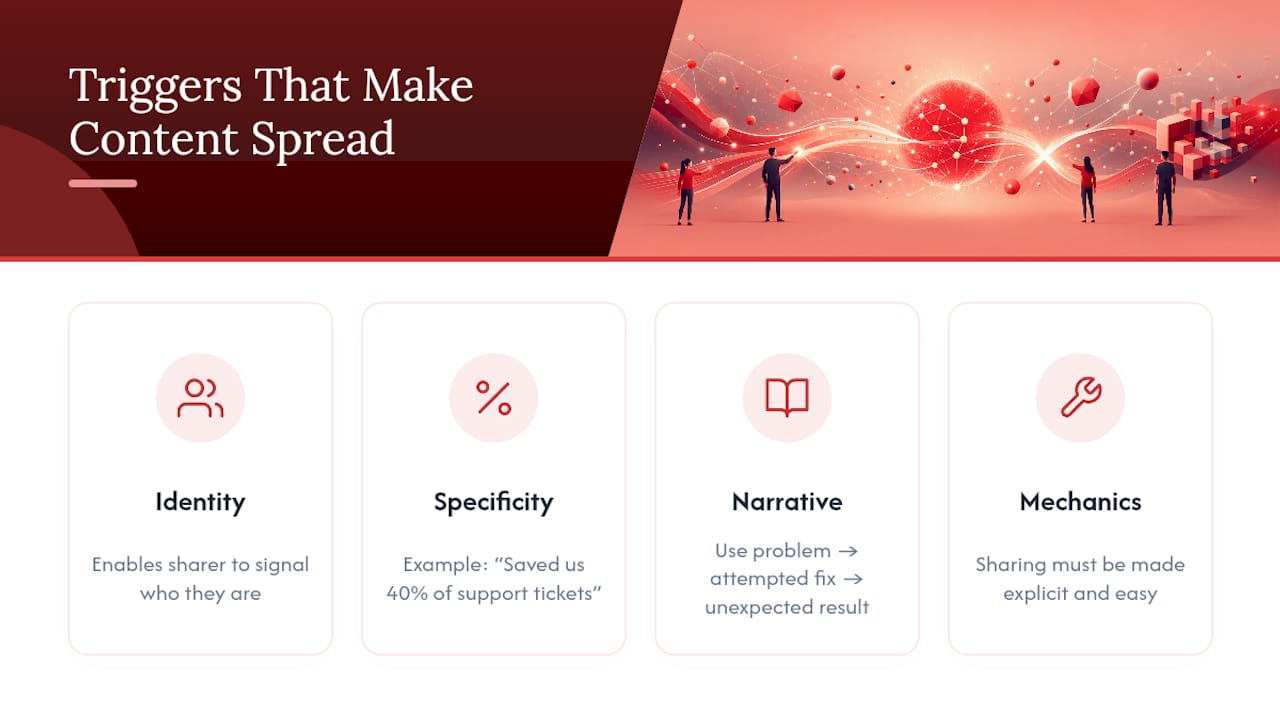
What Psychological Triggers Make Content Spread?
Three triggers show up consistently across launches that move past a first wave and into genuine second and third-degree sharing.
Identity signaling drives more shares than pure information does. People share content that says something about who they are, “I was early to this,” “I understand this technology,” “I care about this cause.” A payload that lets someone signal identity by sharing it will outperform a payload that’s purely informative, even when the information is equally good.
Specificity beats vagueness in every hook test worth running. “This saved us 40% of our support ticket volume” spreads further than “this tool really helped us,” because specificity reads as credible and gives the sharer something concrete to repeat.
Narrative tension works better than a flat announcement. A post structured as problem, attempted fix, unexpected result holds attention longer than “we launched X today,” because it mirrors how people naturally tell stories to each other. The launch thread on X should follow that same arc: set up the problem in the hook, deliver the payload as the resolution, and let the proof element close the loop.
None of these triggers work in isolation from the mechanics already covered. A strong identity-signaling hook still needs a pass mechanic that’s explicit, and narrative tension still needs proof that holds up. The psychology decides whether someone wants to share; the mechanics decide whether sharing is easy enough that they actually do it.
How Should a Viral Launch Fit Into Your Broader Marketing Strategy?
A viral launch works best as an amplifier bolted onto a strategy that already exists, not a replacement for one. Sprout Social’s guidance is direct about this: virality should supplement a scalable social strategy, not substitute for it, and social listening to catch micro-trends early is one of the highest-return moves available, especially for smaller brands trying to participate in a moment before it goes mainstream.
That means a launch needs to connect to existing brand positioning rather than introduce a disconnected voice for one week and disappear. If your account has spent six months building a reputation for technical credibility, a launch hook built on cheap shock value will read as off-brand and can cost more trust than the launch gains in reach.
It also means the post-launch period matters as much as launch day. A spike in followers or signups that isn’t followed by consistent content and community engagement decays fast, often within two to three weeks. Ongoing account management, daily content, replies, and community engagement, is what converts a one-week spike into a sustained audience rather than a temporary bump that reverts to baseline.
Budget and calendar planning should treat the viral launch as one coordinated moment inside a longer content calendar, with pre-launch teaser content, the launch itself, and a defined follow-up cadence for the two weeks after, rather than an isolated event with nothing before or after it.
What Mistakes Sink Most Viral Launch Campaigns?
Three mistakes account for most failed launches, and all three are avoidable with the checklist already covered.
Forcing paid reach behind weak organic signal is the most expensive one. Teams see a post underperforming and respond by throwing ad spend at it instead of iterating the hook. Paid amplification should only ever follow organic proof, never replace it.
Ignoring format fit kills reach before the hook even gets tested. A launch built as a long-form thread when the audience responds to short, visual posts will underperform regardless of how strong the underlying idea is.
Weak or missing measurement is the quiet failure mode. Teams that don’t track share multiplier and sentiment ratio in the first 48 hours can’t tell the difference between a launch that’s building momentum slowly and one that’s already dead, which means they either kill something that was about to take off or keep funding something that never had a chance.
A fourth, less obvious mistake: skipping the post-mortem. Launches that don’t get documented, which hook worked, which creator cohort drove the pass, which proof element got quoted most, force every future launch to start from zero instead of compounding on what already worked.
How Do You Segment and Target Audiences for Viral Content?
Not every audience segment shares for the same reason, and treating them as one undifferentiated group is why generic launch content underperforms even when the product is genuinely good.
Early adopters share to signal that they found something before it was mainstream. Hooks built around exclusivity or being first work best here, and this segment is usually the right target for your initial seed wave.
Practitioners and peers share to demonstrate expertise to their own network. Content with specific technical detail, real numbers, actual screenshots, performs better with this group than polished marketing language.
Skeptics and lurkers rarely share on launch day but often convert weeks later once they’ve seen the product validated by people they trust. This segment is why follow-up content in the two weeks after launch matters as much as the launch itself.
Targeting should map creator selection to these segments directly. Seed accounts with audiences full of early adopters get your first wave; practitioner-heavy accounts get the technical proof content a week later; broader reach accounts get a simplified version once the product has social proof to back it. Running the same message across all three segments wastes the specificity that makes each one actually share.

Knowix Perspective: Common Launch Mistakes and Overlooked Levers
Most launches fail for boring reasons: no format fit, no measurement discipline, and paid spend chasing a hook that never had organic pull. The fix isn’t more budget. It’s calendar-based seeding locked in a week out, modular rights negotiated before launch day, and a hook bank tested in batches instead of shipped on instinct. Nowix has run exactly this system across tech and AI launches on X, coordinating up to 700 creators inside a one-hour window and layering controlled quote-retweets to extend velocity past the first spike. The teams that win treat every launch as a data point for the next one, not a one-off bet.
— Knowix
Run Your Next Viral Launch With Nowix
Building the hook bank, recruiting 50 supporters, coordinating launch-day pings, and running a proper 48-hour post-mortem takes a team that’s done it dozens of times, not a single marketer juggling it alongside everything else. Nowix executes every step of this checklist for tech and AI brands: creator sourcing and vetting, launch-day orchestration across up to 700 creators within a one-hour window, controlled amplification through vetted micro-influencer quote-tweets and comments, and the measurement discipline to know when to scale and when to kill a creative.
Clients get a coordinated launch built on the same mechanics covered here, not a generic content calendar with “post more” as the strategy. If you’re planning a launch and want it engineered instead of improvised, go viral on X with a dedicated timeline takeover campaign, or explore organic post amplification if you already have content that’s showing early signs of life and needs a push past the 1.5x share multiplier threshold. For brands that want the momentum to continue after launch week, ongoing X account management keeps daily content, replies, and community engagement running so the spike turns into sustained growth. Reach out to request a launch estimate and get a plan built around your product’s specific hook and audience.
Sources
- Viral marketing: a 2025 playbook for predictable lift — InfluencerDB
- Okara
- Viral marketing examples and lessons — Shopify
Recommended
- Go Viral on X: The Engineered Playbook for Tech Brand Dominance in 2026
- Engineering the X Viral Launch Strategy: A Practitioner’s Guide for 2026
- X Launch Campaign for Tech Startup: The Engineered Distribution Playbook (2026)
- X Profile Management for Startups: The 2026 Growth Playbook
Frequently asked questions
What should be ready before a brand launch on X?
Prepare the approved announcement, audience, product proof, destination link, publishing owner and follow-up plan. Where creators are involved, confirm the brief and delivery window.
Can a launch plan guarantee a trend or sales?
No. Agree the work and reporting before launch, then measure delivered activity, observed reach and recorded website actions separately.