Tue to Thu 9–11 AM: Tested Times to Post on Twitter for B2B

For B2B accounts, the best time to post on Twitter for B2B is Tuesday through Thursday, 9 to 11 a.m. in your audience’s local time zone, with a secondary lunch window at 12 to 1 p.m. Tech and SaaS brands can stretch that window into the early afternoon. Treat these as starting points, not final answers. Your account’s own analytics will always beat any aggregated study.
TL;DR:
- The optimal posting window for B2B accounts is Tuesday to Thursday, between 9 and 11 a.m. in the audience’s local time zone, with a secondary slot at lunchtime.
- Engagement peaks on Wednesday, with an estimated 17% higher response rate than the weekly average, making it the best single day to focus major content.
- Tech and SaaS brands should extend their posting window into the early afternoon, as their audiences tend to browse more flexibly than other B2B sectors.
- For global audiences, building a staggered schedule with regional anchors is essential, since a single universal hour rarely covers multiple time zones effectively.
- Consistently posting in the recommended windows and seed early replies from trusted contacts significantly boosts immediate engagement and algorithmic visibility.
Table of Contents
- Best Time to Post on X for B2B Accounts and Why It Works
- Day-by-Day: Which Days Actually Move the Needle
- How Tech and SaaS Windows Differ From General B2B
- Why Timing Matters More Than You Think (and Less Than Content Quality)
- How to Test and Validate Your Own Best Posting Times
- What Nowix Sees Running Tech and AI Accounts on X
- Weekly Schedule Templates for B2B Teams
- Impact of Audience Time Zones and Global Reach
- Do Decision-Makers and Influencers Engage at Different Times?
- Case Studies: What Successful B2B Posting Actually Looks Like
- How News Cycles and Industry Events Shift the Best Time to Post
- Why We Test Every Client Instead of Trusting the Averages
- Turn Your Best Posting Window Into Actual Momentum
- Where the Data in This Article Comes From
- Sources
- FAQ
Best Time to Post on X for B2B Accounts and Why It Works
Every major dataset points at the same three hours, even when the studies disagree on the details. Buffer’s analysis of 8.7 million tweets found Tuesday at 9 a.m. as the single strongest slot, with Wednesday at 9 and 10 a.m. close behind. Sprout Social’s dataset leans later, flagging midday through 6 p.m. as the broader engagement window, especially for software brands. Neither study is wrong. They’re measuring different account types across different industries, and B2B lands somewhere in the overlap: strong mid-morning activity that often bleeds into a second peak around lunch.
The behavioral logic behind this is simple. Business audiences check X in bursts tied to their workday, not in one continuous scroll like consumer audiences do on weekends. That produces three predictable moments:
- The commute check (roughly 8 to 9 a.m.): quick scrolling before the workday starts, low engagement depth but decent impressions.
- The mid-morning lull (9 to 11 a.m.): after the first meeting block, before lunch, when professionals actually stop and read.
- The lunch scroll (12 to 1 p.m.): a secondary spike as people eat at their desks and catch up on the feed.
Decision-makers and marketing professionals both show up heaviest in that mid-morning window, which is why it’s the primary target rather than the commute check. The commute slot gets you seen. The 9 to 11 a.m. slot gets you read, replied to, and quote-tweeted.
If you’re setting up a schedule for the first time, don’t spread your posts evenly across the day hoping to catch everyone. Front-load your most important content, launch announcements, product news, thought-leadership threads, into that primary window. Save lighter, low-stakes content (polls, quick reactions, community replies) for the lunch spike, where attention is real but shorter.
One nuance worth flagging: this pattern assumes your audience clusters in a single time zone or a tight band of them. If your followers are split across North America, Europe, and Asia Pacific, a single “best hour” doesn’t exist. You’ll need to layer your schedule by region, which the time zone section below covers in more detail.
The practical takeaway for anyone building a Twitter content calendar is to treat 9 to 11 a.m. Tuesday through Thursday as your default anchor, then build outward from there once your own data starts talking back.
Day-by-Day: Which Days Actually Move the Needle
Not every weekday earns equal weight, and treating Monday the same as Wednesday is one of the more common scheduling mistakes B2B teams make. Here’s how the week actually breaks down.
- Monday: ramp-up, not peak. Professionals spend Monday morning triaging inboxes and catching up from the weekend, so engagement is present but muted. Post in the morning window anyway to establish presence, but keep expectations modest and save your best content for later in the week.
- Tuesday: the workhorse day. Tuesday consistently ranks near the top across studies, with 9 a.m. showing up repeatedly as a peak slot. This is a strong day for announcements, product launches, and anything you want maximum eyes on early.
- Wednesday: the strongest single day. Outfeed AI’s synthesis of aggregated studies places Wednesday at the top of the week, with some tracking showing roughly a 17% engagement lift over the weekly average. If you only have bandwidth to test one day intensively, make it Wednesday.
- Thursday: still peak territory. Thursday closes out the Tuesday through Thursday trio that dominates nearly every B2B-focused study. Engagement holds steady, though it starts to soften slightly compared to Wednesday.
- Friday: front-load early. Attention drifts by midday as people mentally clock out for the week. Post your primary content in the early morning window and treat the afternoon as low-value real estate for anything requiring a response.
- Weekend: generally weak, with one exception. Saturday and Sunday post volume from B2B accounts drops off, and so does audience attention. The one documented pocket worth testing is Sunday afternoon, roughly 3 to 5 p.m., when some practitioners report an underserved window for long-form threads read by professionals easing back into work mode.
The pattern that matters most here isn’t any single day. It’s the trio. Tuesday, Wednesday, and Thursday consistently outperform the rest of the week across independent datasets, which makes them the natural home for your highest-priority content, product announcements, funding news, major thread drops, while Monday and Friday absorb your lower-stakes posts.
How Tech and SaaS Windows Differ From General B2B
Software audiences don’t clock out mentally at 11 a.m. the way many other B2B verticals do, and that changes the shape of the posting window.
Eclincher’s breakdown of B2B and SaaS engagement shows the standard 9 to 11 a.m. window holding steady, but with a longer tail than general B2B accounts see. Sprout Social’s industry tables back this up, showing software audiences maintaining meaningful engagement well into the afternoon on Tuesday through Thursday, often stretching to 4 p.m. Developers, founders, and product managers tend to browse X in longer, less scheduled bursts than sales or marketing professionals, which spreads their attention across a wider slice of the day.
That extended window changes what you should post and when:
- Product updates and changelogs perform well in the early afternoon slot, when developers are between focus blocks and scanning for what shipped.
- Technical threads benefit from the 11 a.m. to 4 p.m. stretch, since they require more reading time than a quick morning scroll allows.
- Founder-voice content (opinions, build-in-public updates) tends to land anytime in the extended window because founders themselves are often the ones scrolling then, not just consuming on a fixed schedule.
If you’re running a tech or AI brand account, don’t compress your best content into the same tight 9 to 11 a.m. box a traditional B2B services company would use. Test a second content block in the early afternoon and compare its performance against your morning slot before assuming the general rule applies to you unchanged.
Why Timing Matters More Than You Think (and Less Than Content Quality)
X’s feed still rewards recency and early velocity, which is the mechanical reason timing matters at all. A post that gets replies, retweets, and likes within its first 20 to 30 minutes signals the algorithm to keep showing it, both to your existing followers and into wider discovery feeds. Miss that early window with no engagement, and even a well-written post can sink before most of your audience ever sees it.
Format compounds this effect. Text-first posts and threads tend to hold attention on the platform longer than link-first posts, which push people off X immediately and reduce the signals that reward reach. If a post needs to point somewhere external, put the link in the first reply rather than the main tweet body. It’s a small structural change with an outsized effect on how far the original post travels.
None of this replaces the actual substance of what you post. Timing is a multiplier on content that’s already worth engaging with, not a fix for content that isn’t. A mediocre announcement posted at the “perfect” hour still underperforms a sharp, specific thread posted at a mediocre hour. Get the content right first, then use timing to extend its reach.
Pro Tip: Seed two or three replies from teammates or trusted contacts within the first ten minutes of posting. Early replies signal activity to the algorithm and often outperform waiting passively for organic engagement to build.
How to Test and Validate Your Own Best Posting Times
Aggregated studies tell you where to start. Your own account data tells you where to stay. Here’s a test plan that produces a real answer instead of a guess.
- Pick three candidate windows based on the general guidance above, for example, Tuesday 9 a.m., Wednesday 1 p.m., and Thursday 3 p.m. Keep the content type matched across all three so you’re testing timing, not creative quality.
- Run the test for at least two to four weeks. A single week isn’t enough sample size to separate a real pattern from noise, especially if a single viral post skews one window.
- Track first-hour reply velocity alongside standard metrics. How many replies and retweets a post earns in its first 60 minutes is often a better early predictor of total reach than raw impression count.
- Compare engagement rate per impression, not just raw totals. A window with fewer impressions but a higher engagement rate is often the better long-term slot, since it signals a more attentive audience rather than a passing scroll.
- Watch follower growth and click-through rate as secondary indicators. These move slower than engagement rate, but they confirm whether a window is attracting the right audience, not just a busier one.
For teams with a global audience, run this test separately for each major region rather than assuming one time zone’s winning window applies everywhere. Sprout Social’s guidance on time-zone layering recommends anchoring posts to regional business hours rather than chasing a single global peak hour, which almost never exists for accounts with meaningfully split audiences.
Roughly 8.7 million tweets went into Buffer’s dataset, and even at that scale, the study still frames its findings as a starting range rather than a fixed rule, which tells you something about how much account-level variance exists even within a single industry.
Once you have four weeks of data, lock in your top-performing window as your default and keep testing a single new variable at a time, cadence, format, or a shifted hour, rather than overhauling your whole schedule at once.
What Nowix Sees Running Tech and AI Accounts on X
Running launch campaigns and ongoing account management for tech and AI brands gives Nowix a narrower, noisier dataset than the big aggregate studies, but a more actionable one. Our starting points align closely with the broader research: Tuesday through Thursday mornings as the anchor, with a second daily slot in the afternoon for tech accounts specifically. On accounts running active content calendars, we typically recommend three to five posts per day, spaced to avoid crowding the same audience segment twice in one scroll session.
The single tactic that moves first-hour numbers the most is reply-first amplification: seeding early replies from brand-aligned accounts within 10 to 20 minutes of a post going live. This isn’t about faking engagement. It’s about giving the algorithm an early signal before your organic audience has had time to find the post on its own.
Threads built around a single clear claim, backed by one or two receipts, consistently outperform threads that try to cover too much ground. Our reply-first strategy guide breaks down the sequencing in more detail for teams building out their own cadence.
Weekly Schedule Templates for B2B Teams
Your posting frequency should scale with your team’s capacity to actually engage with what you publish, not just with how many posts you can schedule.
Small team (1 to 2 people managing X part-time): One to two posts per day, anchored to the Tuesday through Thursday 9 to 11 a.m. window. Use the lunch slot for a lighter reply or repost rather than new content. Consistency matters more than volume here, so pick a fixed time and hold it for at least a month before adjusting.
Medium team (a dedicated social lead plus support): Three to four posts per day, split between the primary morning window and an early afternoon slot for tech and SaaS audiences. Pair major announcements with the Tuesday or Wednesday morning window specifically, and use Thursday afternoon for threads or product deep-dives.
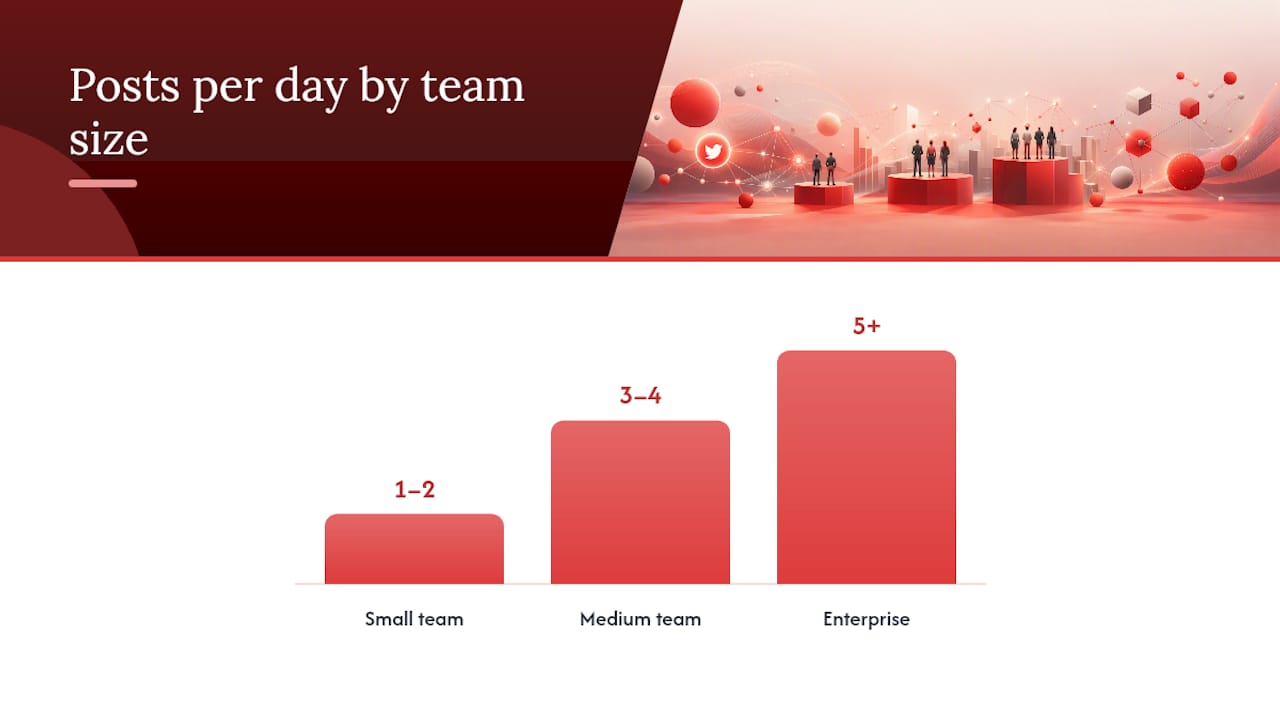
Enterprise (a full content and community function): Five or more posts per day across time zones, with regional anchors for each major market rather than a single global schedule. This tier can support real-time reply management and same-day amplification around news cycles, which smaller teams typically can’t sustain.
Matching content type to time slot matters as much as the slot itself:
- Announcements and launches belong in the primary Tuesday through Thursday morning window, when reply velocity potential is highest.
- Threads and technical deep-dives perform better at lunch or in the tech-specific afternoon window, when readers have more time to engage.
- Community replies and lighter content can fill gaps throughout the day without needing a premium slot.
| Team size | Posts per day | Primary window use |
|---|---|---|
| Small | 1 to 2 | Announcements only, Tue to Thu mornings |
| Medium | 3 to 4 | Announcements AM, threads at lunch/PM |
| Enterprise | 5+ | Regional anchors, real-time reply coverage |
Scale cadence gradually. Jumping from one post a day to five overnight usually dilutes engagement per post before it builds momentum, since your existing audience hasn’t adjusted to seeing you that often yet.
Impact of Audience Time Zones and Global Reach
A single “best time” breaks down fast once your following spans multiple regions, which is common for tech and AI brands with customers in North America, Europe, and Asia Pacific simultaneously. Posting at 9 a.m. Eastern hits your U.S. audience perfectly while landing in the middle of the European evening and the dead of night in most of Asia.
The fix isn’t finding a magic universal hour. It’s building a staggered schedule with regional anchors, posting your primary content once for each major time zone cluster rather than once globally. A B2B account split evenly between the U.S. and Europe might run its main announcement at 9 a.m. Eastern and a second, complementary post at 9 a.m. Central European Time rather than trying to force one post to serve both audiences.
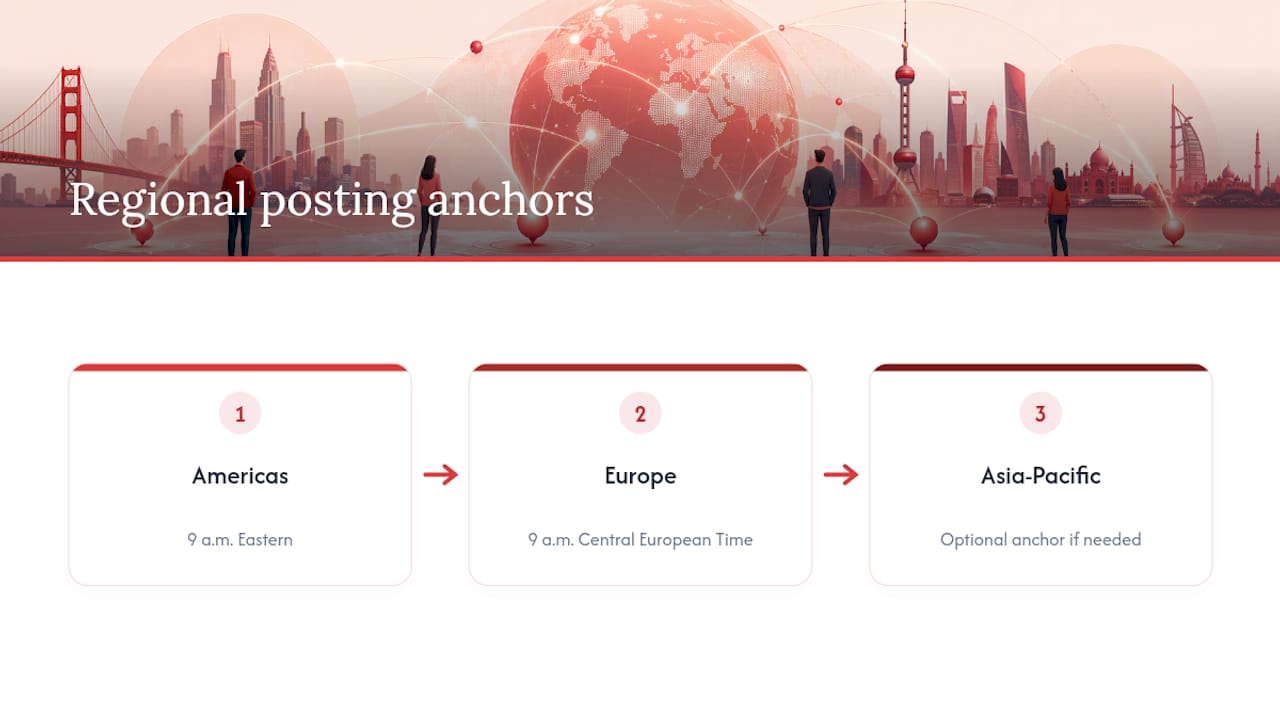
This requires knowing your actual audience distribution, not guessing at it. Your platform’s native analytics or a dashboard tool can show where your followers are concentrated, which tells you how many regional anchors you actually need versus how many would be overkill for a smaller international footprint.
For most B2B accounts, two anchors, one for the Americas and one for Europe or Asia Pacific depending on where the audience skews, cover the bulk of the opportunity without fragmenting your team’s bandwidth into an unmanageable posting schedule.
Do Decision-Makers and Influencers Engage at Different Times?
Not every follower behaves the same way on X, and lumping “B2B audience” into one bucket misses a real distinction between the people who buy your product and the people who talk about it.
Decision-makers, VPs, directors, and founders evaluating a purchase, tend to browse X in short, focused bursts tied tightly to their calendar: before their first meeting, during a lunch break, or in a brief wind-down window at the end of the day. They’re less likely to be scrolling casually and more likely to click through when something directly relevant catches their eye, which makes the primary 9 to 11 a.m. window especially valuable for content aimed squarely at them, product proof points, case studies, credibility signals.
Influencers and industry commentators, by contrast, often keep X open longer throughout the day as part of their actual job. They’re more likely to catch content in the early afternoon or evening, and they’re the audience most likely to quote-tweet or reply in ways that extend a post’s reach beyond your existing followers.
Practically, this means your highest-conversion content, anything aimed at a buying decision, should target the tight morning window when decision-makers are actually looking. Content designed to spread, threads, hot takes, industry commentary, has more room to succeed later in the day when the commentator crowd is more active. Treating both audiences identically wastes the natural rhythm each one runs on.
Case Studies: What Successful B2B Posting Actually Looks Like
The clearest pattern across successful B2B accounts isn’t a single magic hour. It’s disciplined repetition of a window that works, paired with format choices that keep people on the platform.
Accounts that consistently post technical threads in the Tuesday through Thursday morning window, then reinforce them with a lunchtime follow-up post, tend to build compounding reach over weeks rather than relying on any single viral moment. The mechanism is straightforward: showing up reliably at the same time trains a portion of your audience to check for you then, which raises the baseline number of people who see each post within its critical first hour.
Launch-day campaigns tell a slightly different story. Rather than relying purely on organic timing, successful tech and AI launches often combine a well-timed primary post, Tuesday or Wednesday morning, with coordinated early engagement from a network of aligned accounts. That early velocity boost is what separates a launch that trends within its first hour from one that quietly appears and fades. Nowix’s own viral launch campaigns are built around exactly this mechanic: pairing the right time window with a controlled wave of early replies and quote-tweets from vetted creators.
The common thread across these examples isn’t luck. It’s a repeatable structure: pick a window backed by data, hold it consistently, and stack extra engagement into the first hour whenever a post carries extra weight, a launch, a funding announcement, a major product shift.
How News Cycles and Industry Events Shift the Best Time to Post
Fixed schedules are a starting point, not a cage, and the biggest exception to any “best time” rule is a live news cycle relevant to your industry.
When major industry news breaks, a funding round in your sector, a competitor’s announcement, a widely discussed AI development, attention on X spikes immediately and temporarily overrides the normal daily rhythm. Posting into that moment, even outside your usual window, can outperform a perfectly timed post on a quiet news day, because the volume of people actively scrolling and discussing is simply higher.
Industry calendars matter too. Major conferences, product launch seasons, and recurring events like end-of-quarter earnings weeks create predictable windows of heightened attention within your specific vertical. A SaaS account posting during a week when a major industry conference is trending will likely see better reach on relevant content than the same post published during an ordinary week, simply because more of the right people are already paying closer attention to that topic.
The practical adjustment is to keep your standard schedule as the default, but build in flexibility to post ahead of schedule or add an extra post when something directly relevant to your audience is actively breaking. Treat your tested time windows as the plan for a normal week, not a rule that overrides genuine, timely relevance.
Why We Test Every Client Instead of Trusting the Averages
Wednesday mornings are where we start almost every new account, because the aggregated data points there most consistently. But we’ve had tech clients whose real audience peaked on Thursday afternoon instead, and no amount of study data would have caught that without running the actual test.
The harder trade-off clients face is resourcing. Daily posting builds the compounding reach that makes future amplification campaigns land better, but it competes for the same team bandwidth that a big launch push needs. Accounts that treat daily cadence and amplification as separate budgets, rather than borrowing from one to fund the other, tend to see steadier growth on both fronts.
If you take one thing from all of this, prioritize content built to spark a reply over content built to look polished. A post that gets three genuine replies in its first ten minutes will usually outperform a beautifully designed graphic posted at the “perfect” hour with nothing to react to.
— Knowix
Turn Your Best Posting Window Into Actual Momentum
Knowing your optimal window solves half the problem. Sustaining daily posts, replies, and community management at that cadence, or coordinating a launch-day surge of early engagement, is where most in-house teams run out of bandwidth.

Some agencies run both sides of that equation for tech and AI brands. If you’re launching something and need early velocity fast, post amplification puts controlled quote-tweets and comments from vetted micro-influencers into your first-hour window, the exact mechanic that separates a post that trends from one that quietly disappears. If your challenge is sustaining a daily schedule, X management hands your account’s strategy, content, and replies to practitioners who already test these windows for a living. Either way, you’re not guessing at the next test cycle. Reach out for a consult and tell us whether you’re planning a launch or need ongoing management, and we’ll map the right service to your timeline.
Where the Data in This Article Comes From
For deeper testing, go straight to the sources. Sprout Social’s 2026 dataset covers broad midday and afternoon patterns with industry-specific tables. Buffer’s analysis of millions of tweets backs the mid-morning window. Outfeed AI’s synthesis reconciles both into a practical day-by-day table worth bookmarking. For scheduling execution, tools like Gleanit can help track cross-channel performance once your test is running.
Sources
- Best Times to Post on Twitter (X) in 2026 Updated
- Best Time to Post on Twitter/X (2026)
- Best Time to Post on Twitter / X (2026 Day-by-Day Data) | Outfeed AI
- Best Time to Post on X (Twitter) for B2B & SaaS Companies (2026) | Eclincher
FAQ
What Is the Most Optimal Time to Post on Twitter for B2B?
Tuesday through Thursday between 9 and 11 a.m. in your audience’s local time zone, with a secondary spike at 12 to 1 p.m. Wednesday tends to be the single strongest day across aggregated studies.
What Is the 5-3-1 Rule on Social Media?
The 5-3-1 rule suggests a weekly content mix: five pieces of curated or third-party content, three original posts, and one promotional post, aimed at keeping a feed balanced rather than overly self-promotional.
What Is the 5-5-5 Rule for Social Media?
Definitions vary depending on the source, but a common version suggests spending five minutes engaging with others’ content, five minutes checking analytics, and five minutes creating or scheduling your own posts as a quick daily social media routine.
What Are Peak Posting Hours on X for Business Accounts?
Peak hours cluster around 9 to 11 a.m. and 12 to 1 p.m. on Tuesday, Wednesday, and Thursday, with tech and SaaS accounts often holding steady engagement into the early afternoon.
Does Posting Frequency Affect the Best Time to Post?
Yes. Accounts posting three to five times a day should spread their highest-priority content across the primary morning window and a secondary afternoon slot rather than clustering everything into one hour, which risks audience fatigue and diminishing returns per post.