
For U.S. audiences, the best time to post on Twitter in 2026 is Tuesday through Thursday, 9–11 AM local time, with a secondary spike at 12–1 PM. Outfeed AI’s synthesis of multiple 2026 studies confirms Wednesday as the strongest single day, running roughly 17% above the weekly engagement average. Sprout Social’s analysis of ~2 billion engagements across 307,000 profiles adds a complementary finding: the 12–6 PM window on those same three days drives strong afternoon reach. The morning data and the afternoon data are not in conflict. They reflect different metrics: early-velocity studies capture likes and reposts in the first 30 minutes, while reach-focused studies like Sprout Social’s weight total impressions across the day. Both windows are worth owning.
Your micro-action this week: Schedule one tweet for Wednesday at 9 AM ET and one for Wednesday at 12:30 PM ET. Run both for two weeks, then compare first-30-minute engagement rates. That single experiment gives you a real baseline faster than any general guide can.
- Best days: Tuesday, Wednesday, Thursday
- Primary window: 9–11 AM local time
- Secondary window: 12–1 PM local time
- Weakest day: Sunday
- Strongest single slot: Wednesday, 9 AM ET
Pro Tip: Set your scheduler to post at 9:00 AM ET on Wednesday first. That slot consistently surfaces as the top performer across TendX, Outfeed AI, and OpenTweet’s 2026 datasets — it’s the lowest-risk starting point for any new account.
Key Takeaways
The best time to post on Twitter in 2026 for U.S. audiences is Tuesday through Thursday, 9–11 AM local time, with Wednesday at 9 AM ET as the single highest-engagement slot across multiple 2026 datasets.
| Point | Details |
|---|---|
| Best days and windows | Post Tuesday–Thursday, 9–11 AM local time; secondary spike at 12–1 PM. |
| Wednesday is the top slot | Wednesday at 9 AM ET runs roughly 17% above the weekly engagement average in aggregated 2026 studies. |
| Daily cadence beats sporadic posting | Accounts posting daily see materially higher engagement than sporadic posters per OpenTweet’s 2026 dataset. |
| Test your own account | Run a 2–4 week A/B test across two candidate windows with at least 300 impressions per slot before deciding. |
| Nowix for coordinated launches | Nowix deploys up to 700 creators within a 1-hour window to maximize early velocity at your chosen launch slot. |
Table of Contents
- How do timing studies actually calculate the “best time to post”?
- What’s the best time to post on Twitter in 2026, day by day?
- How do optimal posting windows shift by industry?
- How do you schedule posts across U.S. time zones?
- How do you find the best posting time for your specific account?
- How does X’s 2026 algorithm interact with your posting time?
- Which tools help you schedule and test posting times?
- How coordinated amplification changes the timing playbook
- Timing matters — but amplification is the multiplier
- Nowix puts this timing playbook into practice
- Sources
How do timing studies actually calculate the “best time to post”?
Not all timing studies are equal, and the differences matter. Before you apply any dataset’s recommendation to your account, check four things: sample size, date range, the engagement metric used, and whether times were normalized to the audience’s local time zone.
Sprout Social’s 2026 dataset draws on approximately 2 billion engagements across 307,000 profiles globally. That scale makes it reliable for broad patterns but less precise for a niche B2B tech audience in the U.S. Midwest. OpenTweet’s 2026 study analyzed 50,000+ scheduled tweets from January through April 2026, a smaller but more recent and U.S.-weighted sample. Trends In Social Media aggregates multiple 2026 datasets and consistently surfaces 8–10 AM and 12–1 PM as the highest-engagement windows across studies.
The most common reason two studies disagree: one measures engagement velocity (likes, reposts, replies in the first 15–30 minutes) while the other measures total engagement over 24 hours. A tweet posted at 9 AM ET may win on velocity; a tweet posted at 2 PM ET may accumulate more total reach by midnight. Neither is wrong. They answer different questions.
| Attribute to check | What to look for |
|---|---|
| Sample size | 50,000+ posts preferred |
| Date range | 2026 data; avoid studies older than one year |
| Engagement metric | Specify velocity (first 30 min) vs. total engagement |
| Account mix | Industry breakdown or U.S.-only filter noted |
| Time normalization | Times listed in audience local time, not UTC |
Pro Tip: When a study lists times in UTC without converting, add 5 hours for ET and 8 hours for PT. A “2 PM UTC peak” is actually 9 AM ET — which explains why morning windows dominate U.S.-centric studies.
Statista’s age-distribution data for global Twitter users helps explain one more variable: audience demographics. Professional-skewing cohorts are more active during weekday work hours, which is why B2B brands consistently see stronger weekday morning performance than B2C entertainment accounts.
What’s the best time to post on Twitter in 2026, day by day?
Use this as your starting hypothesis. Plug these windows into your scheduler, run them for two to four weeks, then adjust based on your own data.
- Monday: 9–10 AM. Moderate strength. Audiences are re-engaging after the weekend, but attention is split across email and meetings. Good for news-adjacent content or quick takes.
- Wednesday: 9–11 AM and 12–1 PM. Best day. TendX identifies Wednesday at 9 AM ET as the single highest-engagement slot across 2026 data. Outfeed AI’s aggregated studies put Wednesday at roughly 17% above the weekly average. Post your most important content here.
- Thursday: 9–11 AM and 12–1 PM. Strong. Nearly as consistent as Wednesday. Good for threads and longer-form content since audiences have more reading bandwidth mid-commute and at lunch.
- Friday: 8–10 AM. Moderate. Engagement drops off after noon as attention shifts to weekend mode. Front-load your Friday posts.
- Saturday: 10 AM–12 PM. Weak for B2B. Casual browsing only. Reserve for community content, polls, or lighter brand personality posts.
Starting cadence: 3–5 tweets per day, spread across the morning window (9–10 AM), the lunch window (12–1 PM), and an optional late-afternoon slot (4–5 PM). Never stack two tweets within 30 minutes of each other. Spacing preserves each post’s individual velocity window.
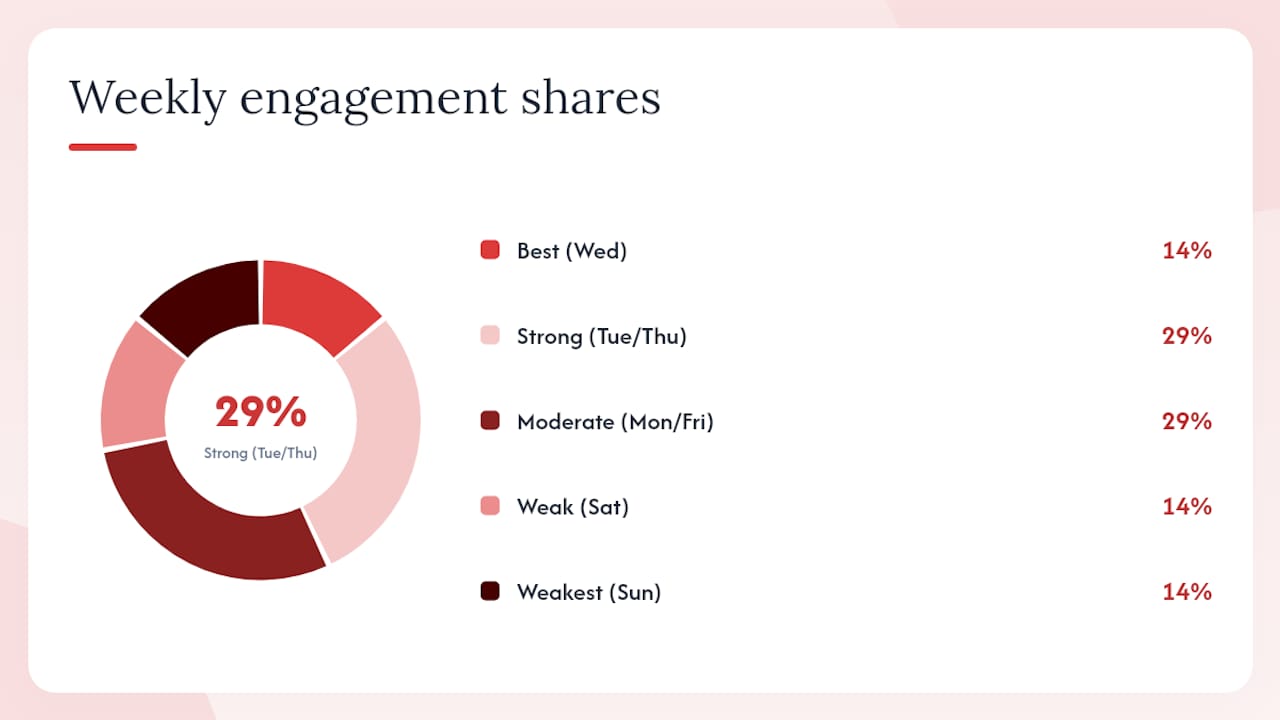
| Day | Best window (local time) | Relative strength |
|---|---|---|
| Monday | 9–10 AM | Moderate |
| Tuesday | 9–11 AM, 12–1 PM | Strong |
| Wednesday | 9–11 AM, 12–1 PM | Best |
| Thursday | 9–11 AM, 12–1 PM | Strong |
| Friday | 8–10 AM | Moderate |
| Saturday | 10 AM–12 PM | Weak |
| Sunday | Avoid | Weakest |
How do optimal posting windows shift by industry?
The baseline Tue–Thu morning schedule works for most accounts. But your audience’s daily routine determines when they actually open X, and that varies by vertical.
B2B tech
Post at 8–10 AM on Tuesday through Thursday for single tweets and short updates. Engineers and product managers check X before their first standup. A secondary window at 3–4 PM catches the post-meeting scroll. Avoid anything after 6 PM on weekdays; this audience logs off early.
Finance and education
Weekday mornings (8–10 AM) and the 12–1 PM lunch window are your primary slots. Finance audiences scan market commentary before the opening bell; education professionals check feeds during planning periods. Late evenings underperform for both verticals. Threads work well at lunch for this audience since they have time to read.
E-commerce and media (B2C)
Midday (12–2 PM) and early evening (6–9 PM) are your primary windows. Consumers browse during lunch and again after dinner. Promotional posts and product announcements perform best at 12 PM or 7 PM. Entertainment content can extend into Saturday mornings, where B2B brands would pull back. For music and entertainment releases specifically, event-driven scheduling around album and content drop timing follows similar logic: front-load the announcement in the morning, then amplify through the afternoon.
- B2B tech: 8–10 AM weekdays for updates; 3–4 PM for discussion threads
- Finance/education: 8–10 AM and 12–1 PM weekdays; avoid evenings
- E-commerce/media: 12–2 PM and 6–9 PM; Saturday mornings viable
- General brand: Tue–Thu 9–11 AM as the default starting point
How do you schedule posts across U.S. time zones?
The U.S. spans four major time zones: ET, CT, MT, and PT. A post at 9 AM ET lands at 6 AM PT, which is too early for a West Coast audience. A post at 9 AM PT hits at noon ET, which is solid but misses the morning velocity window for East Coast followers.
For most U.S.-focused brands, post at 9 AM ET. That covers the East Coast morning peak and reaches Central at 8 AM (still strong). Mountain and Pacific audiences see it at 7 AM and 6 AM respectively — early, but not invisible. The lunch post at 12 PM ET lands at 9 AM PT, which is actually a second morning hit for West Coast followers.
If your audience is split roughly evenly across all four zones, consider two posts per day:
- 9 AM ET (primary morning post, optimized for East and Central)
- 12 PM PT / 3 PM ET (secondary post, optimized for West Coast morning and East Coast afternoon)
For global audiences, the math gets more complex. Use your scheduler’s audience location data before you commit to a fixed window. Twitter audience targeting tools can surface where your followers are concentrated so you’re not guessing.
- Never post duplicate content within the same 24-hour window on the same account. Stagger by at least 3 hours and vary the copy.
- For multi-timezone campaigns, use a scheduling tool that lets you set time-zone-specific delivery rather than a single UTC timestamp.
- If your top 20% of followers are in one time zone, anchor your primary post to that zone and treat others as secondary.
Pro Tip: Check your X Analytics “Audience” tab monthly. Follower geography shifts as you grow, and a window optimized for your current audience may drift out of sync within a quarter.
How do you find the best posting time for your specific account?
General data gives you a starting hypothesis. Your own account’s data gives you the answer. Here’s the testing plan.
- Define your goal. Pick one KPI: first-30-minute engagement rate, reach, or click-through rate. Testing multiple KPIs at once muddies the results.
- Select two candidate windows. Start with Wednesday 9 AM ET vs. Wednesday 12:30 PM ET. These are the two most-cited peaks across 2026 studies.
- Run randomized posts across both slots for 2–4 weeks. Alternate which slot gets your “A” content each week to control for content quality. Aim for at least 300 impressions per slot before drawing conclusions.
- Measure engagement velocity. Pull data from X Analytics at the 30-minute mark after each post. Log it in a spreadsheet: slot, post type, impressions at 30 min, likes, reposts, replies.
- Identify the winner. After 2–4 weeks, the slot with consistently higher 30-minute engagement rate is your primary window. Shift 60% of your posts there.
- Retest after any major campaign or audience shift. A viral post, a product launch, or a follower spike can change your audience composition enough to invalidate your previous baseline.
For benchmarks, use Twitter engagement rate data for 2026 to contextualize whether your results are above or below average for your category.
- Minimum test duration: 2 weeks for accounts posting daily; 4 weeks for accounts posting 3x per week
- Minimum impressions per slot: 300 per slot before comparing
- KPIs to track: first-30-minute engagement rate, reach, CTR (for link posts), thread completion rate (for multi-tweet content)
Pro Tip: Noisy results usually mean your content quality is too variable across slots. Before concluding that a time window doesn’t work, check whether your underperforming posts were also weaker in copy or creative. Isolate timing from content quality by using near-identical post formats in your test.
How does X’s 2026 algorithm interact with your posting time?
Timing is a distribution lever, not a content substitute. X’s 2026 algorithm still weights recency and early velocity as primary signals. A tweet that earns strong engagement in its first 15–30 minutes gets pushed into more For You feeds. That means the window you post in directly affects how much organic reach the algorithm grants you, independent of your follower count.
Format interacts with timing in a specific way. Single tweets and image posts perform best in the morning velocity window (9–11 AM) when users are scanning quickly. Threads perform better during lunch and commute windows because readers have more time to follow a multi-tweet sequence. Video posts can extend into the early evening (6–8 PM) when passive consumption rises.
Practical tactics for 2026:
- Post 3–5 times per day. Accounts posting daily see materially higher engagement than sporadic posters, according to OpenTweet’s 2026 dataset.
- Space tweets at least 90 minutes apart to avoid cannibalizing each other’s velocity windows.
- Reuse high-performing tweets after 30 days with updated copy. The algorithm treats them as new content.
- Pin your best-performing tweet to your profile during a campaign window to capture cross-window exposure from profile visitors.
- For thread ideas that drive engagement, schedule the first tweet of the thread at 12 PM ET on Tuesday or Thursday, when thread completion rates peak.
Which tools help you schedule and test posting times?
The right tool depends on whether you need basic scheduling, A/B testing, or full analytics. Here’s what each option actually does for timing work.
X (Twitter) Analytics (native) Free and always current. Use it to check your top posts by engagement, see your audience’s active hours, and pull 30-day engagement summaries. It doesn’t offer A/B testing or scheduling, but it’s the ground truth for your account’s performance. Keep it in the loop even when you’re using a third-party tool — no scheduler’s reporting is more accurate than the platform’s own data.
Buffer Clean scheduling interface with time-zone support and a “best time to post” suggestion feature based on your account’s historical data. Good for teams that need a simple calendar view and want to schedule a week of posts in under 20 minutes. Buffer’s analytics show engagement by post but don’t break out first-30-minute velocity natively.
Sprout Social The most analytics-heavy option in this group. Sprout’s “ViralPost” feature calculates optimal send times based on your specific audience’s engagement history, not just global averages. Its reporting lets you compare engagement across time slots at a granular level. Best for teams running formal A/B tests who need exportable data.
RecurPost Built for content recycling and consistent cadence. RecurPost lets you build content libraries and automatically recycle evergreen posts at scheduled intervals. Useful for the “reuse high-performing tweets after 30 days” tactic. Its time-zone handling is straightforward, and it supports multiple X accounts from one dashboard.
- Start with X Analytics to establish your baseline before spending on any tool.
- Add Buffer if you need a simple scheduler with time-zone support and a team calendar.
- Upgrade to Sprout Social when you’re ready to run formal slot-comparison tests with exportable velocity data.
- Use RecurPost alongside any of the above when content recycling and cadence consistency are priorities.
For a full Twitter content calendar strategy that maps these tools to a weekly posting plan, Nowix’s guide walks through the scheduling setup in detail.
How coordinated amplification changes the timing playbook
Organic timing optimization assumes your posts live or die on their own velocity. Coordinated amplification changes that math entirely. When multiple creators post, quote-retweet, or comment within a defined window, the early-velocity signal the algorithm reads is multiplied, not added.
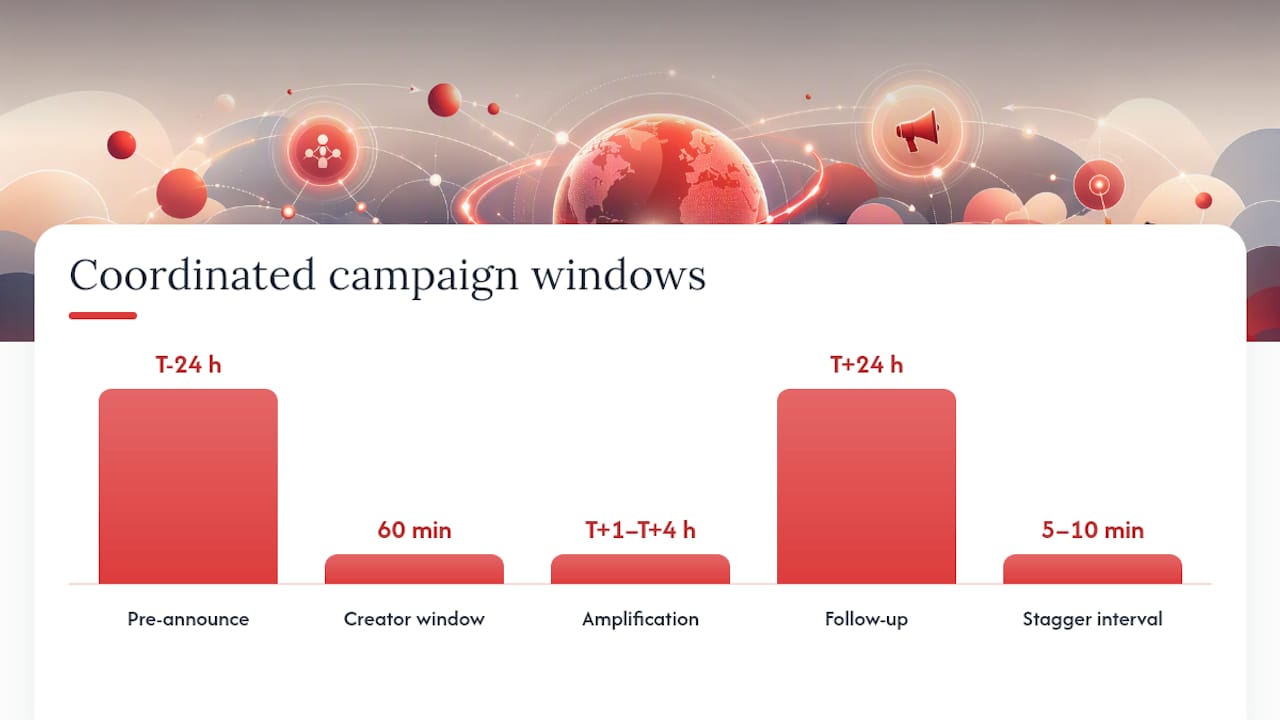
For a coordinated launch campaign, the timing structure looks like this:
- Pre-announce window (T-24 hours): Seed the conversation with 2–3 teaser posts from the brand account. Post at 9 AM ET the day before launch.
- Creator posting window (T=0, within 60 minutes): All creator posts go live within a 1-hour window at the launch time. Wednesday 9–10 AM ET is the highest-leverage slot for this.
- Amplification window (T+1 to T+4 hours): Quote-retweets and replies from micro-KOLs extend the velocity signal through the morning into the lunch window.
- Follow-up cadence (T+24 hours): Brand account posts a results or reaction tweet to capture the second-day audience.
- Coordinated campaigns require a creator brief that specifies exact posting windows, not just dates.
- Stagger creator posts by 5–10 minutes within the launch window to avoid simultaneous posting flags.
- Avoid repetitive automated posting patterns and identical copy across accounts — Multilogin’s 2026 guidance on shadowbans flags this as a primary enforcement trigger.
- Ethical amplification means every creator post reflects genuine opinion or commentary, not copy-pasted brand language.
Pro Tip: For a launch campaign, the creator window matters more than the brand account’s posting time. If your creators are posting at 9 AM ET with strong early engagement, the brand account’s post can follow at 9:15 AM and still ride the velocity wave rather than competing with it.
For a full checklist on structuring a launch campaign around these windows, the startup viral campaign checklist covers the pre-launch, launch, and amplification phases in sequence.
Timing matters — but amplification is the multiplier
Timing is the floor, not the ceiling. You can post at the perfect window and still get buried if your content has no early-velocity signal behind it. The brands that consistently trend on X aren’t just posting at 9 AM on Wednesday. They’re coordinating a creator wave that hits the algorithm with enough simultaneous engagement to force distribution.
That’s the gap most timing guides miss. They treat posting time as the primary variable when, for a tech or AI brand trying to launch something, the primary variable is how many credible voices are amplifying that post in the first hour. Timing sets the stage. Coordinated amplification fills the seats.
The practical implication: if your account has fewer than 5,000 engaged followers, optimizing your posting window will produce incremental gains. A well-timed post from a small account still reaches a small audience. The faster path to meaningful reach is pairing good timing with coordinated amplification from vetted micro-KOLs who already have your target audience’s attention.
Test your windows. Build your baseline. Then, when you have something worth launching, don’t rely on organic timing alone.
Nowix puts this timing playbook into practice
Timing data tells you when to post. Nowix executes the campaign that makes that window count. For tech and AI brands that need more than a scheduler, Nowix runs three services that map directly to what this guide covers:

- Go Viral on X: Coordinated launch campaigns with up to 700 creators deployed within a 1-hour window. Your launch hits the algorithm with maximum early velocity at the exact slot the data supports.
- Amplify Your Reach: Post amplification through controlled quote-retweets and comments from vetted micro-KOLs. Turns a well-timed post into a trending signal.
- X Management: Full account management including daily content, replies, and community engagement. Your posting cadence stays consistent without you managing a scheduler.
If you’re ready to move from testing windows to owning them, book a campaign assessment with Nowix and get a timing and amplification plan built for your launch.
Sources
- Best Time to Post on X (Twitter) in 2026: Day-by-Day Data | tendX
- Best Time to Post on X (Twitter) in 2026: Data-Backed Guide for Maximum Engagement - Trends In Social Media
- Twitter shadowbans in 2026: how to check, avoid, and fix it - Multilogin