Best Brand Monitoring Tools in 2026: The Definitive Guide

For most marketing and communications teams, the right starting point is a mid-market social listening platform for day-to-day coverage, an enterprise-grade media intelligence suite for global PR, and a developer-community specialist if your product lives in technical channels. If you’d rather skip the tool stack entirely, Nowix handles monitoring inputs, amplification, and full X account management as a managed service.
7-tool shortlist at a glance:
| Category | Best For | TL;DR |
|---|---|---|
| Nowix (managed) | Teams wanting monitoring + X amplification, no tool ops | Agency-run, campaign-ready, zero tool overhead |
| Enterprise media intelligence | Global PR, crisis, multilingual coverage | Brandwatch, Talkwalker, Meltwater |
| Mid-market social listening | Marketing teams, integrated publishing | Sprout Social, Hootsuite |
| Budget / entry-level | Startups, SMBs, tight budgets | Brand24, Mention, Awario |
| Developer-community specialist | B2B SaaS, technical products | Octolens, Shadow |
| Content intelligence | PR + content performance | BuzzSumo, Semrush |
| Built-in / free | Zero-cost baseline | Google Alerts, Google Trends |
Immediate next steps:
- Run a 14-day trial on your top two category picks with live brand keywords.
- Test the API with a sample export before committing to any annual contract.
- Define your pilot scope: which channels matter most (social, news, dev forums, review sites)?
- If headcount is the constraint, contact Nowix for a managed pilot instead.
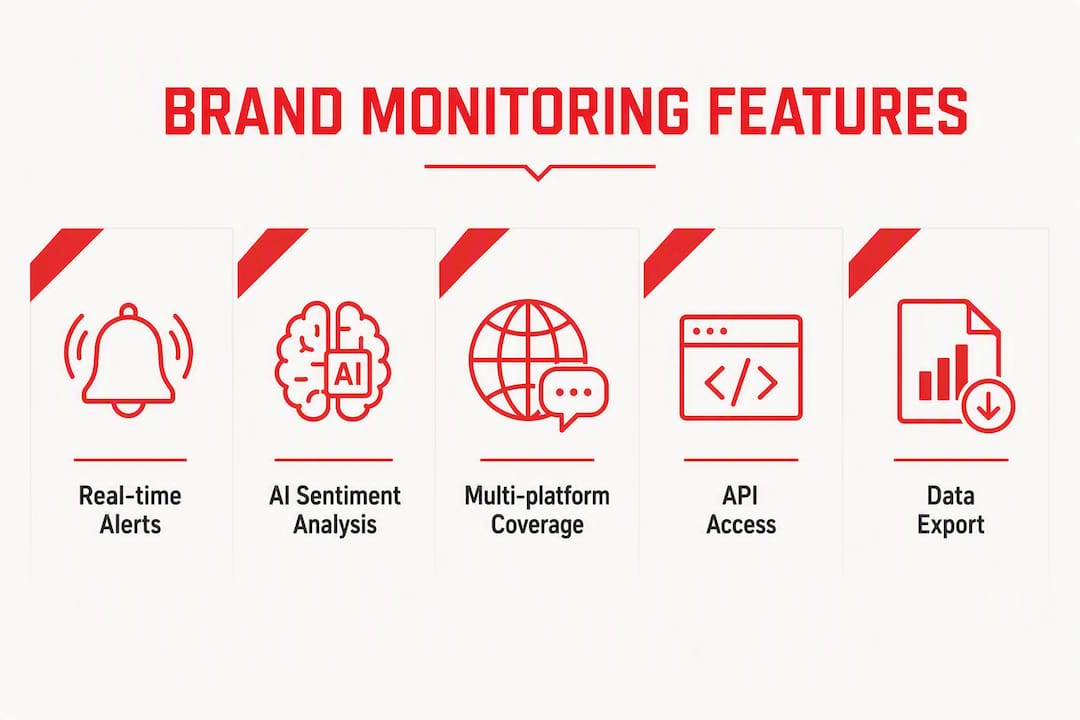
Modern brand monitoring has moved well past counting mentions. AI-driven, proactive reputation management now flags narrative spikes before they escalate, and the tools that win procurement decisions in 2026 are the ones that combine real-time alerting, cross-channel coverage, and clean API exports. The sections below give you everything you need to pick one.
Table of Contents
- What do the best brand monitoring tools actually do?
- Detailed breakdowns: every tool category and Nowix
- Full feature comparison across tool categories
- How do you choose the right brand monitoring tool?
- Which tool fits your team’s actual use case?
- How we evaluated these tools
- Key Takeaways
- What most teams get wrong about brand monitoring
- Nowix: monitoring and amplification as a managed service on X
- Useful sources and vendor pages
What do the best brand monitoring tools actually do?
Every tool in this guide tracks where and how your brand is mentioned across the web. The differences that matter are which sources they index, how fast they alert you, and what they do with the data after capture.

Social listening and media monitoring are distinct disciplines: social listening focuses on engagement and sentiment across social channels, while media monitoring unifies news, broadcast, print, and AI-generated outputs. The best platforms now do both, but most started in one camp and still show that bias in their coverage depth.

Comprehensive coverage across social, news, broadcast, podcasts, and forums is the baseline for proactive crisis detection. Anything narrower and you’re reacting, not anticipating. For B2B SaaS and developer-facing products, add GitHub, Hacker News, and Stack Overflow to that list. Developer-community coverage is a common blind spot for general social listening tools, and missing it means missing the conversations that actually shape product reputation in technical markets.
Detailed breakdowns: every tool category and Nowix
Nowix (managed monitoring + amplification)
Nowix is not a self-serve monitoring dashboard. It’s an agency-managed service built specifically for tech and AI brands on X. The workflow: Nowix monitors brand signals on X, then acts on them directly, amplifying posts with up to 700 vetted micro-KOLs within a one-hour launch window, running quote-retweet and comment campaigns, and managing your full X account including strategy, daily content, replies, and community engagement.
Monitored platforms: X (primary), with monitoring inputs informing campaign execution.
Pricing shape: Project-based fees for campaign execution (viral launches, post amplification) and monthly retainer for ongoing X account management. Pricing is not publicly listed; contact Nowix for scoping.
API / integrations: Not applicable as a managed service; outputs are campaign results and account performance reports.
AI / sentiment features: Practitioner-led signal interpretation rather than automated sentiment dashboards.
Pros:
- Zero tool overhead; Nowix handles execution end-to-end.
- Monitoring feeds directly into amplification, so insights become campaigns without a handoff gap.
- Ideal for launch moments where speed and creator volume matter.
Cons:
- Not a replacement for a full cross-channel monitoring dashboard (news, forums, review sites).
- Requires a budget for managed services rather than a SaaS subscription.
Mini verdict: The right choice when you need monitoring and amplification to work as one motion on X, not two separate tools.
Enterprise media intelligence platforms
Brandwatch, Talkwalker, and Meltwater are the three names that dominate this category. Enterprise tools often require substantial annual budgets and dedicated analyst teams to extract full value. What you get for that spend: historical archives going back years, multilingual support across dozens of languages, AI-powered narrative analytics, image and logo recognition for untagged visual mentions, and board-ready reporting dashboards.
Monitored platforms: Social (all major networks), news, broadcast, podcasts, forums, blogs, print, and increasingly AI-generated content outputs.
Pricing shape: Custom enterprise contracts; expect annual budgets in the five-figure to six-figure range for full global deployments.
API / integrations: Full API access, webhook support, and native connectors to Tableau, Power BI, Salesforce, and Slack.
AI / sentiment features: Automated sentiment scoring, topic clustering, narrative trend detection, and image recognition. Some platforms offer image and logo recognition to catch untagged visual brand mentions in images and video.
Scalability: Built for global teams with multiple users, custom roles, and multi-brand management.
Pros:
- Deepest source coverage available.
- Historical data access for crisis benchmarking.
- Enterprise SLAs and dedicated onboarding.
Cons:
- High cost and long implementation timelines (6–12 weeks for full rollout).
- Overkill for teams that only need social coverage.
Mini verdict: The right fit for global PR and enterprise comms teams with analyst capacity and a budget to match.
Mid-market social listening platforms
Sprout Social and Hootsuite sit in this tier. Both combine social publishing with listening, which makes them attractive for marketing teams that want one platform for scheduling and monitoring. Coverage is solid across the major social networks, with reasonable sentiment analysis and alert features. Neither matches enterprise-class depth on news or broadcast, but for teams whose primary concern is social engagement and brand sentiment, they deliver without requiring a six-figure contract.
Monitored platforms: Major social networks (X, Instagram, Facebook, LinkedIn, TikTok, YouTube), some news and blog coverage.
Pricing shape: Transparent SaaS tiers; Sprout Social starts at several hundred dollars per month per user, Hootsuite at lower entry points with add-on modules.
API / integrations: API access available on higher tiers; native integrations with CRM and helpdesk tools.
AI / sentiment features: Automated sentiment scoring and basic topic tagging; less sophisticated than enterprise platforms.
Pros:
- Publishing + listening in one platform reduces tool sprawl.
- Predictable SaaS pricing with no long-term lock-in on entry tiers.
- Fast onboarding; most teams are live within days.
Cons:
- Limited coverage of forums, developer communities, and broadcast.
- Sentiment accuracy drops on niche or technical language.
Mini verdict: Best for marketing teams that want integrated publishing and listening without enterprise complexity.
Budget monitoring / entry-level tools
Brand24, Mention, and Awario lead this category. Brand24 monitors a very large number of sources with real-time alerts and transparent pricing starting at a low entry point, making it a genuine option for small teams. Mention covers social, news, and blogs with a clean UI. Awario focuses on social and web mentions with Boolean search support.
Monitored platforms: Social networks, news, blogs, forums (coverage varies by tool and plan).
Pricing shape: Brand24 and Mention start under $100/month on entry plans; Awario offers competitive annual pricing.
API / integrations: Basic API access on higher tiers; limited native integrations compared to enterprise tools.
AI / sentiment features: Basic automated sentiment; no advanced narrative analytics.
Pros:
- Transparent, affordable pricing with no sales call required.
- Quick setup; most teams are monitoring within hours.
- Sufficient for startups validating brand presence.
Cons:
- Mention quotas can be restrictive on entry plans.
- Coverage gaps on forums, developer communities, and broadcast.
Mini verdict: The right starting point for startups and SMBs that need broad coverage at a price that doesn’t require a procurement process.
Developer-community monitoring specialists
Octolens and Shadow are purpose-built for this gap. General social listening tools miss GitHub issues, Hacker News threads, Stack Overflow questions, and developer newsletters entirely. For technical and developer-focused brands, a monitoring solution that natively indexes GitHub, Hacker News, and Stack Overflow prevents critical blind spots that can let product reputation problems compound undetected.
Monitored platforms: GitHub, Hacker News, Stack Overflow, developer forums, niche newsletters, Reddit (technical subreddits).
Pricing shape: Typically lower-cost SaaS or usage-based; pricing varies by tool.
API / integrations: API-first architectures designed for data export into internal dashboards and BI tools.
AI / sentiment features: Keyword and topic matching; sentiment less developed than social-focused tools.
Pros:
- Native coverage of channels that matter for developer-facing products.
- API-first design makes data export straightforward.
Cons:
- Limited coverage of mainstream social and news.
- Requires pairing with a social listening tool for full coverage.
Mini verdict: Non-negotiable for B2B SaaS and developer-tool teams; pair with a mid-market social tool for complete coverage.
Content intelligence platforms
BuzzSumo and Semrush anchor this category. Both connect brand mentions to content performance metrics: share counts, backlink data, topical trend signals, and coverage reach. Ahrefs and SE Ranking also offer mention tracking as part of broader SEO suites. These tools are most valuable for PR and content teams that want to know not just where they were mentioned but how much reach that mention generated.
Monitored platforms: Web content, news, blogs, social shares; less depth on real-time social streams.
Pricing shape: SaaS tiers starting from around $99/month for entry-level plans; enterprise tiers available.
API / integrations: Strong API access; native integrations with content management and SEO workflows.
AI / sentiment features: Content trend detection and topic clustering; sentiment less central than in social listening tools.
Pros:
- Connects mentions to reach and engagement metrics.
- Strong for reactive PR and pitch tracking.
- Useful for competitive content benchmarking.
Cons:
- Not designed for real-time crisis alerting.
- Social stream coverage is secondary to content indexing.
Mini verdict: Best for content and PR teams that want to tie brand coverage to measurable reach, not just mention volume.
Built-in / free options
Google Alerts and Google Trends are the zero-cost baseline. Google Alerts delivers email notifications when your brand name appears in Google’s index. Google Trends shows search interest over time. Mentionlytics, Alertmouse, Brand Radar, Peec AI, Gumloop, and YouScan round out the free or freemium tier with varying levels of social and web coverage.
These tools work for individual practitioners testing monitoring needs or teams with no budget. The tradeoffs are significant: no real-time social stream monitoring, no sentiment analysis, no API, and no alert routing to Slack or Teams. They are a starting point, not a strategy.
Mini verdict: Use Google Alerts to validate that monitoring matters for your brand, then upgrade to a paid tool once you’ve confirmed the signal volume.
Statistic callout: Brand24 monitors a very large number of sources across social, news, blogs, and forums, making it one of the broadest-coverage options in the budget tier.
Full feature comparison across tool categories
The table below maps each category and Nowix against the dimensions that matter most in procurement decisions. Pricing reflects typical starting ranges; enterprise contracts vary significantly.
| Option | Best For | Pricing (starting) | Monitored Sources | Sentiment & AI | Real-time Alerts | API / Exports | Scalability | Reporting | Languages / Geo | Support / Onboarding |
|---|---|---|---|---|---|---|---|---|---|---|
| Nowix | Managed monitoring + X amplification for tech/AI brands | Custom retainer / project | X (primary), campaign inputs | Practitioner-led | Campaign-driven | Managed outputs | Scales with campaign scope | Campaign performance reports | English / US-focused | Dedicated account team |
| Enterprise media intelligence | Global PR, crisis, multilingual | Five-figure or six-figure annual budget (custom) | Social, news, broadcast, podcasts, forums, print | Advanced AI sentiment, image recognition, topic clustering | Real-time | Full API, webhooks, BI connectors | Enterprise-grade, multi-brand | Board-ready dashboards | multilingual support, global | Dedicated CSM, SLA |
| Mid-market social listening | Marketing teams, publishing + listening | $100–$500+/month | Major social networks, some news/blogs | Automated sentiment, basic topic tagging | Real-time (social) | API on higher tiers | Team-level, multi-user | Standard dashboards | Major languages | Self-serve + support |
| Developer-community specialist | B2B SaaS, technical products | Varies (SaaS/usage) | GitHub, Hacker News, Stack Overflow, dev forums | Keyword/topic matching | Near real-time | API-first | Small-to-mid teams | Export-focused | English-primary | Community / docs |
| Budget / entry-level | Startups, SMBs | Under $100/month | Social, news, blogs, forums (varies) | Basic automated sentiment | Real-time alerts | Limited API | Single-team | Basic dashboards | Major languages | Self-serve |
| Content intelligence | Content + PR teams | $99+/month | Web, news, blogs, social shares | Topic clustering, trend detection | Batch / near real-time | Strong API | Mid-market | Content performance reports | English-primary | Self-serve + support |
| Built-in / free | Zero-cost baseline | Free | Web index (Google), search trends | None | Email digest | None | Individual | Minimal | Limited | None |
Legend: Pricing ranges are indicative starting points based on publicly available vendor information as of 2026. Enterprise contracts are custom and will differ. Verify current pricing and coverage directly with vendor sales teams before procurement.
How do you choose the right brand monitoring tool?
Selection criteria that actually matter
Start with coverage breadth. A tool that misses Reddit, industry forums, or developer communities will give you a false sense of security. Map your brand’s actual conversation channels before you evaluate any platform.
Data freshness is the second filter. For crisis workflows, real-time alerts with customizable thresholds delivered to Slack, Teams, or email are non-negotiable. Batch delivery that arrives hours later is useless when a narrative is accelerating.
API access and data export matter more than most buyers realize upfront. An API-first architecture with webhook or connector support is essential when you plan to pipe mentions into data warehouses, BI tools, or AI agents for automated playbooks and executive reporting. If the tool can’t export cleanly, you’ll hit a ceiling fast.
Consolidating social listening, media intelligence, and influencer tracking into a single AI-enabled platform can reduce costs and remove duplicated work across teams. But consolidation only makes sense if the single platform genuinely covers your channels. A consolidated tool with coverage gaps is worse than two specialized tools.
The vendor evaluation checklist
- Run a 14-day trial with your actual brand keywords, not demo keywords.
- Pull a three-month historical export for a past crisis or product launch to validate data depth.
- Test the API with a sample query before signing any contract.
- Check alert routing: can alerts go to Slack, Teams, and email simultaneously?
- Validate developer-channel coverage if your product has a technical audience.
- Request a sample board-ready report to confirm reporting quality.
- Define your pilot success metrics before day one: mention volume baseline, alert response time, sentiment accuracy.
Questions to ask vendors directly
- “Which raw sources do you index for developer communities, and how frequently?”
- “How is sentiment calculated, and can we tune it for our industry vocabulary?”
- “What is your SLA for alert delivery from source publication to notification?”
- “Can you provide a three-month historical export for our keywords before we sign?”
- “How do you surface narrative context across channels, not just mention counts?”
- “What are the hard limits on mention volume at our pricing tier?”
Red flags to walk away from
- Opaque pricing with no published tiers and no trial access.
- No API or data export on standard plans.
- Narrow platform coverage with no forums, developer communities, or broadcast.
- No anomaly detection or alert customization beyond keyword matching.
- Forced onboarding with no sandbox access for at least two weeks.
Pricing and implementation timeline
Budget tools (under $100/month) are live within hours. Mid-market platforms typically take days to a week for full configuration. Enterprise media intelligence platforms often require substantial annual budgets and implementation timelines of 6–12 weeks for full rollout, including data integration, user training, and alert workflow setup. Plan for a 30-day pilot before committing to an annual enterprise contract.
Which tool fits your team’s actual use case?
| Use Case | Best Category Match | Why It Fits | 30-Day Pilot Approach |
|---|---|---|---|
| PR & crisis comms | Enterprise media intelligence | Cross-channel coverage, real-time alerts, narrative analytics | Set up crisis keywords, run a historical crisis simulation, validate alert SLA |
| Product feedback & NPS | Mid-market social listening | Social + review platform coverage, sentiment tracking | Monitor product name + competitor names, tag sentiment by feature |
| Developer-community monitoring | Developer-community specialist | Native GitHub, Hacker News, Stack Overflow indexing | Track repo mentions, issue threads, and HN posts for 30 days |
| Competitive intelligence | Content intelligence + mid-market | Competitor mention tracking, content performance benchmarking | Set up competitor keyword alerts, compare share-of-voice weekly |
| Review & reputation management | Budget / mid-market | Review platform coverage, sentiment alerts | Monitor G2, Capterra, Trustpilot mentions with weekly digest |
| Content intelligence | Content intelligence platforms | Mention-to-reach metrics, backlink and share data | Track coverage of a recent campaign, measure reach per mention |
| X amplification + monitoring | Nowix (managed) | Monitoring feeds directly into amplification execution | Pilot a post amplification campaign with monitoring inputs |
Where single-tool coverage fails:
- Developer communities + broadcast TV: No single tool covers both well. Pair a developer-community specialist with an enterprise media intelligence platform.
- Global multilingual PR + real-time social: Budget tools break down at scale. Enterprise platforms are the only viable option.
- X amplification + monitoring: Self-serve tools monitor but can’t amplify. Nowix closes that gap as a managed service.
Three mini scenarios:
- Startup product launch: A B2B SaaS team launching a developer tool uses a developer-community specialist to track GitHub stars, Hacker News threads, and Stack Overflow questions during the first 30 days. They pair it with Google Alerts for basic web coverage and upgrade to a mid-market platform at 90 days.
- Global PR team: A multinational brand’s comms team runs an enterprise media intelligence platform for multilingual news and broadcast monitoring, with real-time Slack alerts routed to regional PR leads.
- Tech brand on X: A growth team at an AI startup uses Nowix to monitor X conversation signals and immediately amplify high-performing posts with a creator wave, turning monitoring insights into momentum within hours.
Pro Tip: If your brand operates in developer communities, run a test query on GitHub and Hacker News in any tool you’re evaluating before you sign. If the tool returns zero results for a keyword you know is active there, that’s a coverage gap, not a data anomaly.
How we evaluated these tools
Evaluation methodology
This guide was built using a structured evaluation across six criteria:
- Coverage breadth: Which source types does each category index (social, news, forums, developer sites, broadcast, podcasts, review platforms)?
- Alerting and data freshness: Real-time vs. batch delivery; customizable thresholds; Slack/Teams routing.
- API access and data export: Availability, documentation quality, and export format options.
- AI and sentiment features: Automated sentiment scoring, topic clustering, narrative analytics, image recognition.
- Reporting and dashboards: Quality of out-of-the-box reports; board-ready output availability.
- Pricing transparency: Published tiers, trial availability, and contract flexibility.
Information sources include vendor product pages, publicly available documentation, independent review platforms (G2, Capterra), and category-level analysis from industry research. Practical checks included trial query testing, sample API calls, and historical export validation where tool access was available.
Disclosure: Nowix is the publisher of this guide and offers a managed monitoring and amplification service as an alternative to self-serve tools. Where Nowix appears in comparisons, it is presented on its merits as a managed option, not as a direct substitute for a self-serve monitoring dashboard. No affiliate relationships exist with the tool vendors named in this guide.
Limits: Pricing and coverage change frequently. Enterprise contracts are custom and will differ from published starting prices. Verify current coverage and pricing directly with vendor sales teams before any procurement decision.
Key Takeaways
The strongest brand monitoring setup in 2026 combines a platform matched to your primary channels, real-time alert routing to your team’s communication tools, and API access for downstream reporting.
| Point | Details |
|---|---|
| Match tool to channel | Developer-facing brands need native GitHub and Hacker News coverage; social-first brands need real-time stream monitoring. |
| Validate alerts before signing | Test alert SLA and Slack/Teams routing in the trial; batch delivery fails crisis workflows. |
| API access is non-negotiable | Export capability determines whether monitoring data reaches BI tools and executive reports. |
| Enterprise tools require budget and time | Annual budgets in the five-figure to six-figure range and 6–12 week rollouts are standard for enterprise media intelligence platforms. |
| Nowix closes the monitoring-to-amplification gap | For tech and AI brands on X, Nowix combines monitoring inputs with immediate campaign execution, removing the handoff between insight and action. |
What most teams get wrong about brand monitoring
The conventional wisdom says: buy the tool with the most sources, set up keyword alerts, and you’re covered. That’s wrong in three specific ways.
First, tool sprawl is the real cost. Teams that run a social listening platform, a media monitoring tool, and a separate review tracker end up with three dashboards, three billing cycles, and no one responsible for synthesizing the signals. The data sits in silos. Consolidating into an AI-enabled platform reduces duplicated work and lowers total cost of ownership, but only if the consolidated tool genuinely covers your channels.
Second, developer platforms are almost always ignored. If your product has a technical audience, the conversations that shape your reputation happen on GitHub, Hacker News, and Stack Overflow, not on Twitter or LinkedIn. Most social listening tools don’t index these at all. You can run a perfectly configured Brandwatch setup and still miss the thread where 200 developers are debating whether to use your API.
Third, alert validation is skipped. Teams set up keyword alerts, assume they’re working, and never test them against a real scenario. The right practice: once a quarter, run a simulated crisis query against a past event and check whether your alerts would have fired within your SLA window. Most teams that do this discover gaps they didn’t know existed.
The practical fix is straightforward. Set thresholds based on your baseline mention volume, not arbitrary numbers. Route alerts to a dedicated Slack channel with a triage protocol, not to a shared inbox. Run a weekly narrative digest that summarizes how stories moved across channels, not just how many mentions you received. That combination keeps monthly costs predictable and keeps your team focused on signals that matter.
Pro Tip: Combine an API export from your monitoring tool with an internal triage Slack channel and a weekly narrative digest. The export feeds your BI reporting, the Slack channel handles real-time crisis routing, and the digest keeps leadership informed without drowning them in raw mention data. Three outputs, one monitoring stack, zero alert fatigue.
Nowix: monitoring and amplification as a managed service on X
Most brand monitoring tools give you data. Nowix gives you momentum. For tech and AI brands on X, the gap between seeing a signal and acting on it is where opportunities are lost. Nowix closes that gap by combining monitoring inputs with immediate amplification execution, run by practitioners who know the platform.
Here’s what that looks like in practice. When a post gains traction, Nowix deploys up to 700 vetted micro-KOLs within a one-hour window to amplify it with quote-retweets and comments. When you need a launch to trend, Nowix coordinates a timeline takeover campaign that turns paid momentum into organic coverage. And for ongoing account management, Nowix handles strategy, daily content, replies, and community engagement so your brand stays active and visible without adding headcount.
The three Nowix services that map directly to a monitoring + amplification workflow:
- Post amplification: Controlled QRT and comment campaigns from vetted micro-KOLs that turn a strong post into a creator wave.
- X account management: Full account management by practitioners, including strategy, daily content, and community replies.
- Timeline takeover campaigns: — Rapid launch amplification with up to 700 creators in a one-hour window for product launches and announcements.
This makes sense when you have limited headcount, need fast launch execution, or want monitoring and amplification to work as one motion rather than two separate tools and two separate teams. See how Nowix approaches algorithmic distribution for tech brands to understand the full workflow.
Ready to run a managed pilot? Reach out to Nowix to scope a campaign or account management engagement.
Useful sources and vendor pages
Pricing and coverage details change frequently. Confirm current specifications directly with vendor sales teams before making any procurement decision.
| Source | Description | Accessed |
|---|---|---|
| Brand Monitoring & Reputation Management Software — Meltwater | Meltwater’s overview of cross-channel monitoring capabilities and narrative analytics | 2026 |
| Social Media Monitoring Software — Meltwater | Meltwater product page covering real-time alerts, AI features, and source coverage | 2026 |
| Best Brand Monitoring Tools — Octolens | Independent category comparison covering enterprise, mid-market, and developer-specialist tools | 2026 |
| Media Monitoring Software — Brand24 | Brand24 vendor page with source coverage claims and pricing tiers | 2026 |
| Media Monitoring — Hootsuite | Hootsuite product page covering social listening and image recognition features | 2026 |
| Best Brand Monitoring Tools — Shadow | Shadow’s category overview including developer-community monitoring context | 2026 |
| Brand Monitoring Tools — Mentionlytics | Mentionlytics blog covering tool categories and use-case mapping | 2026 |
| Brand Mentions Tool — Gumloop | Gumloop’s overview of brand mention tracking and automation workflows | 2026 |
| Brandwatch Consumer Intelligence — G2 Reviews | User reviews of Brandwatch on G2 | 2026 |
| Sprout Social — G2 Reviews | User reviews of Sprout Social on G2 | 2026 |