15 Minute Reply Velocity: Twitter Community Engagement for Tech & AI

The fastest way to grow community engagement on Twitter (X) is to stop chasing followers and start engineering early reply velocity. That means seeding replies in the first 15 minutes, posting into the right Community instead of just your timeline, and tracking reply rate over vanity likes. Do these three things consistently for a few weeks and your distribution changes before your follower count does.
TL;DR:
- Reply velocity in the first 15 minutes is critical, with seeding replies from 3 to 8 trusted engagers before posting to boost early interaction.
- Posting in a relevant, well-moderated Community in addition to your timeline doubles engagement opportunities and enhances discoverability.
- Using reply-bait questions related to your niche or Community discussion significantly increases reply rates and sustained conversation.
- Visuals, polls, and checklists outperform plain text because they encourage quicker reactions and are more bookmarkable for future reference.
- Consistently tracking reply, engagement, and bookmark ratios, especially within the initial 15-minute window, helps optimize and validate your engagement strategy.
Table of Contents
- What Is Community Engagement on Twitter, and Why Reply Velocity Wins
- Top High-Impact Tactics to Run This Week
- How Twitter (X) Communities Work in 2026 and Why That Matters
- Reply-First Tactics: Engineering Early Velocity and Sustaining Conversation
- Community-Post Content Tactics: Formats, Dual-Posting, and Design
- Measurement and Benchmarks: What to Track and How to Test
- Tools and Workflows for Scheduling, Monitoring, and Scaling Engagement
- Nowix’s 2026 Benchmarks and a Playbook You Can Run In-House
- Real-World Patterns Behind Successful Community Campaigns
- Community Posting Mechanics: Dual-Posting, Labels, and Moderation
- When Communities Are the Right Investment
- How Nowix Can Help You Scale This Without the Manual Grind
- Sources
- FAQ
What Is Community Engagement on Twitter, and Why Reply Velocity Wins
Community engagement on Twitter means the ongoing back-and-forth between an account and its audience: replies, quote posts, saves, and repeat visits inside Communities and on the open timeline. It is not follower count, and it is not likes. X’s ranking system rewards fast, active interaction more than passive approval, and replies and quote posts now carry far more ranking weight than likes. A post that earns five replies in ten minutes will usually outperform a post that earns fifty likes over three days.
That shift matters for anyone managing a brand account or a personal following in tech and AI. Engagement velocity in the first 15 minutes acts as the single biggest amplifier for out-of-network distribution on X. The algorithm treats early activity as a signal worth spreading further. Miss that window and even good content stalls in a small pocket of your existing audience.
Top High-Impact Tactics to Run This Week
Start with the moves that produce measurable lift inside a few days, not months.
- Reply velocity seeding. Line up 3 to 8 people who reliably engage with your posts (teammates, close collaborators, loyal followers) and give them a heads-up 5 minutes before you publish. Ask for a genuine reply, not a generic “great post.”
- Community-first or dual-posting. Post into a relevant Community when the content fits its niche, and consider posting to your timeline too. Dual-posting doubles your relevant distribution vectors because Community members and timeline followers can both react.
- Reply-bait frameworks. Ask a direct, low-friction question tied to a choice your audience already has an opinion on: “Which one would you ship first?” beats “Thoughts?”
- Bookmarkable formats. Build checklists, comparison lists, or short frameworks people want to save for later, not just admire once.
- Visuals and polls. A chart, screenshot, or poll consistently outperforms plain text because it lowers the friction to react. Sprout Social’s research on X engagement backs visuals and polls as reliable, repeatable tactics.
Pro Tip: Draft your reply-bait question before you write the rest of the post. If you can’t imagine three different real answers to it, rewrite the question.
How Twitter (X) Communities Work in 2026 and Why That Matters
A Community on X is a topic-based group with three roles: admins who set rules and add moderators, moderators who approve posts and remove violations, and members who post and reply within the group. The biggest shift heading into 2026 is visibility. All Community posts are now public, which means they show up in search results and on member profiles, not just inside the Community feed. That single change turned Communities from a closed side-channel into a real discovery surface.
Moderation quality directly shapes the engagement signal a Community sends the algorithm. A well-run Community with active daily posts and real back-and-forth reads as high-value; a spam-filled one gets buried. Before joining or investing time in a Community, check for:
- Daily or near-daily posts with actual replies, not just drive-by shares
- A visible moderator presence removing low-effort spam
- Repeat contributors, not a rotating cast of one-time posters
- A member count that matches activity level. Aim for Communities with 20 to 50 genuinely active members before judging it worth wide promotion.
Reply-First Tactics: Engineering Early Velocity and Sustaining Conversation
The first 15 minutes after you post decide whether X shows your content to people outside your existing followers. Every reply, quote post, and bookmark in that window functions as a vote of confidence the algorithm reads instantly. Wait an hour to check your notifications and you’ve already lost the highest-leverage window you’ll get.
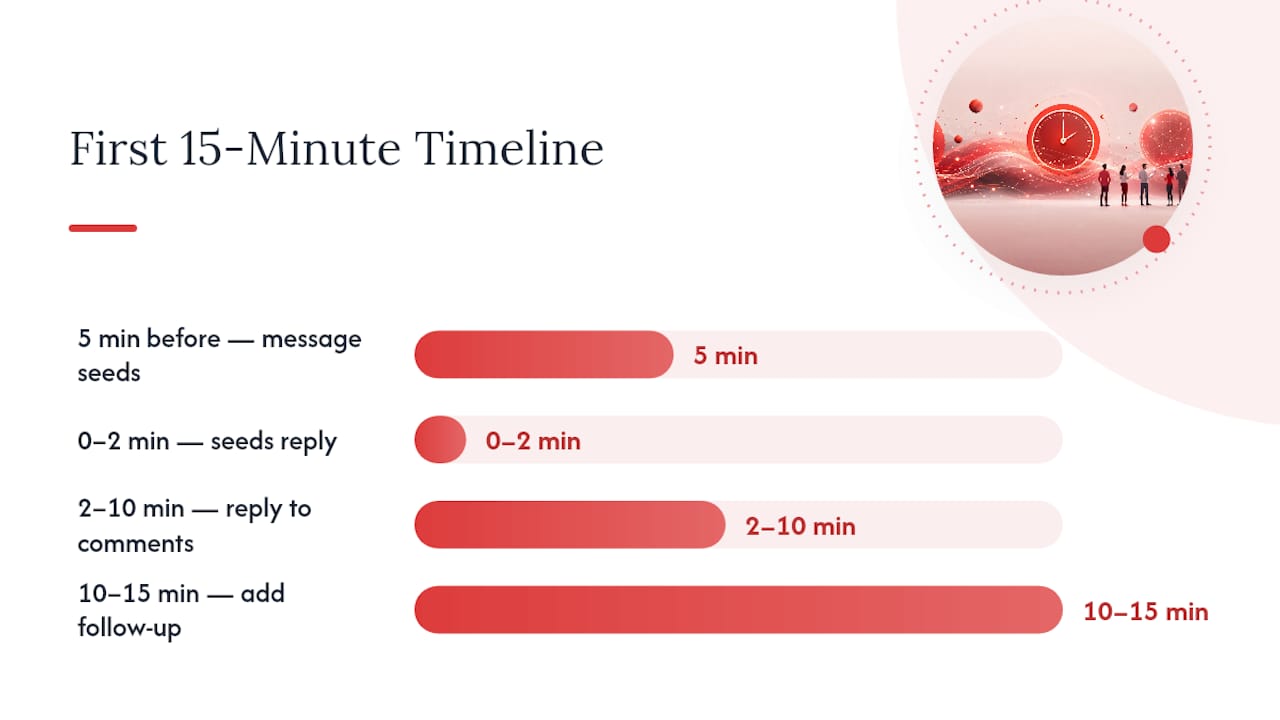
Here is the sequence that turns a quiet post into an active thread, based on the pre-post routine researchers recommend for maximizing early velocity:
- Five minutes before posting, message your 3 to 8 seed engagers directly. Tell them what’s coming and ask for a real reaction, not a copy-paste comment.
- At the moment you post, note the exact time. This becomes your measurement anchor for the 15-minute window.
- Within 0 to 2 minutes, your seed engagers like and reply. Genuine disagreement or a follow-up question works better than agreement.
- Within 2 to 10 minutes, reply to every comment that’s come in, even the seeded ones. Each reply you send generates a fresh notification and creates a new node of content tied to the original post, which is why author re-engagement multiplies distribution rather than just adding to a static like count.
- Between 10 and 15 minutes, extend the thread with a follow-up point or a question back to a commenter. This is what keeps the conversation compounding instead of flattening out.
Scripts help here. When someone replies with agreement, ask “What would change your mind?” When someone pushes back, ask “What’s the strongest version of that argument?” Both moves invite a second reply, and a second reply from the same person often counts more toward sustained velocity than a first reply from someone new.
There is a line between seeding engagement and gaming the system, and it matters. Ethical amplification means recruiting real people who will leave honest reactions, not bots or reciprocal engagement pods trading fake replies. X’s own research into ranking and engagement signals suggests the platform actively models for authenticity patterns, and engagement-bait language (“reply if you agree,” “tag someone who needs this”) tends to get suppressed rather than rewarded over time.
Pro Tip: Rotate your seed engagers. Using the same five people every time creates a detectable pattern; a rotating pool of 8 to 12 people looks like organic interest instead of a scripted routine.
Community-Post Content Tactics: Formats, Dual-Posting, and Design
Certain formats consistently pull more replies and saves than others inside Communities and on the open timeline.
- Threads that solve one specific problem step by step outperform single posts because each reply in the thread becomes its own engagement opportunity.
- Checklists and screenshot lists work because they’re scannable and inherently bookmarkable. Bookmarks are an underrated high-intent signal that most accounts never optimize for directly.
- Polls lower the cost of replying to almost zero, which is exactly why they generate fast early velocity.
- Spaces follow-up posts that recap a live audio session give attendees a reason to reply with their own takeaway, and give non-attendees a reason to ask a question.
Dual-posting timing matters more than most people assume. Post to a relevant Community first if the topic is niche enough to spark expert-level replies, then post a version to your main timeline within an hour once the Community conversation has some momentum behind it. That sequencing gives you social proof to reference (“this sparked a good debate over in the [Community name]”) when you bring it to a broader audience.
For calls to action, specificity beats enthusiasm. “Tag someone who’s dealt with this exact problem” produces real tags. “What’s your version of this?” produces real answers. Generic engagement bait like “thoughts?” produces silence more often than not, because it gives the reader nothing concrete to react to.
Measurement and Benchmarks: What to Track and How to Test
Engagement rate on X is calculated as total engagements (likes, replies, reposts, bookmarks, clicks) divided by impressions, multiplied by 100. That’s the standard, impressions-based formula most benchmarking guides use. But total engagement rate hides the metric that actually predicts distribution: reply rate, which is replies divided by impressions alone.
Benchmarks vary by niche, but account size is the biggest driver of the range you should expect:
| Account size | Typical engagement rate range | What drives it |
|---|---|---|
| Micro (1K to 10K followers) | Often the highest proportionally | Personal replies scale better at small size |
| Mid-size (10K to 100K followers) | Moderate, more variable | Depends heavily on niche and posting consistency |
| Macro (100K+ followers) | Often lower proportionally | Harder to reply to everyone; broadcast dynamic sets in |
Micro accounts frequently post the highest proportional engagement rates precisely because responsiveness and personal acknowledgment are easier to sustain at smaller scale. Don’t benchmark a 3,000-follower account against a 300,000-follower one; the dynamics are different.
Track four velocity metrics for every post: engagements in the first 15 minutes, replies per post, reply-to-like ratio, and bookmarks. A reply-to-like ratio above roughly 1:10 is a strong early signal; most passive posts sit closer to 1:30 or worse.
Run a simple A/B test to validate your own numbers instead of trusting benchmarks blindly. Post two similar pieces of content a week apart, holding the topic constant but varying one thing: seed the first with 5 engagers and skip seeding the second, or post one to a Community and one only to your timeline. Measure reply rate at the 15-minute and 24-hour marks for both, and let that comparison, not an industry average, decide what you do next.
Tools and Workflows for Scheduling, Monitoring, and Scaling Engagement
You don’t need a dozen subscriptions to run this playbook consistently, but you do need tools that cover four jobs: scheduling posts (ideally with Community-posting support), pulling analytics you can export, flagging replies fast enough to act inside the 15-minute window, and monitoring brand mentions across the platform. A tool like Opti Arts’s analytics and monitoring suite covers the scheduling-and-monitoring half of that stack, letting you track mentions and manage reply queues without babysitting notifications manually.
The workflow itself is simple to repeat: prepare the post and CTA, warn your seed engagers, publish (to a Community, your timeline, or both), seed the first replies inside the 2-minute window, personally re-engage every commenter for the next 10 minutes, then log your 15-minute and 24-hour numbers before moving to the next post.
AI-generated replies can help you keep pace when volume gets high, but use them for drafting speed, not for the actual reply. A reply that sounds automated gets read as automated, and that kills the authenticity signal the algorithm is watching for. Use AI to draft three options, then edit one into your own voice before you send it.
When picking tools, check for:
- Native Community posting or scheduling support, not just timeline posts
- Exportable analytics so you can build your own benchmark history over time
- Reply and mention alerts fast enough to hit the 15-minute window
- Clear compliance with X’s platform rules on automation and bulk actions
Nowix’s 2026 Benchmarks and a Playbook You Can Run In-House
Engagement benchmarks and tactic performance tracked across various tech and AI accounts show a consistent pattern: reply-first sequencing consistently outperforms broadcast posting on velocity and 24-hour engagement rate alike.
A simplified version of the sequence Nowix runs for client launches:
- Pre-post: identify 5 to 8 relevant accounts likely to engage authentically with the topic and give them a short heads-up
- T0: publish, log the timestamp, and open notifications
- T0 to T10: reply to every single comment, prioritizing the first few to arrive
- T10 to T60: extend the thread with a follow-up insight or question
- T24h: log engagement rate, reply rate, and bookmarks against the previous week’s baseline
Teams with the internal bandwidth to run this daily can absolutely execute it in-house using the workflow above. Teams launching a product, scaling past what one person can manage, or needing guaranteed velocity at volume tend to bring in specialized help instead, which is where dedicated X account management becomes worth the cost of a retainer rather than staff hours.
Real-World Patterns Behind Successful Community Campaigns
The AI and dev-tool space on X has produced a repeatable pattern worth studying: a small account posts a genuinely useful checklist or framework inside a niche Community, seeds a handful of early replies from people who actually use the tool, and lets the Community’s own moderators and repeat posters carry the thread forward without any paid push. Within a day, the post surfaces in search because Community content is public, and it pulls in profile visits from people who never saw the original timeline post at all.
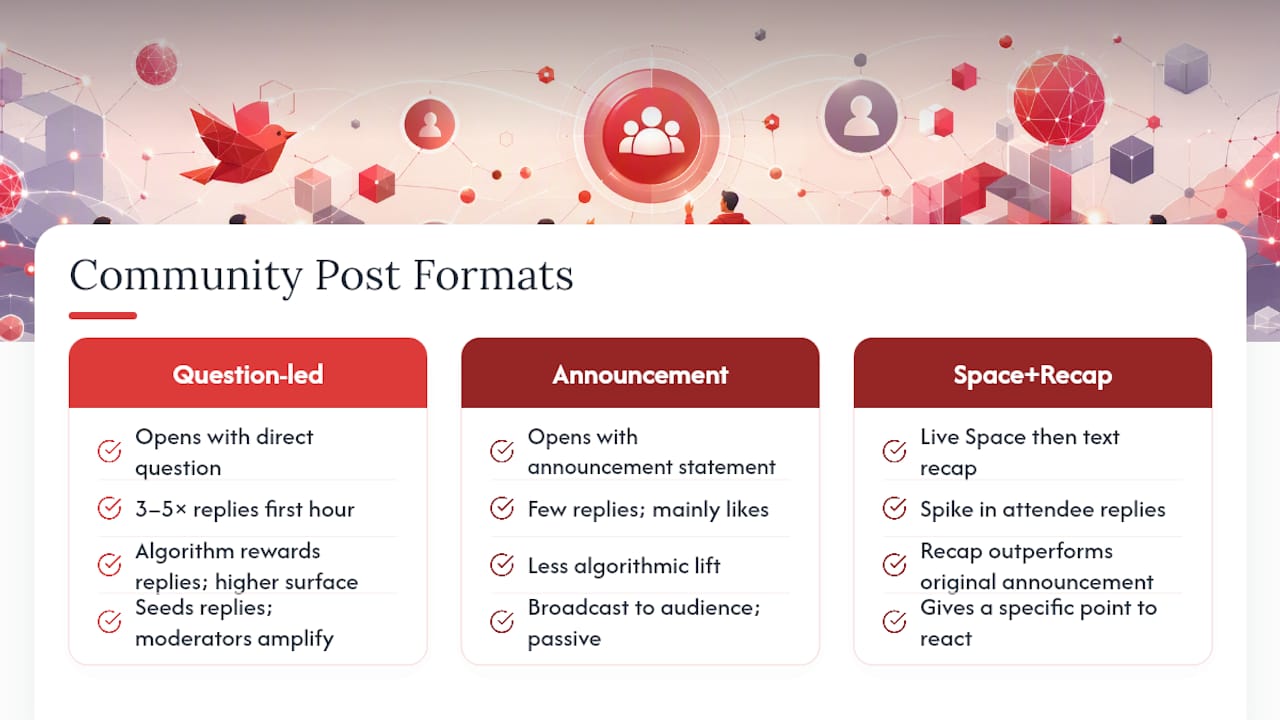
The common thread across these wins isn’t the size of the account. It’s the sequencing. Posts that opened with a direct question to the Community, rather than an announcement, generated three to five times more replies in the first hour based on patterns Nowix has observed across client accounts. Posts framed as an announcement (“We just launched X”) get likes. Posts framed as a question (“What’s the biggest friction point in Y right now?”) get replies, and replies are what the algorithm actually rewards.
A second pattern shows up around Spaces. Accounts that ran a live audio Space and then posted a text recap within an hour saw a spike in replies from attendees who wanted to add a point they didn’t get to make live. That follow-up post consistently outperformed the original Space announcement, because it gave people something specific to react to instead of just a calendar invite.
The lesson generalizes past any one niche: a Community campaign succeeds when it treats members as co-creators of the conversation, not an audience for a broadcast. The account that asks questions and replies fast wins the algorithm; the account that only announces loses it.
Community Posting Mechanics: Dual-Posting, Labels, and Moderation
When you post inside a Community, X attaches a visible Community label to that post, marking it as belonging to that group even when it surfaces in search or on your profile. Dual-posting means publishing a related version to your main timeline as well, either simultaneously or staggered by an hour, so you capture both the Community’s engaged niche audience and your broader follower base.
Moderators play a bigger role in your engagement outcomes than most people account for. A moderator who removes spam quickly and enforces real discussion standards keeps the Community’s engagement signal clean, which is part of why recommended time allocation inside healthy Communities skews 70% engaging with others’ posts and 30% creating original content. Communities that flip that ratio, heavy on broadcasting and light on replying, tend to see engagement quality drop even as post volume rises.
Best practices for posting mechanics:
- Match content to the Community’s specific topic; off-topic posts get removed and damage your standing with moderators
- Reply inside the Community thread before cross-posting to your timeline, so the Community conversation has momentum first
- Watch for repeat contributors reacting to your posts. That’s a stronger health signal than raw member count
- Avoid posting the identical, unedited copy to five different Communities. Moderators notice, and it reads as spam even when the content itself is good
Treat Community labels as a discovery advantage, not a formality. A public, well-moderated Community post is now one of the few places on X where a smaller account can genuinely out-rank a larger one on relevance alone.
When Communities Are the Right Investment
Building a Community from scratch takes real time. Joining a few existing, well-moderated ones and engaging consistently usually pays off faster for most teams. Create your own only once you have a genuinely specific niche and enough content velocity to seed daily activity yourself.
Expect 4 to 8 weeks of consistent reply-first posting before engagement rate moves noticeably enough for you to point to with confidence. The early signal to watch isn’t follower growth. It is whether the same handful of people keep showing up in your replies week after week. That repeat-contributor pattern, more than any single viral post, is what tells you the approach is actually working.
— Knowix
How Nowix Can Help You Scale This Without the Manual Grind
Running the reply-first playbook by hand works, but it takes daily discipline most founders and growth leads don’t have hours to spare for. Nowix built its services around exactly this gap for tech and AI brands: organic post amplification that seeds early engagement from vetted micro-influencers within your launch window, and full X account management that handles the daily replies, community engagement, and reply-first sequencing described throughout this playbook.
If you’re a founder trying to run a launch alone, DIY works fine for a few posts a week. If you’re coordinating a product launch that needs guaranteed velocity in a tight window, or you simply don’t have someone free to reply to every comment within the first ten minutes, that’s the point where managed execution starts to make more financial sense than staff hours. Check what a campaign or ongoing account management engagement looks like for your launch timeline, and get a sense of whether reply-first amplification or full account management fits your team’s current stage.
Sources
- Twitter Communities in 2026: How to Find, Join & Grow | Planify
- 5 strategies to amplify your Twitter (X) engagement | Sprout Social
FAQ
What Are the 5 C’s of Community Engagement?
Definitions vary across marketing frameworks, but community-management guidance generally centers on consistency, conversation, contribution, connection, and care, meaning regular posting, real replies, member-generated content, member-to-member relationships, and active moderation.
Do Twitter Communities Still Exist in 2026?
Yes, and they’re more relevant to discoverability than ever. All Community posts are now public, meaning they surface in search results and profiles rather than staying locked inside the Community feed.
How Much Does Twitter Pay Per 1 Million Views?
Payout amounts through X’s creator monetization program vary by engagement type, subscriber revenue share, and region, and X does not publish a fixed universal rate per view. Check your account’s Monetization dashboard directly for your specific payout terms.
What Counts as Engagement on Twitter (X)?
Engagement includes likes, replies, reposts, quote posts, bookmarks, clicks, and profile visits generated by a post. Replies and quote posts carry significantly more algorithmic weight than passive likes in how X ranks and distributes content.
Is It Better to Post in a Community or on My Main Timeline?
Dual-posting to both usually outperforms either alone, since it doubles your relevant distribution vectors by exposing the post to Community members and timeline followers at once.