
Controlled quote retweets are agency-coordinated posts where vetted micro-influencers add curated commentary to your launch or campaign tweet, amplifying reach while shaping how the conversation reads. Hire an agency for this when you need narrative control at speed, like a product launch, a proof post, or a founder moment that has to land right the first time. Skip it for routine updates where a simple repost does the job.
TL;DR:
- Vetting creators against audience overlap and topical relevance is more crucial than volume, as credible quotes outperform numerous low-quality posts.
- The most effective campaigns focus on high-quality, pre-approved commentary within a strict two-hour window, not just on maximizing impressions.
- Monitoring downstream signals like link clicks, replies, and conversions provides better insight into campaign success than impressions alone.
- Excessive, unvetted quotes increase the risk of twisting messages or spreading spam, making precise moderation and review essential.
- A small, curated list of authoritative creators will generate better results than large volumes of generic content, emphasizing quality over quantity.
Table of Contents
- What Controlled Quote Retweets Are (And Why They Beat a Reply)
- Where Controlled Quote Retweets Actually Move The Needle
- The Risks You’re Managing (And How To Manage Them)
- How To Run A Controlled Quote Retweet Window
- What To Measure (And What The Numbers Actually Mean)
- Nowix’s Approach To Managed Quote Retweet Windows
- The Part Of This Tactic Everyone Underrates
- Ready To Run A Controlled Window Of Your Own?
- Sources
What Controlled Quote Retweets Are (And Why They Beat a Reply)
A controlled quote retweet is a curated comment layered on top of your original post by a creator your team has vetted for audience fit and voice. It is not a reply, and it is not an automated repost. The distinction matters because the platform treats each format differently.
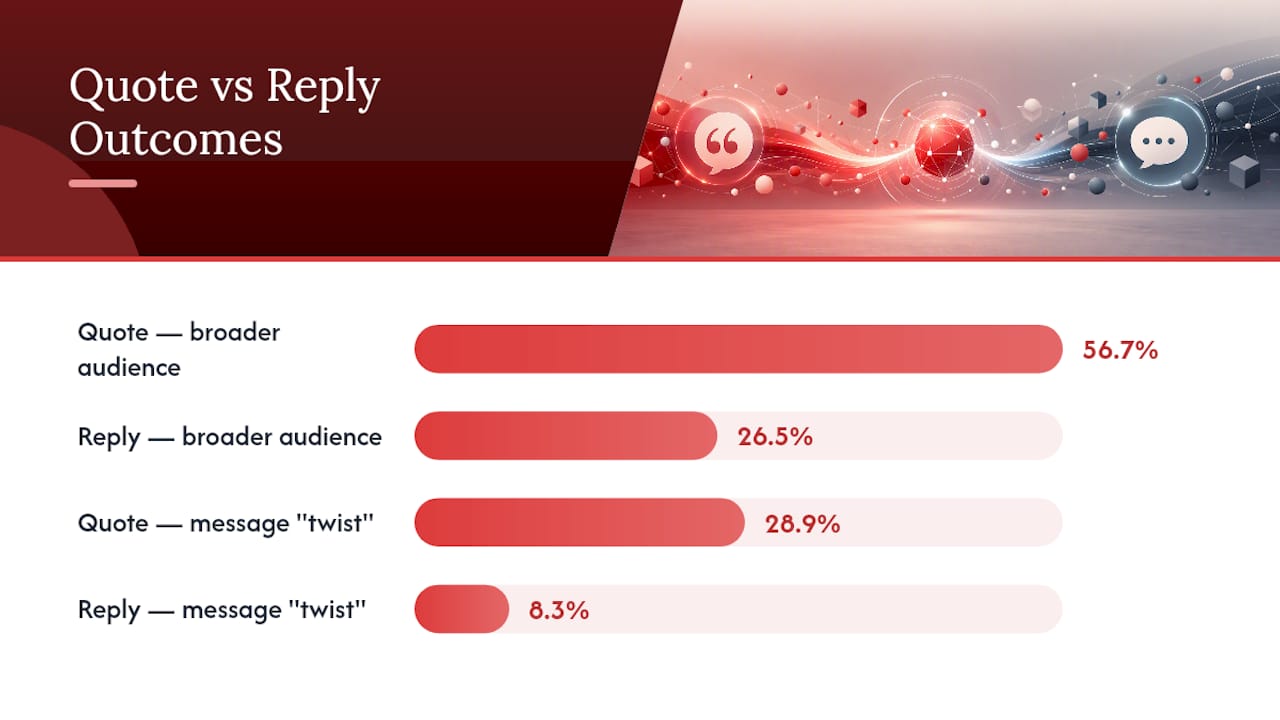
That same ACM study on reply vs. quote tweet affordances found quotes target broader audiences 56.7% of the time versus 26.5% for replies, and quotes “twist” the original message in 28.9% of cases versus just 8.3% for replies. A quote retweet becomes its own standalone post, one that can earn engagement independently of your original tweet.
The practical differences:
- Replies stay inside the original thread and reach whoever is already following that conversation.
- Silent reposts push your exact content to new eyes with zero added commentary or risk.
- Quote retweets create a new, scored post that lives or dies on its own commentary quality.
- Controlled quote retweets apply agency vetting, brief, and QA to that commentary before it goes live.
Where Controlled Quote Retweets Actually Move The Needle
The upside is concrete: you get reach into creator-owned audiences your brand account can’t touch organically, framing control because the commentary is written to a brief instead of left to chance, and credibility that comes from a real voice saying something substantive rather than a bot echoing your copy.
Three scenarios deliver the strongest return:
- Product launches, where a wave of on-brief quotes in the first hour sets the narrative before anyone else can define it for you.
- Proof posts, where creators with topical authority validate a claim, a benchmark, or a demo in language their own followers trust.
- Founder amplification and newsjack moments, where timing matters more than volume and a handful of sharp, well-placed quotes outperform fifty generic ones.
Creator selection changes the outcome more than volume does. A creator whose audience overlaps with your target buyer, and who has real standing on the topic you’re launching around, produces quotes that read as credible rather than paid. That’s the difference between amplification and noise.
Pro Tip: Before greenlighting a creator, ask whether their quote could stand on its own if your original tweet got deleted. If the answer is no, the commentary isn’t adding value, it’s just recycling your copy with a new name attached.
The Risks You’re Managing (And How To Manage Them)
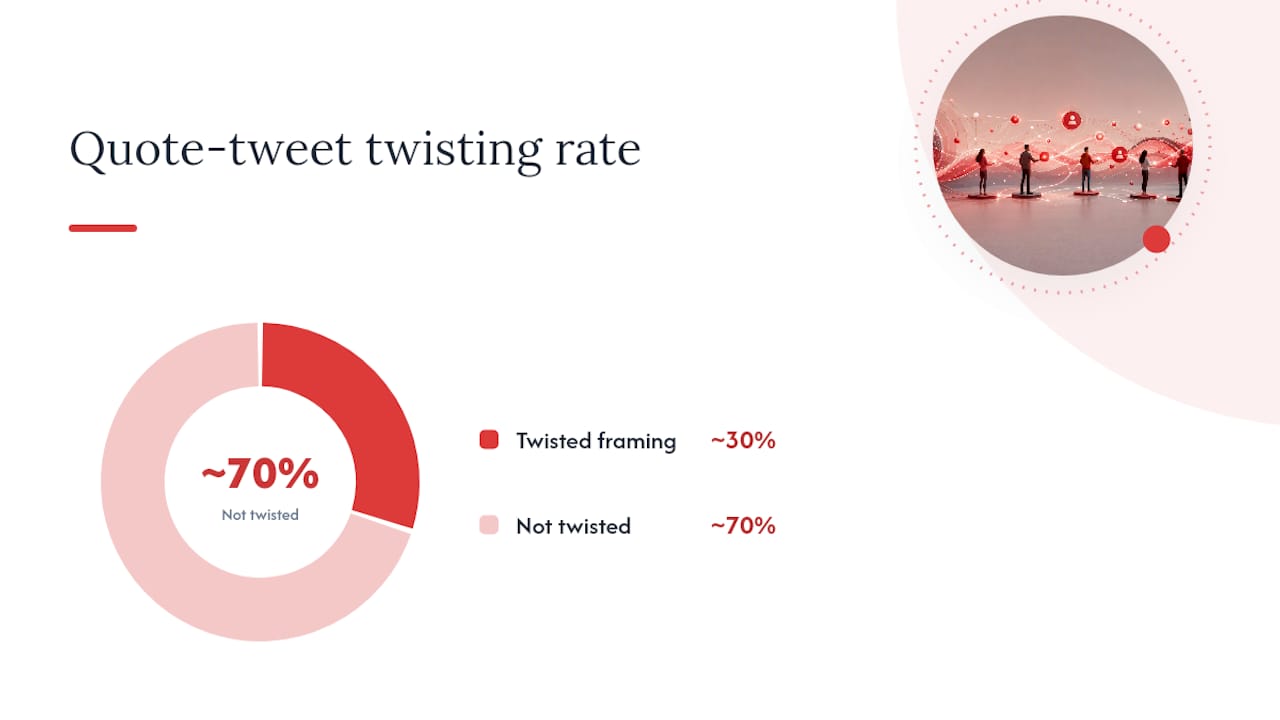
Quote retweets carry a specific failure mode that replies don’t: because they broadcast wider and reframe more often, a bad one spreads faster and further than a bad reply ever could. The same ACM research found twisting happens in nearly 3 out of 10 quote tweets, which is the exact risk you’re paying an agency to control.
Left unmanaged, controlled quote retweet campaigns can drift into pile-on dynamics, where a wave of similar-sounding comments starts to look coordinated in the wrong way, or spammy low-effort quotes that trip algorithmic penalties instead of earning reach. The guardrails that prevent this:
- A vetted creator list, reviewed and refreshed per campaign, not reused blindly across every launch.
- Pre-approved comment templates that leave room for a creator’s own voice instead of scripting them word for word.
- A hard publish cap per window, so volume never outruns your ability to QA in real time.
- A two-hour QA window where every quote gets a human read before and shortly after it goes live.
- Escalation rules that define exactly who pulls a quote or issues a correction if something reads wrong.
Disclosure matters here too. Creators posting paid or incentivized commentary should follow the same disclosure norms that apply to any sponsored content on the platform, and your agency contract should spell out who is responsible for that compliance. This isn’t a gray area worth gambling on.
Pro Tip: Run a “would this stand alone” test on every draft quote before publishing. If a comment only makes sense stapled to your original tweet, it’s dead weight and a policy risk in one package.
How To Run A Controlled Quote Retweet Window
A controlled quote retweet campaign runs in three phases, and the middle one is where most of the value gets made or lost.
Pre-launch (24 to 48 hours out):
- Lock the campaign brief: goal, key message, tone, and the one line every creator should be reacting to.
- Vet creators against audience overlap and topical authority, not just follower count.
- Draft disclosure language and comment templates, leaving room for individual voice.
- Set up UTM parameters on every link so downstream traffic can be traced back to this window.
- Build a priority queue ranking creators by expected reach and credibility.
Live window (the two-hour core):
- Publish in scored waves rather than all at once, watching engagement quality before releasing the next batch.
- Enforce your publish cap strictly, even if momentum tempts you to push past it.
- Keep a consistent brand reply pattern ready, so your own account engages with top quotes as they land.
- Set an emergency stop trigger: a defined threshold of negative sentiment or off-brief commentary that halts the queue immediately.
Post-window:
- Capture and archive the top-performing quotes for future creative reference.
- Convert strong reply threads into direct follow-up conversations with engaged prospects.
- Hand off engagement and click data to whoever owns downstream measurement.
- Log what worked and what didn’t before the next campaign brief gets written.
Four roles carry this: a curator who vets creators and drafts briefs, a publisher who manages the live queue and caps, a moderator who handles escalations and stop triggers, and an analyst who owns the data handoff. Automation has a place here too, but only for monitoring and candidate detection, never for generating the quote text itself. Manual review of every comment during the managed window is what keeps quality above the noise floor.
What To Measure (And What The Numbers Actually Mean)
Impressions tell you almost nothing about whether a controlled quote retweet campaign worked. The metrics that matter sit one layer deeper.
Track these five in order of what they reveal:
- Profile visits from the quote, showing genuine curiosity rather than passive scrolling.
- Link clicks with UTM tagging, giving you a clean attribution trail back to this specific window.
- Reply quality, not just reply count, since a thread full of substantive questions beats a hundred generic “nice” comments.
- Bookmarks, an underused signal that someone intends to act later rather than right now.
- Downstream signups or conversions, tracked over a short attribution window since quote-driven traffic tends to convert (or not) fast.
A strong campaign structure sequences these posts deliberately: an idea-setting post, a proof post, one that handles likely objections, then a follow-up. Practitioner playbooks on X creator campaigns consistently recommend measuring this way rather than leaning on raw reach numbers.
Watch for two red flags specifically: high impressions paired with negative sentiment in the replies, and a wave of one-word quotes that add no substance. Both suggest volume without quality, the exact failure mode controlled campaigns exist to prevent. Report weekly during an active campaign, then shift to monthly once the launch window closes.
Nowix’s Approach To Managed Quote Retweet Windows
Controlled quote retweet campaigns can run on a two-hour management cycle built around the same operational logic outlined above: vetted micro-influencers, curated comment text reviewed before publish, and a publish cap that keeps volume from outrunning quality control.
The work maps directly to the checklist a tech or AI brand needs covered before a launch:
- Creator vetting against audience overlap and topical relevance, not follower count alone.
- Comment drafting and approval inside the live window, with a human reviewing every quote.
- Publish pacing that avoids pile-on dynamics and algorithmic spam flags.
- Post-campaign reporting tied to clicks, replies, and downstream signals rather than impressions.
Readers who want to see the difference between a quote tweet and a standard retweet in practice, or want a fuller breakdown of the two-hour management model, can review those playbooks directly. Real campaign examples show how the sequencing and creator selection choices play out across different launch types, which is a useful gut check before briefing any agency, Nowix included.
The Part Of This Tactic Everyone Underrates
The conventional advice on quote retweets treats them as a volume game: get more creators, more quotes, more impressions. That’s backwards. The ACM research is clear that quotes twist messages more than three times as often as replies, which means every additional low-vetted creator you add is additional risk, not additional reach.
What actually works is smaller and stricter than most brands expect. A tightly vetted creator list of a dozen people with real topical authority will outperform two hundred generic quotes every time, because the algorithm and the audience both reward substance over noise. The mistake most in-house teams make isn’t a lack of ambition, it’s skipping the QA layer because a two-hour managed window feels like overhead instead of the actual product.
If you take one thing from this playbook, take this: treat creator vetting and live-window moderation as the core deliverable, not the campaign volume. Reach without control is just noise with a bigger reach.
— Knowix
Ready To Run A Controlled Window Of Your Own?
Nowix is the alternative to guessing your way through a launch with a scattershot creator list. Instead of chasing volume and hoping the comments land right, you get a two-hour managed window built on the same vetting, capping, and QA discipline covered in this playbook.
Before hiring anyone for controlled quote retweet work, ask three questions in the discovery call: what does their creator vetting process actually screen for, what publish cap protects your campaign from pile-on risk, and what does their reporting window look like after launch. Nowix’s Amplify Your Reach on X service is built specifically around organic post amplification with vetted micro-influencers and controlled quote text, and the X Management service covers the retainer option if you need this running continuously rather than just around a single launch.
If you have a launch date on the calendar, the next step is simple: book a discovery call and bring your launch brief. That is the fastest way to find out whether a controlled window fits your timeline.
Sources
- ACM study on reply vs. quote tweet affordances
- X Creator Connect Brand Campaign Playbook | XPatla
- Quote Tweets vs Reposts on X: When Top Repost Wins
Recommended
- Two Hour Quote Retweet Management for Tech and AI Teams
- Tuesday 9 AM Wins: How Tech and AI Teams Test the Best Time to Tweet
- Tech Startup Announcement Strategy: Engineering a Timeline Takeover on X
- How to Launch an AI Product on Twitter: The Founder’s Playbook
Frequently asked questions
How does a creator quote post differ from a repost?
A quote post adds the creator’s context or perspective to the original post. A repost shares the original without that additional commentary. Choose the format around the explanation your audience needs.
How should paid amplification be reported?
Record the agreed creator deliverables, live post links and available metrics. Identify paid or coordinated activity and keep it separate from unprompted organic response and qualified leads.