Best Marketing Attribution Tools for Marketing Teams

The most reliable marketing attribution tools give you auditable multi-touch credit and a direct path to true ROAS. Here is the decision-ready shortlist: Nowix — Amplify Your Reach for managed creator launches and enforced UTM discipline on X; Nowix — X Management for brands that need continuous measurement without building internal capabilities; SegmentStream for high-spend teams ($50K+/month) who want MTA paired with automated budget rebalancing; ObserviX for revenue-focused teams that need real-time ROAS dashboards and side-by-side model comparisons; Attribi for closed-loop ROAS with bidirectional CRM sync and ad-platform uploads; and GA4 as the baseline on-site analytics layer every team should run alongside a dedicated attribution platform.
Your next step: run a pilot lasting several weeks with at least two attribution models compared side-by-side and closed-loop revenue sync connected to Salesforce or HubSpot. That sprint will surface which channels are actually incremental, not just credited.
- Nowix — Amplify Your Reach: Coordinated creator launches with enforced tagging and closed-loop reporting
- Nowix — X Management: Practitioner-run profiles with integrated measurement for ongoing social campaigns
- SegmentStream: MTA plus automated weekly budget rebalancing for high-spend teams
- ObserviX: Six attribution models with live budget simulation and revenue dashboards
- Attribi: First-party CNAME tracking, bidirectional CRM sync, and ad-platform conversion uploads
- GA4: Free on-site analytics baseline; pair with an independent platform for cross-channel measurement
Table of Contents
- How do the top marketing attribution tools compare at a glance?
- Top picks: vendor profiles and verdicts
- How do you choose the right attribution tool for your team?
- What does implementation actually require?
- MTA vs. MMM vs. incrementality: which method should you use?
- How do you attribute creator and social-first campaigns accurately?
- How were these tools evaluated?
- Key Takeaways
- What practitioners actually learn when measuring social campaigns
- Nowix runs measurement-led X campaigns so you get credit for every creator post
- Useful sources and further reading
How do the top marketing attribution tools compare at a glance?
The table below maps each shortlisted tool against the dimensions that matter most in a buying decision. Pricing shapes vary widely; “custom” means the vendor requires a discovery call before quoting.
Pro Tip: Filter by the “Data collection method” column first. If your team lacks engineering resources, a client-side or ETL-based tool will get you live faster. If privacy signal loss is a concern, server-side or CAPI-first tools are worth the setup cost.
| Tool | Best for | Pricing | Attribution models | Integrations | Data collection | Ease of implementation | Reporting & dashboards | Support |
|---|---|---|---|---|---|---|---|---|
| Nowix — Amplify Your Reach | Coordinated creator launches on X requiring managed execution and measurement | Project-based | Blended / total-impact + UTM-enforced multi-touch | X, GA4, UTM pipelines | Server-side first-party (CNAME) + enforced tagging | Managed (no internal eng required) | Closed-loop campaign reports | Dedicated account team |
| Nowix — X Management | Brands needing continuous content, community, and measurement on X | Monthly retainer | Blended / platform-native | X, GA4, CRM | Server-side + UTM discipline | Managed | Ongoing measurement dashboards | Practitioner-led |
| SegmentStream | High-spend teams ($50K+/month) wanting MTA + budget automation | Custom | Multi-touch + algorithmic + incrementality | GA4, Meta, Google Ads, CRM | Server-side + ETL | Moderate (onboarding support) | Budget simulation + attribution dashboards | Expert-led pro services |
| ObserviX | Revenue-focused teams wanting real-time ROAS and model comparisons | Custom | 6 models incl. AI-driven | Ad platforms, CRM, GA4 | Server-side | Moderate | Real-time revenue dashboards | — |
| Attribi | Teams needing closed-loop ROAS and broad ad-platform uploads | Custom | Multi-touch + first-party | Google Ads, Meta CAPI, LinkedIn, TikTok, HubSpot, Salesforce | Server-side CNAME | Fast (rapid setup claim) | ROAS by channel | — |
| Attributy | Teams needing daily model re-fitting and path-level traceability | Custom | Daily-refitted algorithmic + multi-touch | Ad platforms, CRM | Client-side + API | Moderate | Path-level credit tracing | — |
| GA4 | Any team needing a free on-site analytics baseline | Free / enterprise | Data-driven + last-click + linear | Google ecosystem, 3rd-party via GTM | Client-side + server-side | Low | Standard web analytics | Google support |
| HockeyStack | B2B revenue teams connecting dark funnel to pipeline | Custom | Multi-touch + algorithmic | Salesforce, HubSpot, LinkedIn, G Ads | Server-side | Moderate | Pipeline and revenue dashboards | Dedicated CSM |
| Dreamdata | B2B SaaS teams mapping full revenue journey | Custom | Multi-touch + data-driven | Salesforce, HubSpot, ad platforms | Server-side + ETL | Moderate | B2B revenue attribution reports | Pro services |
| Northbeam | DTC / e-commerce brands needing fast MTA | Custom | Multi-touch + algorithmic | Meta, Google, TikTok, Shopify | Server-side pixel | Moderate | DTC ROAS dashboards | — |
| Triple Whale | DTC Shopify brands wanting blended total-impact models | Tiered | Total Impact + multi-touch | Shopify, Meta, Google, TikTok | Pixel + server-side | Low–moderate | Blended ROAS dashboards | — |
| Ruler Analytics | Agencies and B2B teams tracking calls and forms to revenue | Tiered | Multi-touch (6 models) | CRM, GA4, ad platforms | Client-side + call tracking | Low | Revenue by channel reports | — |
| HubSpot Marketing Hub | HubSpot-native teams wanting built-in attribution | Tiered (free tier) | Multi-touch (7 models) | HubSpot CRM native | Client-side | Very low | Native CRM dashboards | HubSpot support |
| Adobe Marketo Measure (Bizible) | Enterprise B2B teams on Adobe/Salesforce stacks | Custom (enterprise) | Multi-touch + custom | Salesforce, Marketo, ad platforms | Server-side + API | Complex | Enterprise attribution reports | Adobe pro services |
| AppsFlyer | Mobile-first teams and app marketers | Tiered / custom | Multi-touch + probabilistic | Mobile ad networks, MMPs | SDK + server-side | Moderate | Mobile attribution dashboards | — |
| Rockerbox | DTC and omnichannel brands wanting unified view | Custom | Multi-touch + MTA + MMM | Meta, Google, TV, direct mail | Server-side + ETL | Moderate | Unified channel dashboards | — |
| Fospha | E-commerce brands needing privacy-safe MTA | Custom | Algorithmic + MTA | Meta, Google, TikTok, Shopify | Server-side | Moderate | ROAS and channel dashboards | — |
| Measured | Brands running incrementality-first measurement | Custom | Incrementality + MTA | Ad platforms, CRM | ETL + API | Moderate–complex | Incrementality dashboards | Expert services |
| Hyros | Info-product and high-ticket advertisers | Custom | AI-driven + multi-touch | Meta, Google, email platforms | Server-side pixel | Low–moderate | Revenue tracking dashboards | — |
| Wicked Reports | SMB e-commerce teams wanting LTV-based attribution | Tiered | Multi-touch + LTV-weighted | Shopify, Klaviyo, Meta, Google | Client-side + API | Low | LTV and ROAS reports | — |
| Cometly | Performance marketers wanting fast ad attribution | Tiered | Multi-touch + AI | Meta, Google, TikTok | Server-side pixel | Low | Ad performance dashboards | — |
| Usermaven | SaaS and product teams wanting privacy-first analytics | Tiered (free tier) | Multi-touch + funnel | GA4, CRM, ad platforms | Server-side | Low | Funnel and attribution reports | — |
| Northbeam (MTA) | DTC brands wanting granular channel-level MTA | Custom | Algorithmic MTA | Meta, Google, TikTok, Shopify | Server-side | Moderate | Channel-level ROAS | — |
| CaliberMind | B2B revenue teams wanting account-level attribution | Custom | Account-based MTA | Salesforce, HubSpot, ad platforms | ETL + API | Moderate | Account-level dashboards | Pro services |
| WhatConverts | Agencies tracking leads and calls to revenue | Tiered | Multi-touch + call tracking | CRM, GA4, ad platforms | Client-side + call tracking | Low | Lead and call reports | — |
| LeadsRx | Multi-channel advertisers wanting impartial MTA | Custom | Multi-touch + algorithmic | Ad platforms, CRM, radio, TV | Pixel + API | Moderate | Cross-channel dashboards | — |
| Invoca | Brands where phone calls drive revenue | Custom | Call-based multi-touch | Salesforce, Google Ads, Meta | Call tracking + API | Moderate | Call intelligence dashboards | — |
| Funnel | Teams wanting a data aggregation layer for attribution | Tiered / custom | Model-agnostic (data layer) | 500+ connectors | ETL | Low (data layer only) | Connector dashboards | — |
| Adobe Analytics | Enterprise teams on Adobe Experience Cloud | Custom (enterprise) | Multi-touch + algorithmic | Adobe stack, ad platforms | Client-side + server-side | Complex | Enterprise analytics | Adobe pro services |
| Integrate | B2B demand teams managing multi-source lead quality | Custom | Lead-level attribution | MAP, CRM, ad platforms | API + ETL | Moderate | Demand performance dashboards | — |
| Rockerbox | Omnichannel brands wanting a single attribution layer | Custom | MTA + MMM | Meta, Google, TV, direct mail | Server-side + ETL | Moderate | Unified dashboards | — |
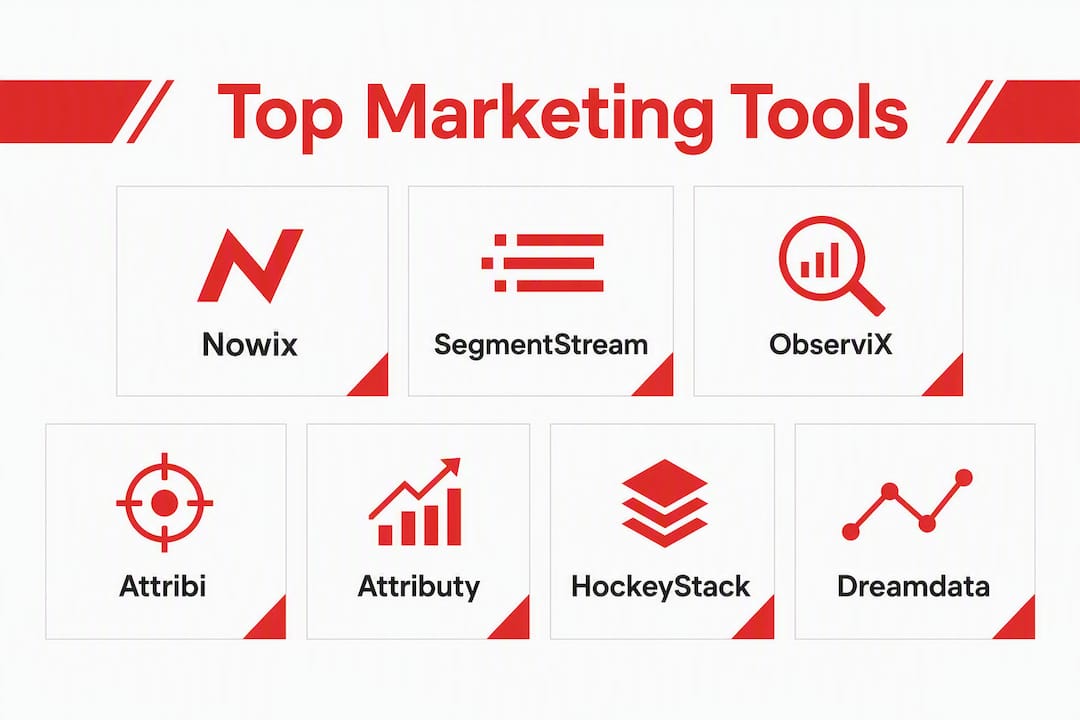
Top picks: vendor profiles and verdicts
Nowix — Amplify Your Reach and X Management
Nowix operates where most attribution software stops: at the execution layer. When you run a coordinated creator launch on X with up to 700 micro-KOLs inside a one-hour window, the measurement problem is not the dashboard. It is enforced UTM discipline across every creator brief, server-side first-party event collection, and closed-loop reporting that ties amplification back to pipeline. Nowix handles all three as a managed service.
Best for: Tech and AI brands that need a coordinated timeline takeover with auditable attribution, not a self-serve tool they have to configure themselves.
- Enforced UTM tagging across every creator post
- Server-side CNAME event collection for social-first traffic
- Closed-loop campaign reports tied to revenue events
- Ongoing X account management with integrated measurement (X Management retainer)
Pricing is project-based for campaign execution and monthly retainer for account management. No public rate card; contact for scope.
SegmentStream

SegmentStream pairs multi-model MTA with automated weekly budget rebalancing and expert-led incrementality testing. For teams spending above $50K/month across paid channels, the budget-automation layer is the real differentiator: the platform moves spend based on attribution signals rather than waiting for a human to act on a report.
Best for: High-spend performance teams that want measurement and budget action in one platform.
- Multi-touch + algorithmic models
- Automated budget rebalancing (vendor claim)
- Incrementality testing support
- GA4, Meta, Google Ads, and CRM integrations
ObserviX
ObserviX exposes six attribution models simultaneously and lets you run one-click comparisons between them tied to revenue metrics. The live budget simulation feature shows before-and-after ROAS projections for spend shifts, which makes it useful for weekly budget reviews with finance.
Best for: Revenue-focused teams that want to compare models in parallel rather than commit to one.
- Six models including AI-driven approaches
- Real-time revenue dashboards with blended ROAS by channel
- Budget shift simulation
- Server-side data collection
Attribi
Attribi focuses on closing the loop between CRM-verified conversions and ad platforms. It pushes verified conversions back to Google Ads, Meta CAPI, LinkedIn, TikTok, and Microsoft, and supports bidirectional CRM syncing so closed-won revenue flows back into attribution models. First-party CNAME tracking is included, which matters as third-party cookies continue to erode.
Best for: Teams that need true ROAS rather than proxy metrics, with broad ad-platform upload coverage.
Attributy
Attributy re-fits its models daily, redistributing credit as new journey patterns arrive rather than applying fixed positional rules. Path-level traceability lets you audit exactly which touches received credit and why. That transparency is valuable when stakeholders question why a mid-funnel channel is receiving less credit than expected.

Best for: Teams that distrust static models and want daily recalibration with auditable credit paths.
HockeyStack
HockeyStack connects dark-funnel B2B activity, including LinkedIn impressions and content touches that never produce a click, to pipeline and revenue. G2 reviewers highlight its ability to surface influence from channels that last-click models record as zero. It integrates with Salesforce and HubSpot natively and supports server-side data collection.
Best for: B2B SaaS and revenue teams that need to justify spend on LinkedIn and content programs to a CFO.
Dreamdata
Dreamdata maps the full B2B revenue journey from first anonymous touch to closed-won deal, with account-level attribution that aggregates individual touchpoints across buying committees. It connects to Salesforce, HubSpot, and major ad platforms via server-side and ETL pipelines.
Best for: B2B SaaS teams with long sales cycles and multiple stakeholders per account.
Additional tools worth knowing
Triple Whale uses a “Total Impact” blended model that combines multi-touch tracking with survey-based zero-party data to capture influencer assists that last-click misses entirely. It is purpose-built for Shopify DTC brands. Northbeam runs algorithmic MTA server-side and is a strong fit for DTC brands that need granular channel-level ROAS without relying on platform-reported numbers. Ruler Analytics tracks calls, forms, and chat leads back to the originating campaign across six attribution models, making it the go-to for agencies and B2B teams where offline conversions matter. Rockerbox and Fospha both target omnichannel and e-commerce brands needing privacy-safe MTA with server-side collection. Measured is the right choice when incrementality testing is the primary job, not just a supplementary check. Adobe Marketo Measure (Bizible) handles enterprise B2B attribution on Salesforce and Marketo stacks but carries significant implementation complexity and cost. HubSpot Marketing Hub offers seven built-in attribution models for teams already on HubSpot CRM, with near-zero setup friction. AppsFlyer leads for mobile-first attribution. CaliberMind and Integrate serve account-based B2B demand teams. Invoca is the specialist for phone-call-driven revenue. Hyros, Wicked Reports, Cometly, and Usermaven each serve specific niches: high-ticket advertisers, SMB e-commerce, performance marketers, and privacy-first SaaS teams, respectively. Funnel operates as a data aggregation layer rather than an attribution engine, useful when you need a clean data foundation before modeling. WhatConverts and LeadsRx round out the list for agencies tracking lead quality and multi-channel advertisers wanting impartial MTA.
Pro Tip: For B2B teams, check whether the tool supports account-level attribution, not just user-level. A single deal may involve six contacts across three months. User-level MTA alone will fragment that journey and undervalue early-stage content.
How do you choose the right attribution tool for your team?
Evaluation checklist
Start with your primary job-to-be-done. Every tool on this list does something well; none does everything equally well.
- Define your measurement maturity. Are you still on last-click GA4 reporting, or do you already have CRM-synced revenue data? Your current state determines how much implementation lift you can absorb.
- Map your channel mix. Paid search, paid social, creator/influencer, email, and offline channels each have different tracking requirements. Confirm the tool handles your specific mix before shortlisting.
- Confirm CRM sync direction. Bidirectional sync (closed-won revenue flowing back into attribution models) is non-negotiable for B2B teams. Unidirectional sync produces proxy metrics, not true ROAS.
- Check incrementality support. Measuring attribution without incrementality validation risks over-investing in channels that would have converted without spend. Ask every vendor how they support geo-lift or holdout experiments.
- Assess server-side readiness. Privacy changes make server-side tracking increasingly essential. Confirm whether the vendor supports CNAME first-party collection and Meta CAPI / LinkedIn Conversions API.
- Evaluate model transparency. Can you see how credit is assigned? Opaque black-box models make it impossible to audit or explain results to stakeholders.
- Estimate total cost of ownership. Platform fees are only part of the cost. Add data engineering, pro services, and ongoing maintenance. Typical implementation runs several weeks for baseline setup and additional weeks for closed-loop revenue measurement with advanced modeling.
Vendor interview questions
- How do you handle conversions from users who have not consented to tracking?
- Do you support server-side tracking and CAPI integrations natively, or does that require custom engineering?
- What does closed-loop revenue ingestion look like in practice? Can you show a live example with CRM field mapping?
- How long does it take to go from contract to first attribution report?
- What does your incrementality testing methodology look like, and what is the minimum spend threshold to run a valid test?
Red flags to watch for
- Credit assignment is opaque with no model explanation or path-level audit trail
- No bidirectional CRM sync option
- Vendor is locked to a single ad ecosystem (e.g., Google-only or Meta-only)
- Promises of immediate ROI lift without a baseline measurement period
- No incrementality or holdout testing capability
What does implementation actually require?
Getting attribution right is mostly an engineering and data-governance problem, not a dashboard problem. Implementation quality often determines attribution accuracy more than the dashboard itself.
Integration priorities by role
Marketing owner:
- Audit and enforce UTM naming conventions across every campaign and creator brief before launch
- Define conversion events and revenue fields that map to CRM stages
- Align with finance on which revenue metric (pipeline, closed-won, or LTV) feeds attribution models
Analytics / engineer:
- Deploy server-side collection (CNAME or vendor-hosted endpoint) to preserve event data under privacy constraints
- Connect Meta CAPI and LinkedIn Conversions API at the server level
- Map CRM fields bidirectionally so closed-won revenue returns to attribution models
- Validate that GA4 and the attribution platform are receiving consistent event data
Vendor:
- Provide a field-mapping specification and a data-parity SLA before go-live
- Confirm consent-handling logic for non-consented conversions
- Deliver a QA checklist for the first 14 days post-launch
Common technical pitfalls
- Broken UTM discipline: creators or campaign managers using inconsistent or missing UTM parameters, causing viral-launch traffic to register as direct or organic
- Missing server-side events: relying solely on browser-side pixels that are blocked by ad blockers or iOS privacy changes
- Incorrectly mapped revenue fields: CRM stage names that do not match the attribution platform’s expected field schema
- Consent handling gaps: conversion events firing for users who have opted out, creating compliance exposure
Pro Tip: Deploy server-side CNAME tracking before you connect any ad-platform APIs. If your event collection is broken at the source, every downstream model is wrong. Fix the pipe before you read the meter.
For creator-driven campaigns specifically, enforce UTM discipline at the creator brief stage, not after launch. See the micro-influencer campaign framework for a practical tagging checklist built for timeline takeovers.
MTA vs. MMM vs. incrementality: which method should you use?
These three measurement approaches answer different questions. Using only one gives you an incomplete picture.
Multi-touch attribution (MTA) answers: which touchpoints in the customer journey received credit for a conversion? It operates at the individual user or account level and is best for tactical channel optimization and creative-level decisions. Modern platforms offer multiple models, including AI-driven dynamic weighting, so you can compare credit distributions across first-touch, last-touch, linear, time-decay, and position-based models simultaneously rather than committing to one.
Marketing-mix modeling (MMM) answers: how does aggregate spend across broad channels correlate with revenue over time? It works at the macro level, incorporates offline channels and external factors like seasonality, and is the right tool for annual budget allocation decisions. It does not operate at the individual touchpoint level.
Incrementality testing answers: did this spend actually cause additional conversions, or would those customers have converted anyway? Geo-lift and holdout experiments are the gold standard. Without incrementality validation, MTA can assign high credit to channels that are merely present in high-intent journeys rather than causing them.
Recommended pairings
- MTA + incrementality: tactical channel and creative optimization; run holdout experiments on your top two or three channels quarterly
- MMM + MTA: high-level budget allocation (MMM) combined with in-channel optimization (MTA); appropriate for teams spending $500K+/year across multiple channels
- All three: justified when scale and budget make the cost of a wrong allocation decision larger than the cost of running all three measurement programs
A practical example: a DTC brand running paid social and creator campaigns attributed 40% of conversions to a retargeting audience in their MTA model. A geo holdout test showed that audience converted at nearly the same rate in the holdout region with no retargeting spend. The MTA credit was real in the data but not incremental in the market. Cutting retargeting spend by 30% and reallocating to creator amplification held revenue flat while improving margin.
How do you attribute creator and social-first campaigns accurately?
Creator campaigns on X present a specific measurement gap: most of the impact is amplification and narrative, not direct clicks. Last-click models record viral launches as “direct” or “organic” when UTM tagging is absent or inconsistent. The fix is upstream, not in the dashboard.
Enforcement checklist for creator campaigns
- Include UTM parameters in every creator brief as a mandatory deliverable, not a suggestion
- Use a CNAME or server-side endpoint to collect events from social-driven traffic before it hits the browser
- Run creative-level A/B tests across creator cohorts to isolate which narratives drive conversion, not just reach
- Combine click-based MTA with a post-campaign survey (zero-party data) asking customers how they first heard about the brand
- Follow up high-performing launches with a geo holdout or dark-period test to validate that the attributed lift was incremental
Blended or “Total Impact” models combine multi-touch tracking with survey-based data to capture influencer assists that appear as zero-impact under last-click measurement. For X campaigns specifically, quote-retweets and comment amplification rarely produce trackable clicks but do move brand search volume and direct traffic. Survey attribution captures that signal.
Pro Tip: Wait at least 30 days of conversion data before trusting AI-driven attribution models. Models trained on thin data overfit to early patterns and misattribute credit. Run rule-based models in parallel during the first month as a sanity check.
For a deeper look at how X influencer marketing agencies handle tagging enforcement across coordinated launches, the operational detail matters more than the model choice.
How were these tools evaluated?
Gartner Peer Insights defines B2B multi-touch attribution tools by their support for model variety, identity resolution, integrations, and AI-driven insights. That framework shaped the evaluation criteria here.
Evaluation criteria
- Attribution model variety: does the tool support at least first-touch, last-touch, linear, time-decay, and one algorithmic or AI-driven model?
- CRM sync: bidirectional sync with Salesforce and HubSpot, with closed-won revenue returning to attribution models
- Server-side support: native CNAME, Meta CAPI, and LinkedIn Conversions API integrations
- Incrementality capabilities: built-in or partner-supported geo-lift and holdout testing
- Budget optimization: automated or semi-automated spend rebalancing based on attribution signals
- Methodology transparency: can you audit credit assignment at the path or touchpoint level?
- Security and compliance: SOC 2 certification, GDPR/CCPA consent handling, and data residency options
- Time to value: realistic baseline setup in 2–8 weeks; closed-loop revenue measurement in 8–12+ weeks
Data sources
- Vendor product pages and published documentation
- Independent reviews on Gartner Peer Insights and G2
- Published vendor comparisons and roundups
- Vendor demos and public case studies
Limitations
Vendor claims about setup speed and model accuracy are self-reported. Before signing a contract, require a proof-of-concept with your own data and a data-parity SLA. Specifically: ask the vendor to push closed-won revenue from your CRM back to at least one ad platform during the pilot and show you the field-level mapping. That single test reveals more about implementation quality than any demo.
Key Takeaways
The most important decision in attribution is not which model to use. It is whether your data collection is clean enough for any model to produce reliable results.
| Point | Details |
|---|---|
| Match tool to your primary job | Pick the tool that fits your measurement maturity and channel mix, not the one with the most features. |
| Server-side and CRM sync first | Deploy server-side collection and bidirectional CRM sync before trusting any attribution model’s output. |
| Pair MTA with incrementality | MTA alone can credit channels that are present but not causal; holdout tests validate which spend is actually driving lift. |
| Budget several weeks for setup | Baseline attribution takes 2–8 weeks; closed-loop revenue measurement with advanced modeling takes 8–12+ weeks. |
| Nowix for X campaigns | For coordinated creator launches on X, Nowix combines enforced UTM discipline, server-side collection, and closed-loop reporting as a managed service. |
What practitioners actually learn when measuring social campaigns
The speed-versus-accuracy tradeoff is real and rarely discussed honestly. When you launch a creator wave on X with 700 micro-KOLs inside a one-hour window, you need UTM enforcement baked into the creator brief before the campaign goes live. There is no retroactive fix. If the tagging is broken at launch, the first 48 hours of traffic, often the highest-volume period, is unattributable. That is not a dashboard problem. It is a workflow problem.
The second lesson: channel-level measurement and creative-level measurement require different setups. Most teams optimize at the channel level (paid social vs. organic vs. creator) but make creative decisions based on platform-reported metrics that are increasingly unreliable. Running creative-level A/B tests across creator cohorts, with server-side event collection, gives you a cleaner signal than any platform dashboard.
The candid view: when a tech brand is running a coordinated viral launch on X, a managed agency approach like Nowix is faster and more measurement-sound than a self-serve attribution platform. The platform gives you a dashboard. The agency gives you enforced tagging, coordinated distribution, and a report that ties amplification to revenue events. For a one-time launch, that operational control is worth more than another SaaS subscription.
Nowix runs measurement-led X campaigns so you get credit for every creator post
Most attribution software assumes your traffic arrives via clean, tagged links from paid channels. Creator campaigns on X do not work that way. Amplification spreads through quote-retweets, replies, and organic shares that most tools record as direct or unattributed traffic.

Nowix solves that at the execution layer. Every creator brief includes enforced UTM parameters. Events are collected server-side via CNAME before they hit the browser. And closed-loop campaign reports tie amplification activity back to pipeline and revenue events, giving you the same audit trail you expect from paid search. You get coordinated distribution across up to 700 vetted micro-KOLs inside a one-hour launch window, plus the measurement infrastructure to prove what moved.
For brands that need ongoing measurement without building internal capabilities, the X Management retainer covers daily content, community engagement, and integrated measurement in one engagement. To start with a single campaign, the Amplify Your Reach service is the right entry point. Book a scoping call to define your pilot, set your conversion events, and run your first 30-day attribution sprint.
Useful sources and further reading
These sources were used to build the shortlist and evaluation framework. Each is worth bookmarking for ongoing vendor research.
- Gartner Peer Insights — B2B Multi-Touch Attribution Tools: The authoritative enterprise definition of what B2B attribution tools must support, including model variety, identity resolution, and AI-driven insights. Use it to benchmark any vendor’s feature claims.
- Triple Whale — Total Impact Attribution: The clearest public explanation of blended total-impact models that combine click tracking with survey data to capture influencer assists.
- Adobe Marketo Measure (Bizible): Enterprise B2B attribution on Salesforce and Marketo stacks. The documentation on offline conversion integration and CRM field mapping is detailed and useful even if you are evaluating other tools.
- Nowix — X Influencer Marketing Agencies: Covers how top agencies enforce tagging and measurement across coordinated creator campaigns on X.
- Nowix — Coordinated X Marketing Campaign: Timeline Takeover Mechanics: Operational detail on blended attribution for community-driven brand campaigns, including how survey data combines with UTM tracking.
- Revenue Operator — Creator Monetization Insights: Practical notes on creator monetization and revenue measurement, including blended and total-impact model approaches for creator economy campaigns.
Before finalizing any vendor, request a proof-of-concept that includes pushing closed-won revenue from your CRM back to at least one ad platform. That single test is the fastest way to validate whether a vendor’s implementation claims match reality.