
Micro influencers win on conversions and niche trust. Macro influencers win on reach and speed. If you need both, run them in sequence. That’s the verdict. Everything below explains why, with benchmarks and a decision framework you can use in your next brief.
Pick micro when your primary KPI is engagement rate, affiliate conversions, or community credibility in a defined niche. Pick macro when you need fast impressions at scale, a product launch window, or a brand-awareness spike. Run both when your campaign has two phases: open wide, then convert deep.
The core trade-off is simple. Macro influencers compress your timeline. Micro influencers compress your cost-per-conversion. Neither is universally better. The right choice depends on your goal, audience, and budget — and the smartest campaigns use both.
Key Takeaways
Micro influencers win on cost-per-conversion and niche trust; macro influencers win on speed and reach; hybrid campaigns that sequence macro awareness with micro conversion consistently outperform single-tier approaches on X.
| Point | Details |
|---|---|
| Tier selection by KPI | Match macro to impressions/reach goals; match micro or nano to engagement rate, CPA, and affiliate conversions. |
| Engagement rate vs. absolute interactions | Micro creators average 2–5% engagement; a macro creator at 1% on 800K followers still generates 8,000 raw interactions. |
| Budget rule of thumb | A micro pool of a moderate number of creators often delivers more interactions per dollar than a single macro post, depending on campaign specifics. |
| Hybrid sequencing | Run macro on day one for awareness, then activate micro-KOLs over weeks two and three to sustain conversation and drive conversions. |
| Nowix for X campaigns | Nowix coordinates up to 700 creators in a single launch window, combining macro reach with micro amplification and built-in attribution. |
Table of Contents
- How influencer tiers are defined (and why the ranges matter)
- Micro vs. macro influencers: the head-to-head comparison
- Pros, cons, and the campaign types where each tier excels
- Pricing ranges and engagement benchmarks to budget by tier
- The Nowix decision framework: pick your tier in five steps
- How to measure influencer success and attribute results
- Checklist: questions to answer before you brief an influencer
- What Nowix sees working in 2026
- Nowix runs hybrid micro+macro campaigns on X
- Sources
How influencer tiers are defined (and why the ranges matter)
The industry uses five tiers. Agencies don’t always agree on exact cutoffs, so confirm which thresholds your partner uses before signing a contract.
According to HubSpot’s influencer marketing guide, nano influencers average around 4.39% engagement, the highest of any tier. That number drops as follower counts climb. Why do ranges matter operationally?
- Availability: Micro and nano creators are far more abundant, giving you negotiation leverage and pool depth.
- Scale: Macro and mega creators are scarce. One cancellation can derail a campaign.
- Budget flexibility: Pooling 10 micro creators often costs less than one macro post and generates more total interactions.
Note that some practitioners place macro at 100K–1M rather than 500K–1M. Neal Schaffer’s breakdown of macro influencers flags this variation directly. Always confirm the threshold a partner uses in writing.
Micro vs. macro influencers: the head-to-head comparison
Here’s how the two tiers stack up across the dimensions that actually move campaigns.
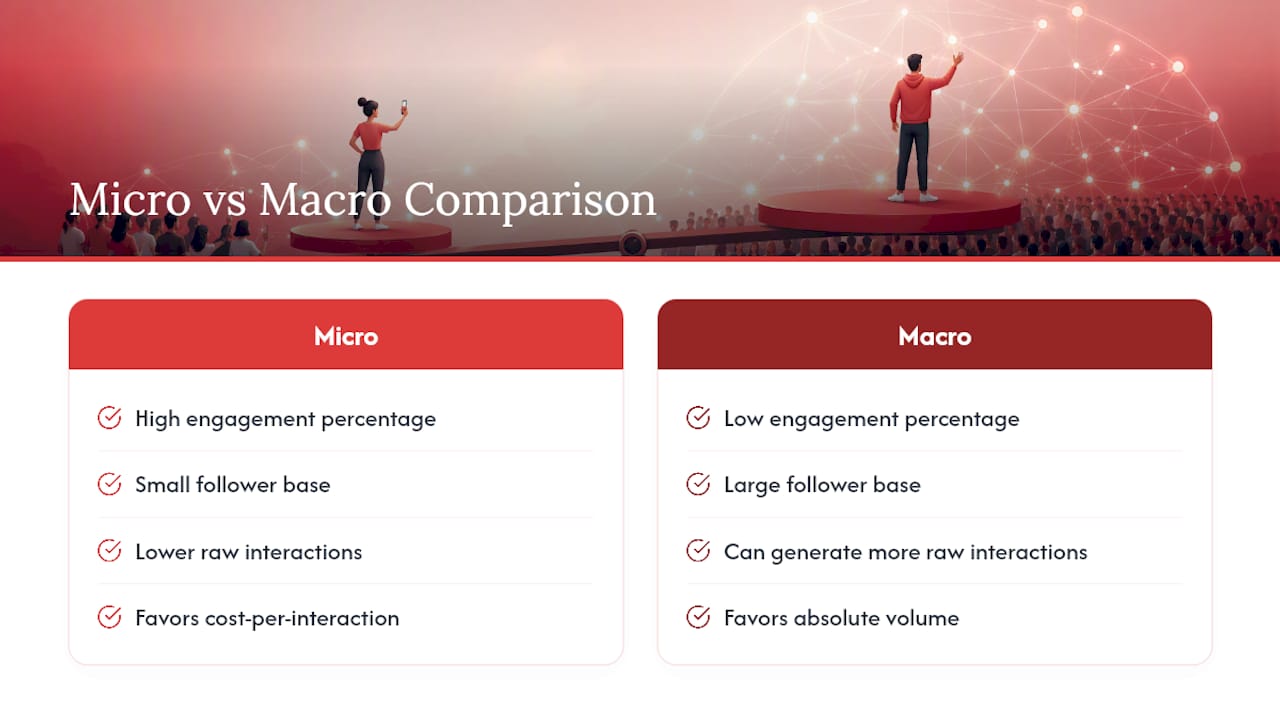
MarketingProfs notes that a low engagement percentage on a large follower base can still generate more raw interactions than a high percentage on a small one. The math matters when you’re choosing between absolute volume and cost-per-interaction.
Pros, cons, and the campaign types where each tier excels
Micro influencers: what you gain and what you give up
- Pros: Higher engagement rates, niche audience alignment, affordable per-collaboration, flexible contract terms, strong for UGC and affiliate programs, easier to pool for scale.
- Cons: Limited absolute reach per creator, more coordination overhead, inconsistent production quality, harder to vet at volume.
Macro influencers: what you gain and what you give up
- Pros: Fast broad reach, polished content, strong for brand-awareness bursts, fewer contracts to manage, credibility by association.
- Cons: Lower engagement rates, higher cost per post, less niche precision, harder attribution, longer negotiation timelines.
Use-case matrix
| Campaign Type | Recommended Tier |
|---|---|
| Product launch (awareness burst) | Macro or mega |
| Community seeding / niche penetration | Micro or nano |
| Affiliate-driven sales | Micro or nano |
| UGC content library | Micro |
| Retail promotion support | Mid-tier or macro |
| Hybrid (awareness + conversion) | Macro opens, micro converts |
Three quick scenarios:
Micro-led: A B2B SaaS brand seeds a new feature to developer communities on X using 40 micro-KOLs with 15K–60K followers each. Promo codes track conversions. Cost: under $30K. Result: high comment volume, strong affiliate attribution, and a UGC library the brand repurposes.

Macro-led: A consumer app needs 10M impressions in 72 hours for a launch window. Two macro creators on X and Instagram deliver the reach. Cost: $40K–$60K. Attribution relies on lift testing and branded hashtag tracking.
Hybrid: A fintech brand runs a macro creator post on day one to seed awareness, then activates 25 micro creators over the following two weeks to sustain conversation and drive sign-ups via affiliate links. Campaign formats like sponsored posts, affiliate codes, and gifting work across both tiers, making hybrid sequencing practical for most budgets.

Pro Tip: Brief your micro creators AFTER the macro post goes live. Let them react to existing momentum rather than creating it from scratch. Paid momentum tips into organic coverage faster when micro creators amplify a signal that already exists.
Pricing ranges and engagement benchmarks to budget by tier
Hootsuite’s influencer marketing guide publishes the following per-post cost bands. Note that these widen when bundled services (content production plus posting) are included, and platform matters: X, Instagram, TikTok, and YouTube each carry different rate norms.
Sample 30-day budget calculation:
Option A — micro pool: 15 micro creators at an average of $800 per post = $12,000.
Option B — single macro: 1 macro creator at $15,000.
For X-specific rate benchmarks, the platform tends to run lower than Instagram for equivalent follower counts, which makes X a strong channel for micro-pool campaigns on tighter budgets.
Negotiation notes:
- Micro creators typically accept usage rights for 30–90 days, shorter exclusivity windows (often 30 days), and are open to performance bonuses tied to affiliate revenue. They are often more flexible on terms than macro creators, which matters when you’re running a pool of 20+.
- Macro creators usually require longer lead times (4–6 weeks), charge separately for usage rights extensions, and expect kill fees of 25–50% if a campaign is canceled after brief delivery.
Pro Tip: For micro pools, use a standardized creator brief with a fixed rate card. Negotiating individually with 20 creators at different rates creates budget chaos and delays. Set the rate, send the brief, and let creators opt in.
The Nowix decision framework: pick your tier in five steps
Use this flow before every influencer brief. It takes under 10 minutes and prevents the most common planning mistakes.
- Define your primary KPI. Impressions and reach point to macro. Engagement rate, CPA, and affiliate conversions point to micro. Both together point to hybrid.
- Pick your tier(s). Use the rules-of-thumb checklist from the comparison section. Confirm follower-range definitions with your platform partner.
- Set content scope and creative control. Micro creators need a brief with talking points and a promo code. Macro creators need a full creative brief, approval workflow, and a usage rights clause.
- Set measurement windows. Report at 24 hours (early signal), 7 days (engagement plateau), and 30 days (conversion attribution). Platform-specific KPIs matter here: X campaigns should track engagement rate benchmarks separately from Instagram or TikTok.
- Decide on amplification. Organic creator posts alone rarely sustain momentum past 48 hours. Budget for quote-retweet amplification or paid support to extend the window.
Sample timelines:
Awareness-first (macro-led): Week 1: macro creator post + paid amplification. Week 2: PR pickup and organic sharing. Weeks 3–4: micro creators sustain conversation and drive affiliate links.
Conversion-first (micro-led): Week 1: brief and onboard micro pool, seed affiliate codes. Weeks 2–3: staggered posting for sustained feed presence. Week 4: report on CPA and repurpose top UGC.
Hybrid: Day 1: macro creator fires the launch post. Days 2–14: micro-KOLs amplify with QRTs and original takes. Day 15+: brand repurposes top UGC and runs paid support on best-performing posts.
Nowix’s operator framework for timeline takeovers covers the coordination mechanics for running dozens to hundreds of creators inside a single launch window on X.
KPI checklist for briefs:
- Impressions (total)
- Reach (unique accounts)
- Engagement rate (interactions ÷ impressions)
- Comments-to-impressions ratio (quality signal)
- Link CTR (if driving traffic)
- Conversion events (sign-ups, purchases)
- Cost per acquisition (CPA)
Pro Tip: Attach KPIs to the creator brief, not just the internal media plan. Creators who know what you’re measuring tend to optimize their content accordingly, especially on X where comment volume and QRT behavior directly affect algorithmic reach.
How to measure influencer success and attribute results
Attribution is where most influencer campaigns lose credibility with finance teams. Here’s what works.
KPI definitions:
- Impressions: Total times the post was displayed. A vanity metric on its own; useful for reach campaigns.
- Reach: Unique accounts that saw the post. More meaningful than impressions for awareness goals.
- Engagement rate: (Likes + comments + shares + saves) ÷ impressions. The primary quality signal.
- Comments-to-impressions ratio: A tighter quality check. High comment volume relative to impressions signals genuine audience response.
- Link CTR: Clicks on a tracked link ÷ impressions. Requires UTM parameters or a short link.
- Conversion events: Tracked actions (sign-up, purchase, download) tied to the campaign via pixel or affiliate link.
- CPA: Total campaign spend ÷ number of conversions.
Attribution methods and their trade-offs:
- Promo codes: Easy to deploy, easy to track. Leakage happens when buyers share codes. Best for micro pools.
- Affiliate links: Accurate at the click level. Requires a platform (Impact, ShareASale, or similar). Works well for micro and nano creators.
- UTM parameters: Track traffic source in Google Analytics. Doesn’t capture offline or dark social conversions.
- Pixel events: Most accurate for conversion tracking. Requires the creator to use your link; doesn’t work for organic mentions.
- Lift testing / holdout groups: Gold standard for macro campaigns. Expensive and requires statistical rigor. Justified for campaigns above $50K.
Reporting cadence:
- 24 hours: Check early engagement signal. Flag underperforming posts for amplification.
- 7 days: Engagement plateau. Pull reach, engagement rate, and link CTR. Adjust amplification budget.
- 30 days: Full attribution window. Report CPA, total conversions, and cost-per-interaction.
The global influencer marketing market has grown substantially year over year, which means executive teams are increasingly asking for ROI proof. A clean attribution setup before launch is the only way to deliver it.
For X-specific audience targeting that pairs with your influencer campaign, layer in follower targeting and interest segments to extend the reach of top-performing creator posts.
Checklist: questions to answer before you brief an influencer
Selection checklist:
- Does the creator’s audience match your target demographic (age, location, interest)?
- Have you reviewed their last 10 posts for content quality and consistency?
- Does their engagement look authentic? Check for comment quality, not just volume.
- Have you confirmed their follower growth trend (no sudden spikes)?
- Do they have prior brand partnerships in your category? Any conflicts?
- Are they willing to share analytics screenshots before signing?
Contract clauses to request:
- Deliverables: post count, format, platform, and deadline
- Approval workflow: how many rounds, turnaround time
- Exclusivity: category and duration (30, 60, or 90 days)
- Usage rights: duration, channels, and paid amplification rights
- Performance clause: what happens if the post underperforms
- Kill fee: percentage owed if the brand cancels after brief delivery
Red flags:
- Follower count spiked sharply in a short window with no clear reason
- Comments are generic (“Great post!” “Love this!”) with no specifics
- Content is almost entirely sponsored with no organic posts
- Creator refuses to share platform analytics before signing
- No prior experience with creator briefs or approval workflows
Finding and vetting influencers on X requires platform-specific checks that differ from Instagram vetting. X engagement patterns, QRT behavior, and reply quality are the signals that matter most on that platform.
What Nowix sees working in 2026
The conventional wisdom says pick a tier and commit. What we see in practice: the brands getting the best conversion outcomes on X are running hybrid campaigns where macro creators fire the launch signal and micro-KOLs sustain the conversation. The macro post creates the moment. The micro pool makes it last.
Two trends practitioners should plan for right now:
Creator-led amplification is replacing paid social as the primary awareness driver for tech launches. Coordinating 50–700 creators inside a one-hour window produces a timeline density that paid ads can’t replicate. The feed effect is real: when multiple trusted voices post simultaneously, the signal reads as organic consensus rather than advertising.
Measurement expectations are tightening. Finance teams that approved influencer budgets on reach alone in 2023 are now asking for CPA and conversion attribution. If you can’t show a clean attribution setup before the campaign launches, you’ll lose the budget in the next planning cycle. Build the tracking infrastructure first, then brief the creators.
Pro Tip: When running hybrid campaigns, give your macro creator the full brief first and get content approved before briefing the micro pool. Micro creators should react to and amplify the macro post’s framing, not contradict it. Consistent messaging across tiers is what makes the campaign feel like a movement rather than a collection of sponsored posts.
Nowix runs hybrid micro+macro campaigns on X
Tech and AI brands that need both reach and conversion don’t have to choose between tiers. Nowix coordinates UP TO 700 CREATORS in a single launch window on X, combining macro-level awareness with micro-KOL amplification that sustains momentum past the first 48 hours.
You send the brief and the goals. Nowix handles creator sourcing, brief distribution, approval workflows, and post-amplification via controlled QRTs and comments from vetted micro-influencers. The result: paid momentum that tips into organic coverage, with clean attribution built in from day one.
For brands that want ongoing presence, Nowix also offers full X account management covering strategy, daily content, replies, and community engagement on a monthly retainer. Whether you need a one-time launch or a sustained creator wave, the infrastructure is already built.
Amplify your next campaign on X and see how a coordinated creator pool performs against a single macro post.
Sources
These are the primary benchmarking sources used throughout this article. Each one covers a specific planning dimension.
- Influencer Marketing Strategy: How to Build a Plan Creators & Customers Will Love + Templates
- Influencer marketing: Top strategies to maximize ROI in 2026
- Micro vs Macro Influencers: Guide To Influencer Types (2026) - Shopify Ireland
- Micro vs Macro Influencers: Optimize Your Influencer Marketing Strategy | MarketingProfs
- Statista