
A retweet shares another user’s post exactly as-is to your followers with zero commentary. A quote tweet embeds that same post inside a new post you write, letting you add your own text, images, or reactions above it. That single difference changes everything: your visibility, your engagement metrics, and how the X algorithm treats your content.
Here is the short version:
- Retweet (now called repost): shares the original post unchanged; engagement credits the original author; no separate metrics for you
- Quote tweet (now called quote post): creates a brand new post on your profile with the original embedded below; earns its own likes, replies, and bookmarks
- Visibility: retweets amplify someone else’s voice; quote tweets position the content as yours
- Undo: retweets undo instantly with one click; quote tweets must be deleted like any original post
- Notifications: quote tweets notify the original author; retweets do not
- Replies work differently from both and are covered further below
Table of Contents
- What is a retweet and when does it make sense?
- What is a quote tweet and why does it build your brand?
- How do quote tweets and retweets actually differ?
- How to use retweets and quote tweets effectively on X
- What is a reply and how does it differ from both?
- Expert insights on getting the most from quote posts and retweets
- Key Takeaways
What is a retweet and when does it make sense?
A retweet, now officially called a repost on X, shares original content exactly as posted to your followers without any added commentary. Your name appears above the post with a “reposted” label, but the original author’s profile and words stay front and center. All engagement, every like and reply, accrues to the original post.
The retweet is a clean endorsement. You are telling your audience: “This is worth your time, and I have nothing to add.” That restraint is actually a strength in the right context.
Use a retweet when:
- You fully agree and the post needs no extra context
- You want to share breaking news or time-sensitive content fast
- You want to support someone without making their moment about you
- You have nothing meaningful to add beyond amplification
One important mechanic: retweets can be undone instantly. Click the repost icon again and it disappears from your profile and your followers’ feeds completely.
What is a quote tweet and why does it build your brand?
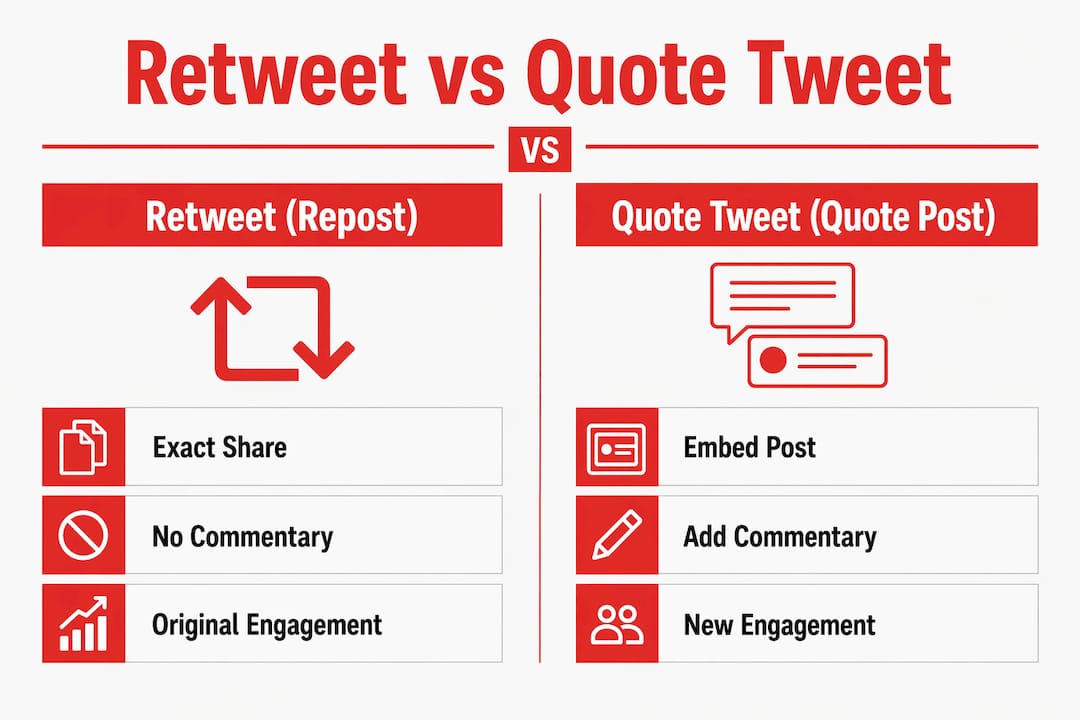
A quote tweet, officially a quote post on X, embeds the original post inside a new post you create. Your commentary sits at the top, full size, with the original content below it as supporting context. Your followers see your take first, then the source.

The strategic difference is real. Quote posts appear as original content on your profile and accumulate their own engagement metrics, completely separate from the original post. When someone visits your profile, they see your quote posts as part of your content output. They do not see your retweets unless they click a separate tab.
Key characteristics:
- Adds your own text, images, or other media above the embedded post
- Appears on your profile feed as an original post
- Generates its own likes, replies, and bookmarks independent of the original
- Notifies the original author, opening a door for relationship-building
- Cannot be undone instantly; must be deleted like any other post you have written
Pro Tip: Quote your own older posts to reactivate content that performed well. X’s algorithm treats it as a brand new post, giving it fresh distribution to your followers.
How do quote tweets and retweets actually differ?
The functional gap between these two features is wider than most users realize. Here is a direct comparison across the dimensions that matter for growth:
| Feature | Retweet (Repost) | Quote Tweet (Quote Post) |
|---|---|---|
| Appears on your profile main feed | No | Yes |
| Generates separate engagement metrics | No | Yes |
| Allows added commentary | No | Yes |
| Sends notification to original author | No | Yes |
| Can be immediately undone | Yes | No (must delete) |
| Algorithm treatment | Amplification signal | Scored as original content |
| Engagement attribution | Goes to original post | Goes to your new post |

The algorithm difference is where it gets interesting. X treats quote posts as original content, which means a strong quote tweet can reach people who do not follow you at all. A retweet only goes to your existing followers. It does not earn the same algorithmic push because you did not create anything new.
Engagement splits cleanly between the two formats: repost engagement accrues to the original post, while quote post engagement, every like, reply, and bookmark, highlights the quoter’s authority and builds their profile.
How to use retweets and quote tweets effectively on X
The biggest mistake on X is using the wrong tool for the job. Here is how to get it right:
- Retweet when the post is perfect as-is and you want to amplify without inserting yourself. News, data, and colleague wins are natural fits.
- Quote tweet when you have a specific perspective, counterpoint, or context your audience needs. The commentary has to add real value.
- Avoid quote tweeting with empty phrases like “this” or “agree.” Empty quotes degrade engagement and signal to your followers that your commentary adds nothing. If you have nothing to say, retweet instead.
- Balance your content mix: original posts for your core ideas, retweets for amplification, quote tweets for positioning and thought leadership.
- Consider reach: retweets reach your existing followers; quote tweets can reach beyond them through algorithmic distribution.
Best practice is to use reposts for amplification without commentary, replies for direct conversations, and quote posts when adding unique context, expert commentary, or a respectful counterpoint. Accounts that grow fastest use each format for its intended purpose.
Pro Tip: Quote tweets are one of the most effective tools for thought leadership on X. Every quote post that earns strong engagement is a public signal that your perspective adds value beyond the original source.
What is a reply and how does it differ from both?
Replies are a different animal entirely. When you reply to a post, your response lives inside that thread, visible primarily to the original poster and people who click into the conversation. It does not appear on your main profile feed by default.
Replies reach participants in the existing conversation, while quote posts broadcast to your followers as entirely new content. That asymmetry matters for growth: replies are tactical, quote tweets are strategic.
Use replies when:
- You are talking directly to the original author
- Your comment is quick, conversational, and belongs in context
- You want to build a one-on-one relationship without broadcasting
- You are participating in a thread discussion
Use quote tweets when you want your take to reach your own audience and stand as a separate piece of content on your profile. Replies nurture conversations. Quote tweets build your presence.
Expert insights on getting the most from quote posts and retweets
Social media practitioners who grow on X treat these two features as distinct tools with distinct jobs, not interchangeable options.
Quote tweets are treated by X’s algorithm as original posts, which makes them highly effective for content reactivation and reach expansion. A retweet is a passive amplification signal. A quote tweet is a new content event with its own distribution potential.
A few patterns worth knowing:
- Quote tweets notify the original author, which creates a relationship opportunity. Thoughtful commentary on a larger account’s post puts your name directly in front of them.
- Retweeting controversial content without a stated position is a credibility risk. Your followers see you amplified something divisive and have no idea where you stand. If you want to engage with controversy, quote tweet with a clear position.
- Successful X creators balance reposts, replies, and quote posts to avoid generic agreement, using quote tweets to frame conversations on their own terms.
- Quote tweets can revitalize older content. Quoting your own past post with fresh context gives it a second life in the algorithm.
- A retweet serves as a simple endorsement, with engagement credited to the original author, whereas a quote post appears on your profile as original content with its own engagement, building personal authority over time.
If you are building a brand on X, the ratio matters. Heavy retweet accounts look like curators. Heavy quote tweet accounts look like thinkers. The strongest profiles do both with intention.
Key Takeaways
A retweet amplifies without adding; a quote tweet creates new content with its own reach, metrics, and authority signal.
| Point | Details |
|---|---|
| Core difference | Retweets share posts as-is; quote tweets embed the original inside a new post you write. |
| Engagement attribution | Retweet engagement goes to the original author; quote tweet engagement builds your own profile metrics. |
| Algorithm treatment | X scores quote tweets as original content, giving them broader reach than plain retweets. |
| Undo behavior | Retweets undo instantly with one click; quote tweets must be deleted like any original post. |
| Strategic use | Use retweets for clean endorsement; use quote tweets when your commentary adds real value. |
If you want your tech or AI brand to show up in the right conversations on X, the difference between a retweet and a quote tweet is just the starting point. Nowix runs post amplification campaigns using vetted micro-influencers who deploy controlled quote posts and comments to put your content in front of the audiences that matter. From viral launch windows to full X account management, Nowix handles the execution so your brand drives the momentum.

Recommended
- Nowix | Go Viral on X, Amplification & X Management
- Go Viral on X: Timeline Takeover Campaigns | Nowix
- Amplify Your Reach on X: Organic Post Amplification | Nowix
- X Management: Brand Profiles Run by Practitioners | Nowix
Frequently asked questions
How does a creator quote post differ from a repost?
A quote post adds the creator’s context or perspective to the original post. A repost shares the original without that additional commentary. Choose the format around the explanation your audience needs.
How should paid amplification be reported?
Record the agreed creator deliverables, live post links and available metrics. Identify paid or coordinated activity and keep it separate from unprompted organic response and qualified leads.