Twitter Audience Targeting: The 2026 Marketer’s Guide

Twitter audience targeting is the practice of reaching specific users on X based on demographics, real-time keywords, follower lookalike signals, and conversation behavior unique to the platform. Unlike search-based channels, X surfaces intent through what people post and engage with right now, not just what they searched last week. That real-time signal is the platform’s sharpest edge for social media marketers. Users spend 26% more time viewing ads on X compared to other platforms, and native video generates 10x more engagement than external link ads. This guide covers how to identify your ideal audience, use every targeting option available, and run campaigns that actually convert.
What is Twitter audience targeting and why does it matter?
Twitter audience targeting, also called X audience segmentation in platform documentation, is the structured process of defining who sees your ads based on layered signals. Those signals include age, location, device type, interests, keywords used in recent posts, and the accounts a user follows. The combination gives marketers a level of behavioral specificity that static demographic filters alone cannot deliver.
The cost case for X is hard to ignore. X average CPM sits at $5.80 compared to LinkedIn’s $34.50 for similar professional audiences. That gap means B2B marketers can reach a comparable audience at a fraction of the spend, provided the targeting is tight enough to filter out noise.
X also provides demographic, interest, behavior, and device data for followers and engaged users. That data feeds directly into campaign configuration, so you are not guessing at who your audience is. You are reading it from actual platform behavior.

How to identify your ideal audience on X
Audience identification starts with Twitter Analytics. The platform’s native dashboard shows follower demographics, top interests, and device usage. Pull this data before you build a single ad group. It tells you whether your current followers skew toward mobile or desktop, which matters for creative format decisions.
Go deeper with these research methods:
- Hashtag monitoring: Search niche hashtags in your vertical and note which accounts post consistently. These are your audience proxies.
- Advanced search: Use X’s advanced search to filter posts by keyword, date range, and engagement level. This surfaces active conversations your audience is already having.
- Engagement pattern analysis: Look at which posts in your category generate replies versus likes. Replies signal a more engaged, opinionated segment worth targeting.
- Audience persona building: Map job roles, stated interests, and posting frequency into a persona. A fintech brand, for example, might find its core audience posts about DeFi, regulatory news, and founder content between 7:00 AM and 9:00 AM on weekdays.
Understanding how to identify your target audience before launching ads prevents wasted spend on segments that look right on paper but do not convert.
Pro Tip: Use X’s follower overlap signals by analyzing which accounts your best-performing followers also follow. That list becomes your seed set for follower lookalike targeting.
What targeting options does X offer?
X provides more targeting dimensions than most marketers use. The primary options break down as follows:
| Targeting type | Best use | Campaign objective |
|---|---|---|
| Demographic | Age, gender, location, language | Awareness, reach |
| Interest and behavior | Category-level affinities | Consideration, engagement |
| Keyword | Real-time post and search activity | Intent capture, conversion |
| Follower lookalike | Audiences similar to a specific account’s followers | Qualified reach, lead gen |
| Conversation and event | Users engaging with specific topics or live events | Relevance, timing |
| Custom audiences | CRM lists, email uploads | Retargeting, nurture |
| Pixel retargeting | Website or app visitors | Conversion, re-engagement |
Keyword targeting is the most distinctive option on X. It reaches users based on their activity within the last 7 days, capturing purchase intent at the moment it forms. That is fundamentally different from behavioral targeting on other platforms, which relies on historical data that can be weeks or months old.
Follower lookalike targeting connects your brand to users who share interests with the followers of a specific account. Point it at a niche publication or micro-influencer in your space, and you reach a concentrated, pre-qualified segment. Point it at a massive celebrity account, and you get volume with low relevance.
Layering multiple targeting types produces the best results. Combine keyword targeting with a demographic filter and a follower lookalike seed, and you narrow your audience to users who are actively discussing your topic, fit your buyer profile, and already follow voices in your space.
X also supports advanced retargeting methods including account-based retargeting, CRM pipeline retargeting, and third-party audience integration. These became critical after iOS 14.5 limited mobile attribution, giving X’s server-side pixel an advantage for conversion tracking.
How to build and launch a Twitter targeting campaign
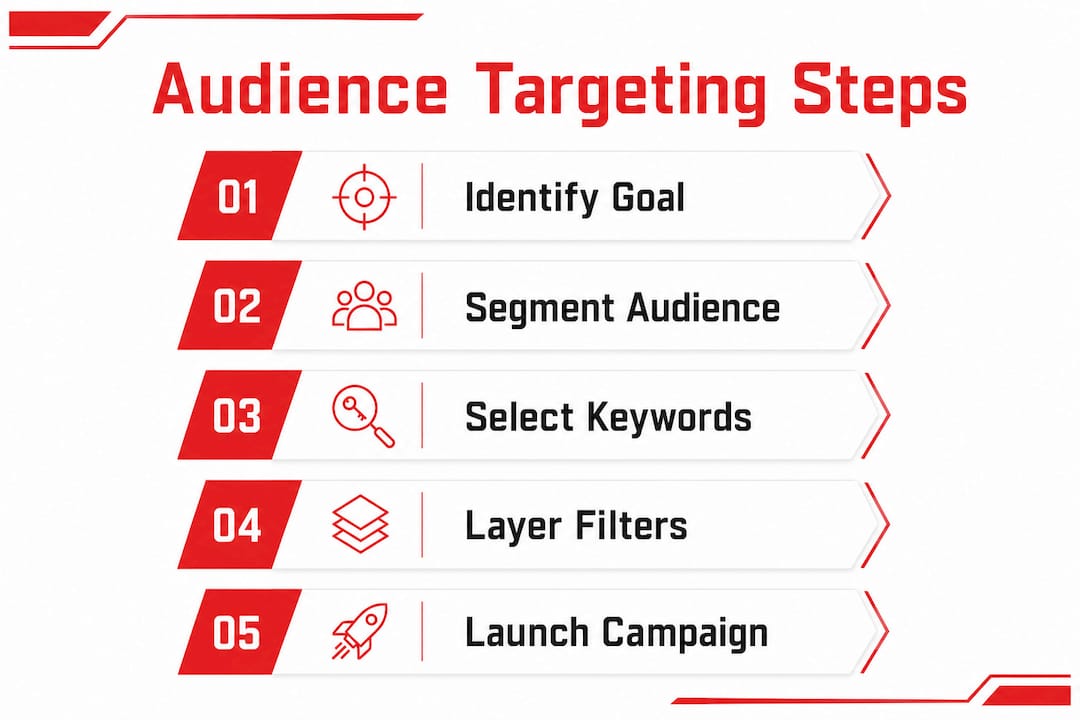
A well-structured campaign follows a clear sequence. Skip any step and you introduce waste.
- Install the X Pixel. Place it on your website before you run a single conversion campaign. Without it, you cannot retarget site visitors or track downstream conversions accurately.
- Upload your CRM list. Match your existing contacts to X users. This creates a custom audience for retargeting and a seed for lookalike expansion.
- Build your keyword list. Keep it to 25–50 tightly themed terms per ad group. Broad lists dilute intent signals. Add negative keywords to exclude irrelevant conversations. A cybersecurity brand, for example, would exclude “password” in a consumer context if it only sells enterprise products.
- Select match types. X supports exact match, phrase match, and broad match. Each ad group supports up to 750 keywords, but fewer, tighter terms outperform large, unfocused lists.
- Layer follower targeting. Add two to five niche accounts as follower seeds. Prioritize vertical publications and micro-KOLs over large general accounts.
- Structure by funnel stage. Run awareness campaigns with interest and demographic targeting. Run consideration campaigns with keyword and follower lookalike targeting. Run conversion campaigns with pixel retargeting and CRM custom audiences.
- Write native-style copy. X is a conversation platform. Ad copy that reads like a press release gets ignored. Write the way your audience posts: direct, opinionated, and short.
| Campaign stage | Primary targeting | Expected outcome |
|---|---|---|
| Awareness | Interest, demographic | Reach, impressions |
| Consideration | Keyword, follower lookalike | Engagement, clicks |
| Conversion | Pixel retargeting, CRM list | Leads, purchases |
Pro Tip: Schedule conversion campaigns around live events and trending topics in your vertical. Real-time keyword targeting captures users at peak intent, and timeline takeover campaigns can amplify that moment across a concentrated window.
Common mistakes that kill campaign performance:
- Using broad match keywords without negative keyword lists
- Targeting follower lookalikes from accounts with millions of followers instead of niche ones
- Running the same creative across all funnel stages
- Ignoring the X Pixel and relying on click-through attribution alone
How to measure and improve targeting performance
Performance measurement on X centers on five metrics: cost per click (CPC), cost per thousand impressions (CPM), click-through rate (CTR), conversion rate, and engagement time. Track all five. Optimizing for CTR alone can inflate clicks from low-intent users who never convert.
Best practices for ongoing optimization:
- Prune keywords weekly. Remove terms with high impressions and zero conversions. They consume budget without producing results.
- Rotate creative every two weeks. X audiences see content at high frequency. Creative fatigue sets in faster than on slower-feed platforms.
- Test audience segments separately. Do not mix keyword and follower lookalike targeting in the same ad group. Separate them so you can read which signal is driving performance.
- Use retargeting tiers. Segment your pixel audience by recency. Users who visited your site in the last 7 days convert at a higher rate than those who visited 30 days ago. Bid accordingly.
Understanding audience targeting fundamentals helps you read these metrics in context rather than reacting to individual data points in isolation.
Pro Tip: Align campaign launches with industry events, product announcements, or regulatory news in your vertical. Real-time keyword targeting on X captures users the moment they engage with breaking topics, which is a window no other platform replicates as well.
The organic post amplification layer matters here too. Paid momentum on X can tip into organic coverage when the right audience engages and QRTs your content. That secondary reach costs nothing and extends your targeting investment further than the ad budget alone.
Key Takeaways
Effective Twitter audience targeting requires layering keyword, follower lookalike, and retargeting signals rather than relying on any single method.
| Point | Details |
|---|---|
| Cost advantage over LinkedIn | X CPM averages $5.80 versus LinkedIn’s $34.50, making it a strong channel for B2B reach. |
| Keyword targeting is real-time | X keyword targeting captures user intent from the last 7 days of activity, not historical behavior. |
| Niche lookalikes outperform broad ones | Follower lookalike targeting works best on micro-influencers and vertical publications, not mass accounts. |
| Layer targeting for precision | Combining keyword, demographic, and follower signals produces tighter, higher-converting audiences. |
| Measure five KPIs, not one | Track CPC, CPM, CTR, conversion rate, and engagement time together to avoid optimizing for the wrong signal. |
The targeting mistake most X marketers keep making
Most X campaigns I see fail at the same point: marketers treat the platform like a search engine. They build keyword lists the way they would for Google, target broad match terms, and wonder why CPCs climb without conversions following.
X is a social platform first. The users you reach with keyword targeting are not in a search mindset. They are in a conversation mindset. That distinction changes everything about how you write copy, which keywords you choose, and how you structure your creative. A keyword like “cloud security” on Google captures someone actively researching a purchase. The same keyword on X captures someone reacting to a news story or debating a vendor’s latest breach. Those are different moments requiring different messages.
The follower lookalike mistake is equally common. Marketers seed their lookalike audiences from the largest accounts in their space because the follower counts feel impressive. The result is a broad, low-intent audience that looks good in reach reports and performs poorly in conversion reports. Niche micro-KOLs with 10,000 to 50,000 followers in a specific vertical produce far more concentrated audiences. The math is simple: a smaller, more relevant seed creates a tighter lookalike.
The cost arbitrage opportunity for B2B marketers is real and underused. Moving even a portion of LinkedIn budget to X, with tight keyword and follower lookalike targeting, can reach similar professional audiences at a fraction of the CPM. The creative approach has to change, but the audience is there.
— Nowix
Nowix runs the X targeting strategy you do not have time to build
Targeting on Twitter at a high level requires constant attention: keyword pruning, creative rotation, pixel management, and real-time conversation monitoring. Most brand teams do not have the bandwidth to do all of it well.
Nowix manages brand profiles on X for tech and AI companies, running the full targeting stack from follower lookalike expansion to keyword list refinement and campaign structuring by funnel stage. The team monitors real-time conversations to catch intent signals as they emerge, not after the moment has passed. If you want your brand’s X presence run by practitioners who do this every day, X management by Nowix is the place to start.
FAQ
What is Twitter audience targeting?
Twitter audience targeting is the process of defining which X users see your ads based on demographics, keywords, follower signals, and behavioral data. It uses real-time activity rather than historical profiles, making it faster to capture current intent.
How does keyword targeting on X work?
X keyword targeting reaches users based on posts and searches from the last 7 days. It supports exact match, phrase match, and broad match types, with up to 750 keywords per ad group.
How many keywords should I use per ad group?
Keep each ad group to 25–50 tightly themed keywords. Larger lists dilute intent signals and increase wasted spend on irrelevant conversations.
Why does follower lookalike targeting work better with micro-influencers?
Niche micro-influencers attract concentrated, topic-specific audiences. Seeding a lookalike from a micro-KOL produces a tighter match than seeding from a mass-followed account, which yields a broad, low-intent audience.
How does X compare to LinkedIn for B2B ad costs?
X CPM averages $5.80 compared to LinkedIn’s $34.50. B2B marketers who apply tight keyword and follower lookalike targeting on X can reach professional audiences at significantly lower cost per impression.