
Running creator campaigns on X without a brand safety framework is like launching a product with no QA. The risks are real, and for tech and AI brands, the stakes are higher. Your audience is sophisticated. Your reputation is built on trust. One misplaced ad or a wave of impersonation accounts can undo months of momentum.
Here is what you need to control from day one:
- Sensitivity settings: X offers three tiers: Conservative, Standard, and Relaxed. Conservative keeps your ads away from all sensitive content categories. Standard is the default. Relaxed allows adjacency to a broader content range.
- Keyword denylists: You can exclude a large number of keywords from triggering ad placements near your content.
- Author exclusions: Block many specific account handles from appearing adjacent to your promoted posts.
- Content adjacency filters: X’s policies prohibit ads near violence, hate speech, harassment, misinformation, and non-consensual nudity, enforced through machine learning plus human review.
- FTC compliance: Twitter’s $150M settlement with the FTC in 2022 reshaped how ad targeting data must be handled. Know the rules before you run a campaign.
Pro Tip: Combine X’s automatic policy enforcement with your own manual keyword and author exclusion lists. Platform defaults protect the floor. Your custom controls protect your brand specifically.
Table of Contents
- How X’s brand safety policies and content adjacency controls actually work
- Legal and compliance considerations you cannot ignore in the US
- Impersonation and social engineering: the vulnerabilities most marketers miss
- Best practices for managing brand safety during creator campaigns on X
- Nowix runs brand-safe creator campaigns for tech and AI brands on X
- Key Takeaways
How X’s brand safety policies and content adjacency controls actually work
X’s brand safety framework has two layers: a platform-wide floor and advertiser-level controls you configure yourself.
The platform floor covers the categories no ad should ever appear near: violence, hate speech, abuse, harassment, misinformation, and sensitive media. X enforces this through a combination of machine learning classifiers and human review teams. No advertiser opts into this layer. It applies to every campaign by default.
Above that floor, you control the context. The three sensitivity settings give you a practical dial:
- Conservative: Strictest filtering. Best for regulated industries or brands with zero tolerance for content risk.
- Standard: Balanced default. Suitable for most tech and AI brands running general awareness campaigns.
- Relaxed: Broader adjacency. Appropriate only when reach is the priority and content context is less critical.
X has also partnered with Integral Ad Science and DoubleVerify to provide pre-bid brand safety certifications. These tools score ad environments before your budget is spent, giving you a third-party signal on placement suitability. IAS provides similar pre-bid technology for TikTok and YouTube, so the methodology is established. The certifications align with Global Alliance for Responsible Media (GARM) standards.
Advertiser controls you should configure before any campaign goes live:
- Keyword denylists (up to 4,000 terms) targeting topics, slang, or competitor mentions
- Author exclusion lists (up to 2,000 handles) for accounts whose content conflicts with your brand
- Geographic and language filters to scope enforcement to your actual target market
- Pre-bid brand safety layers via IAS or DoubleVerify for environment scoring
Third-party certifications are not permanent guarantees. They require continuous adherence to internal standards, including compliance officers and human intervention teams, to remain valid.
Legal and compliance considerations you cannot ignore in the US
The FTC’s action against Twitter in 2022 is the clearest signal of what non-compliance looks like in practice. Twitter collected phone numbers and email addresses under the premise of two-factor authentication security, then used that data to target ads without disclosing it to users. The settlement involved a significant penalty and affected a vast number of users.
Post-settlement, Twitter was mandated to implement comprehensive data safeguards: a new privacy program, independent audits, limits on internal employee data access, and breach notification protocols. For you as a marketer, this means the ad targeting data flowing through X’s systems has a compliance history you need to understand.
What this means for your campaigns:
- Consent-based targeting only: Never use data collected under one stated purpose to target ads under another. The FTC will treat that as deception.
- Transparent data usage policies: Document how your campaign data is collected, stored, and used. Independent audits are now a baseline expectation.
- IP and trademark registration: US brand owners must proactively register trademarks in key jurisdictions to enable effective content takedown on social platforms. Registration is the prerequisite for enforcement.
- No profiting from deceptively collected data: Even indirect use of improperly gathered user data in ad targeting creates legal exposure.
Compliance is not a one-time checkbox. It is an ongoing operational posture.
Impersonation and social engineering: the vulnerabilities most marketers miss
Ad adjacency controls protect your placements. They do not protect your brand from fake accounts pretending to be you. For tech and AI brands, social engineering and impersonation are among the most damaging threats on X, and they scale fast during viral campaigns.
A creator wave that puts your brand on thousands of timelines simultaneously also signals to bad actors that your name has attention. Fake profiles, scam ads mimicking your creative, and phishing accounts targeting your audience can appear within hours of a major launch. Manual reporting cannot keep pace with that velocity.
How to stay ahead of it:
- Automated monitoring: Deploy AI-driven tools that scan for brand name variations, logo misuse, and suspicious account creation patterns in real time.
- Human verification layer: Automated tools flag. Humans confirm and escalate. Both are necessary.
- Rapid reporting workflows: Pre-build your X account reporting process so your team can act in minutes, not hours.
- Social listening integration: Tools that monitor mentions, hashtags, and keyword clusters give you early warning before impersonation accounts gain traction.
- Audience alerts: Proactively communicate to your community what your official accounts look like, especially during high-visibility campaigns.
Building your digital footprint with clear, consistent brand signals across X makes impersonation harder and easier to spot. A well-established presence is itself a defense.
Best practices for managing brand safety during creator campaigns on X
Creator campaigns introduce variables that standard ad placements do not. You are distributing your brand voice across dozens or hundreds of accounts simultaneously. Each creator’s content history, audience, and posting behavior becomes part of your brand’s adjacency context.
Vetting creators before launch is non-negotiable. Review each creator’s recent posts, follower quality, and engagement patterns. A creator brief should specify prohibited topics, required disclosures, and content approval checkpoints. Micro-KOLs with tightly aligned audiences typically carry lower content risk than broad-reach accounts with heterogeneous follower bases.

Configure your controls before the campaign goes live, not after. Set your sensitivity level, finalize your keyword denylist, and lock your author exclusion list at least 48 hours before launch. Changes made mid-campaign can take time to propagate.
Pro Tip: Pair X’s native adjacency controls with IAS or DoubleVerify pre-bid layers for creator campaigns. Platform controls set the floor. Third-party pre-bid scoring adds a second filter before spend is committed. Neither alone is sufficient for high-stakes launches.
Nowix practitioners build monitoring into every campaign phase. During a live creator wave, the team tracks ad placement context, QRT chains, and engagement signals in real time. When a placement looks off, the response is immediate. That kind of active oversight is what separates a controlled launch from a reactive cleanup.
Metrics worth tracking throughout:
- Brand safety incident rate: Flagged placements as a percentage of total impressions
- Creator compliance rate: Percentage of creator posts meeting brief requirements
- Impersonation detection time: Hours from account creation to report submission
- Sentiment delta: Shift in brand mention sentiment during and after the campaign
- Adjacency score: IAS or DoubleVerify environment quality scores across placements
One example of this in practice: the Arcium campaign Nowix executed turned a founder interview into the biggest X story of a weekend, with brand safety controls running throughout the creator wave. Controlled amplification, vetted creators, and real-time monitoring kept the narrative on track.
Platform ad consoles also carry their own risks. Internal data leakage vulnerabilities exist in ad configuration and data-sharing tools. Use authorized API partners and maintain strict data hygiene rather than relying solely on the platform console for critical launches.
Nowix runs brand-safe creator campaigns for tech and AI brands on X
Tech and AI brands that want to grow on X without the brand safety headaches have a direct option: let Nowix run it.
Nowix manages the full campaign stack, from creator vetting and brief creation to live monitoring and post-campaign reporting. Every creator wave, whether it is a viral launch with up to 700 creators in a one-hour window or a sustained post amplification program using vetted micro-KOLs, runs with brand safety controls built in from the start. Sensitivity settings, keyword denylists, author exclusions, and real-time oversight are not add-ons. They are part of every engagement. For brands that want ongoing presence without the operational overhead, Nowix’s X account management service handles strategy, daily content, replies, and community engagement with practitioners who know the platform. Ready to run a campaign that trends and stays clean? Talk to Nowix and get your brand safety strategy in place before your next launch.
Key Takeaways
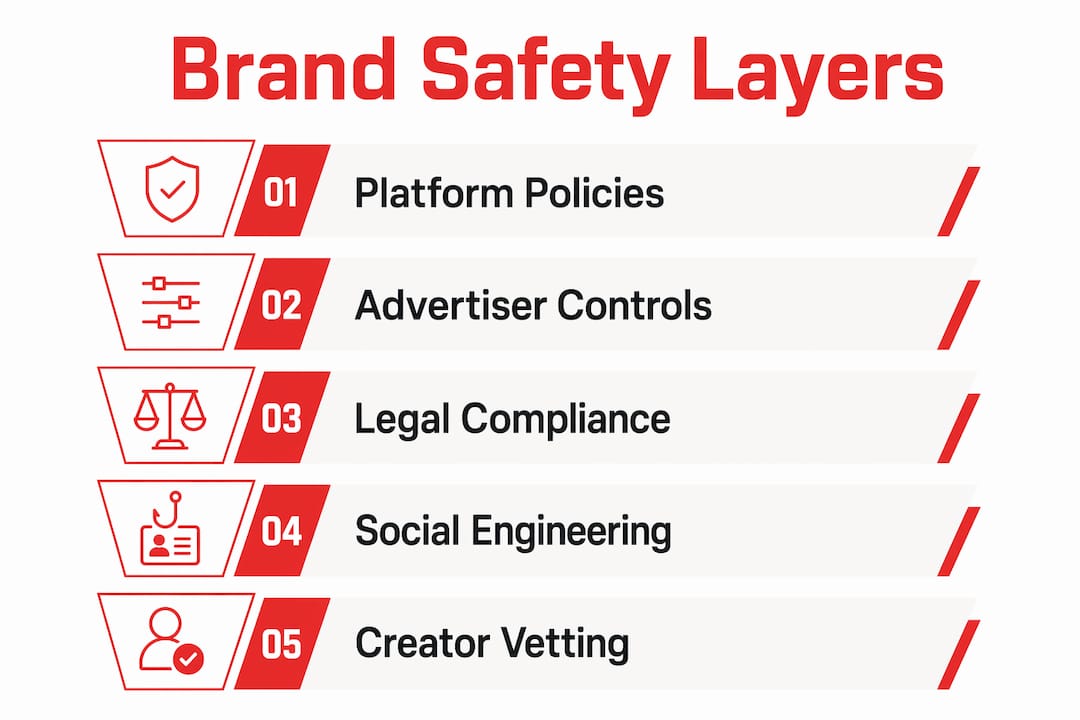
Brand safety on X requires layered controls: platform policies, advertiser-configured exclusions, legal compliance, and active creator vetting working together across every campaign phase.
| Point | Details |
|---|---|
| Use all three control layers | Combine X’s sensitivity settings, keyword denylists (up to 4,000 terms), and author exclusions (up to 2,000 handles) before launch. |
| FTC compliance is mandatory | Twitter’s $150M settlement over two-factor authentication data misuse set the standard for consent-based ad targeting in the US. |
| Impersonation scales with virality | Automated AI-driven monitoring is required during creator campaigns; manual reporting cannot match the speed of fake account proliferation. |
| Third-party certifications add a real layer | IAS and DoubleVerify pre-bid tools score ad environments against GARM standards before spend is committed, but require ongoing internal compliance to stay valid. |
| Nowix integrates brand safety into every campaign | From creator vetting to real-time monitoring, Nowix builds protection into viral launches, amplification programs, and full X account management. |
Recommended
- Amplify Your Reach on X: Organic Post Amplification | Nowix
- X Management: Brand Profiles Run by Practitioners | Nowix
- Go Viral on X: Timeline Takeover Campaigns | Nowix
- Nowix Blog — Articles on X Creator Campaigns and AI Ops
Frequently asked questions
Does this guide mean Nowix offers X customer support or community management?
No. This is informational content. Nowix’s services cover X content, publishing and marketing campaigns; reply handling, moderation, customer support staffing and DM management are outside the offer.
How should a brand define responsibilities around sensitive conversations?
Agree an internal approval owner, escalation route and verified facts before publication. Keep marketing content responsibilities separate from customer support and moderation responsibilities.