
The most useful Twitter campaign examples are concise case studies you can copy: one clear engagement mechanic, one amplification mix, and measurable KPIs. The brands that win on X are not the ones with the biggest budgets. They are the ones who pick a single mechanic, seed it fast, and let paid momentum tip into organic coverage.
Six archetypes deliver repeatable results across industries:
- Reactive moment (Popeyes “pope yes” two-word tweet, 1.8 billion impressions)
- Hashtag UGC (Toyota USA #LetsJoinHands, 116M timeline impressions)
- Conversion-focused Website Cards (MVMT, 353% traffic lift)
- Disruptive single-tweet debate (Heinz fridge-or-cupboard poll)
- Promoted Video + emoji hashtag (Marks & Spencer Christmas)
- Promoted Trend burst (20th Century Fox, 266M trend impressions)
The immediate takeaway: pick one mechanic before you write a single word of copy. Define one primary KPI. Seed with creators or a partner account at launch. Decide your paid amplification budget before the post goes live, not after.
Table of Contents
- 1. Popeyes “Pope Yes” — reactive moment
- 2. Toyota USA #LetsJoinHands — hashtag UGC at scale
- 3. MVMT Website Cards — conversion-focused holiday ads
- 4. Heinz “Fridge or Cupboard?” — disruptive single-tweet debate
- 5. Marks & Spencer Christmas — promoted video and emoji hashtag
- 6. 20th Century Fox “Alien: Covenant” — Promoted Trend burst
- 7. Always #LikeAGirl — hashtag activism
- 8. Red Bull #PutACanOnIt — UGC photo challenge
- 9. Coca-Cola #ShareACoke — personalization at scale
- 10. Diablo IV “Duriel’s Offering” — live-reactive cultural moment
- How do you run a Twitter/X campaign from scratch?
- Agency tactics that scale on X
- Key Takeaways
- What running high-volume X campaigns actually teaches you
- Nowix runs the campaigns you just read about
- Sources and further reading
1. Popeyes “Pope Yes” — reactive moment
Format: Organic Tweet | Amplification: Earned media, zero paid
When Pope Francis was elected, Popeyes posted two words: “pope yes.” That is the entire creative. The result was 1.8 billion media impressions, 535K social engagements, and an estimated $16 million in earned media value, making it the brand’s most engaging post in history.
Why it worked: The pun required no explanation and no click. Replies and quote-retweets flooded in because the entry barrier was zero. The algorithm amplified the reply chain, not just the original post.
Replicate it: Monitor cultural moments in real time. Draft three to five reactive one-liners per event. Post within the first 30 minutes of a trending moment. Speed is the mechanic.
2. Toyota USA #LetsJoinHands — hashtag UGC at scale
Format: Promoted Video + Engagement Cards | Amplification: Paid + UGC seeding
Toyota built a campaign around the Rio Olympics, asking fans to share moments of unity under #LetsJoinHands. The brand pledged a $250,000 donation tied to participation. The result: 116 million timeline impressions and a 370% increase in campaign awareness.
Why it worked: The donation mechanic gave participation real-world stakes. Promoted Video seeded the message; Engagement Cards converted viewers into participants. Paid momentum created the initial velocity; UGC kept it alive organically.
Replicate it: Tie a hashtag to a tangible outcome (donation, product unlock, community milestone). Run Promoted Video for the first 48 hours, then shift budget to amplifying top UGC posts.
3. MVMT Website Cards — conversion-focused holiday ads
Format: Website Cards | Amplification: Paid Twitter Ads, timed creative rotation
MVMT ran timed Website Card ads during Black Friday and Cyber Monday with product-specific creative and direct CTAs. The outcome: a 353% increase in site traffic and a 189% increase in sales versus their daily Q4 average.
Why it worked: Website Cards put the product image, headline, and CTA in a single swipeable unit. No extra click to a landing page. The timed creative matched the exact purchase window when buyer intent peaks.
Replicate it: Build three to five creative variants per product. Schedule them to go live at the start of the purchase window. Test headline copy, not just imagery, because the CTA line drives CTR more than the visual.
4. Heinz “Fridge or Cupboard?” — disruptive single-tweet debate
Format: Organic Tweet + Twitter Poll | Amplification: Earned media, follow-up paid activations
Heinz asked one question: does ketchup belong in the fridge or the cupboard? The tweet earned 65.8K engagements. The follow-up poll drew 13K votes, with 63.2% voting “fridge.” The campaign trended in multiple countries and seeded a giveaway activation that extended reach further.
Why it worked: Polarized, low-effort choices force a reply. You cannot stay neutral on fridge versus cupboard. The algorithm reads that reply chain as high engagement and pushes the post to non-followers.
Replicate it: Find the one opinion in your category that divides people cleanly. Frame it as a binary. Post it without a product mention in the first line.
5. Marks & Spencer Christmas — promoted video and emoji hashtag
Format: Promoted Video + Promoted Trend + Custom Emoji | Amplification: Paid, TV extension
M&S extended its TV Christmas campaign to X with Promoted Video, a Promoted Trend, and a custom hashtag emoji. The measurable uplifts: +1 percentage point in consideration, +12% in favorability, and an 11–37% lift in ad recall.
Why it worked: The custom emoji turned every use of the hashtag into a micro-brand impression. Promoted Trend guaranteed top-of-feed placement during peak shopping days. The TV creative was repurposed, keeping production costs low.
Replicate it: If you have a TV or YouTube asset, cut a 15-second version for X. Pair it with a custom emoji hashtag. Run Promoted Trend for two to three days around your peak moment.
6. 20th Century Fox “Alien: Covenant” — Promoted Trend burst
Format: Promoted Trend + Custom Hashtag Emoji | Amplification: Paid, five-day burst
Fox ran a five-day Promoted Trend campaign ahead of the Alien: Covenant opening weekend. The campaign delivered 266 million trend impressions, a 7-point awareness lift, and a 3-point increase in ticket purchase intent.
Why it worked: Promoted Trends own the “What’s happening” column. Five days is enough to build awareness without frequency fatigue. The custom emoji gave the hashtag visual identity in every timeline.
Replicate it: Use Promoted Trends for hard launch windows only, not always-on campaigns. Five days is the sweet spot. Budget for the trend placement plus a Promoted Video to capture intent after the impression.
7. Always #LikeAGirl — hashtag activism
Format: Promoted Video + Organic Hashtag | Amplification: Creator seeding, earned media
Always asked people to show what it looks like to “run like a girl,” then reframed the phrase as a statement of strength. The hashtag became a cultural reference point, driving millions of organic uses and significant earned media coverage across broadcast and digital.
Why it worked: The mechanic invited participation without requiring a purchase or a click. The creative reframe gave people something worth sharing because it changed the meaning of a phrase they already knew.
Replicate it: Find a phrase or assumption in your category that deserves a reframe. Build the creative around the reframe, not the product. Seed with creators who already hold the audience you want.
8. Red Bull #PutACanOnIt — UGC photo challenge
Format: Organic Hashtag + UGC | Amplification: Creator seeding, community amplification
Red Bull asked fans to photograph a Red Bull can appearing to balance on or interact with objects in the real world, then post under #PutACanOnIt. The challenge spread globally, generating thousands of creative submissions and keeping the brand in timelines without a single paid placement driving the core mechanic.
Why it worked: The brief was visual, repeatable, and playful. Anyone with a can and a phone could participate. The low production barrier meant volume, and volume meant sustained trending presence.
Replicate it: Design a UGC challenge around your physical product. The mechanic must be completable in under two minutes. Seed it with five to ten creators on day one to establish the format before asking the broader audience.
9. Coca-Cola #ShareACoke — personalization at scale
Format: Organic Hashtag + Emoji Activation | Amplification: Earned media, retail tie-in
Coca-Cola extended its “Share a Coke” personalization campaign to X by encouraging fans to tweet photos of named bottles and cans. The emoji hashtag activation added a branded visual layer to every post. The campaign generated sustained organic conversation tied directly to a retail purchase behavior.
Why it worked: The campaign connected an offline purchase to an online social action. Sharing a photo of a bottle with your name on it is inherently personal and inherently public. The hashtag gave that personal moment a community frame.
Replicate it: Look for the moment in your customer journey where someone feels proud or surprised. Build the social mechanic around that moment, not around the product feature.
10. Diablo IV “Duriel’s Offering” — live-reactive cultural moment
Format: Organic Tweet + Community Engagement | Amplification: Creator seeding, earned media
Blizzard’s social team built a live-reactive campaign around an in-game boss drop event, posting in real time as players encountered the moment. The campaign reached over 41 million and produced the channel’s most engaged organic cultural moment, earning recognition at the Shorty Impact Awards.
Why it worked: The team posted from inside the game’s cultural moment, not above it. Fans felt the brand was playing alongside them. Replies and quote-retweets came from genuine shared experience, not manufactured enthusiasm.
Replicate it: Identify the moments in your product’s lifecycle where users feel something strong. Be present in those moments on X, in real time, with copy that sounds like a participant, not a press release.
How do you run a Twitter/X campaign from scratch?
This is the agency-grade playbook. Follow it in order.
Step 1: One objective, one KPI. Awareness campaigns track impressions and awareness lift. Conversion campaigns track CTR and sales lift. Pick one. Every creative decision flows from it.
Step 2: Creative checklist.
- Single-hook copy (one sentence, one idea)
- One CTA per post, not three
- Mobile-first asset specs (1200x675px for cards, 16:9 for video)
- Creator brief: what to post, what hashtag to use, what NOT to say, and the posting window
Step 3: Amplification plan. Seed with two to five partner accounts or micro-creators at launch. Run Promoted Video or Website Cards for the first 48 hours. Shift budget to amplifying top-performing organic posts after day two. For content calendar scheduling, map your posting cadence before launch week.
Step 4: Timeline and budget.
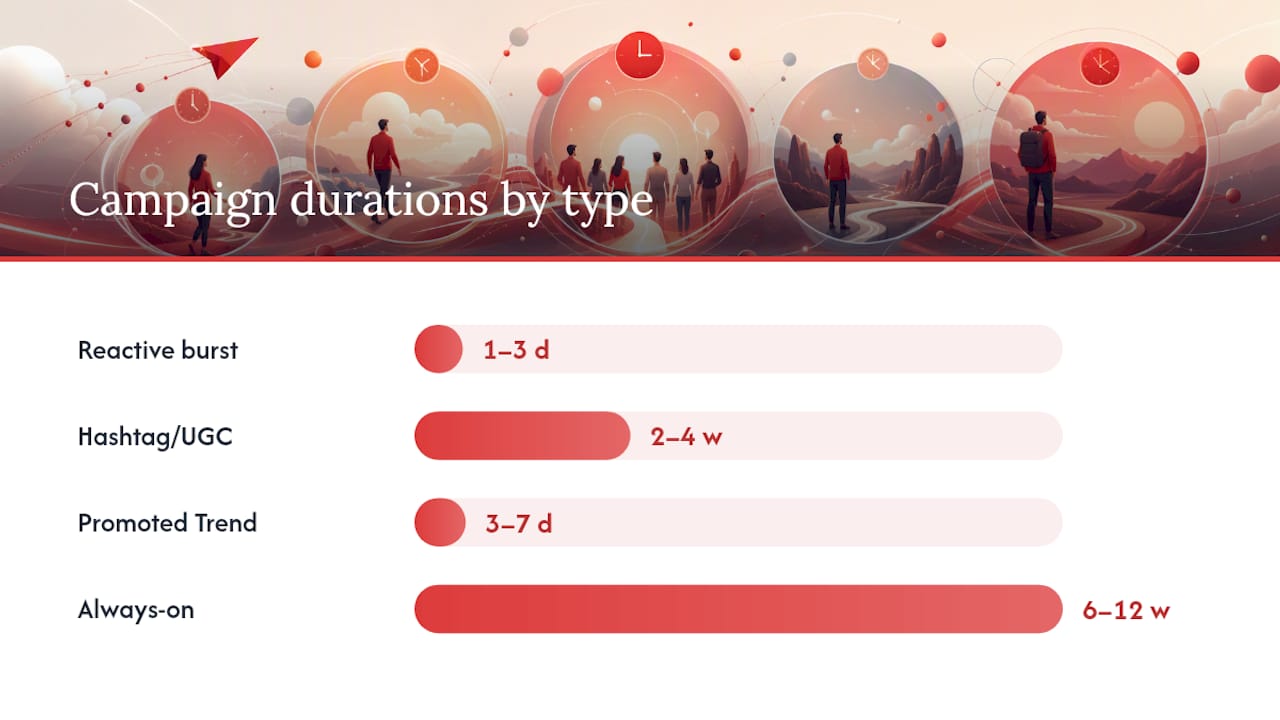
| Campaign Type | Duration | Budget Range (Awareness) | Budget Range (Conversion) |
|---|---|---|---|
| Reactive burst | 1–3 days | — | — |
| Hashtag/UGC | 2–4 weeks | — | — |
| Promoted Trend | 3–7 days | — | Not typical |
| Always-on | 6–12 weeks | — | — |
Step 5: Measurement. Set a baseline before launch (current impressions, engagement rate, CTR). Track in-flight signals daily: reply volume, quote-retweet rate, and hashtag velocity. Post-campaign, report on impressions, engagement rate, awareness lift (via brand lift study if budget allows), CTR, and conversion rate. For engagement rate benchmarks by industry, compare your results against category averages, not platform-wide averages.
Agency tactics that scale on X
These are the mechanics Nowix uses when executing high-volume campaigns for tech and AI brands. They are replicable.
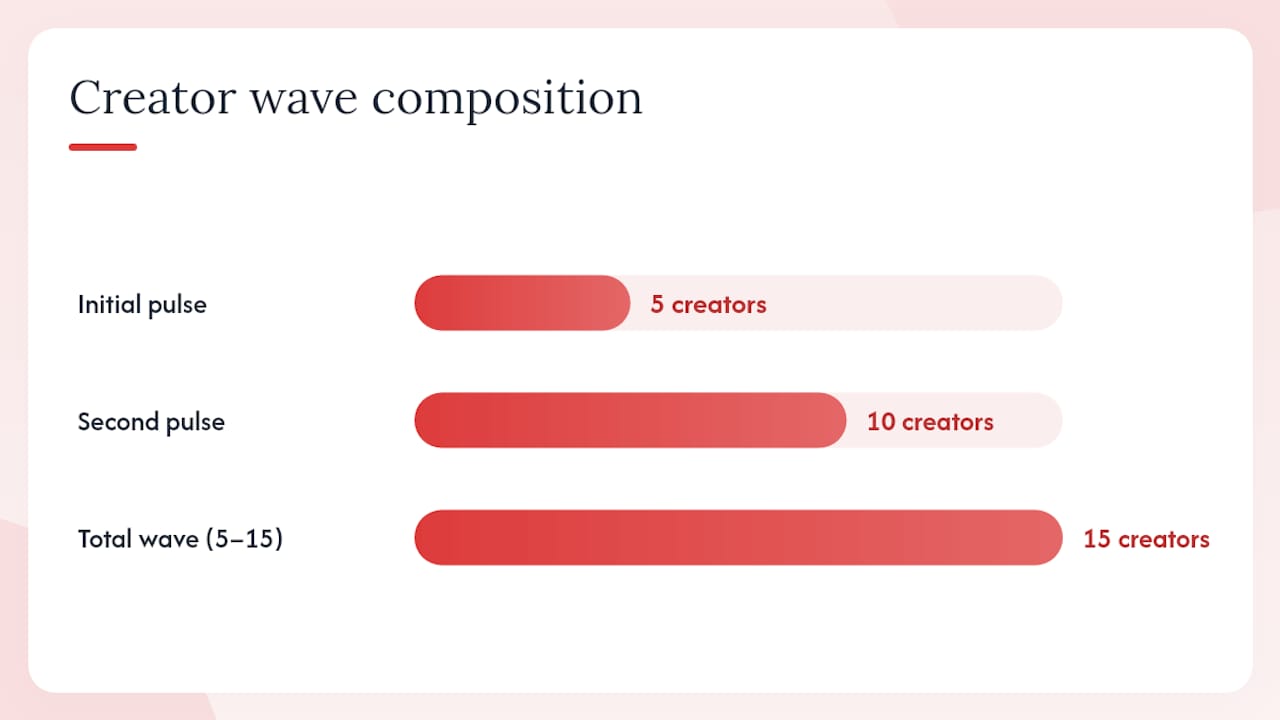
Controlled quote-retweet seeding. At launch, coordinate five to fifteen micro-KOLs to QRT the brand post within the first hour. Each QRT adds a unique comment, which creates a reply tree the algorithm reads as high engagement. This is different from a retweet: a QRT generates its own engagement surface.
Timed posting windows. Post between 8–10 AM and 12–2 PM in the target time zone on weekdays. These windows have the highest organic reach for most B2B and consumer tech audiences. For reactive campaigns, ignore the clock and post immediately.
Paid support thresholds. Run paid amplification until the post reaches a reply-to-impression ratio that signals organic momentum. For most campaigns, that threshold is roughly 0.5% reply rate. Once organic replies are self-sustaining, shift budget to a second creative or a retargeting audience.
Creator brief checklist:
- Deliverable: one QRT with original commentary (not a copy-paste of the brand post)
- Required hashtag: one, placed naturally in the copy
- Brand safety guardrails: no competitor mentions, no political commentary
- Posting window: within 60 minutes of the brand post going live
- Measurable output: screenshot of post analytics at 24 hours
Reactive copy formula: [Cultural moment] + [brand connection in one clause] + [optional question or CTA]. Keep it under 100 characters. The shorter the post, the more room for replies.
Governance checklist for reactive campaigns:
- Pre-approve three to five reactive templates before the event
- Assign one person with posting authority, no approval chain
- Set a “do not post” list (topics, competitors, political events)
- Monitor replies for the first two hours and respond to the top five
Pro Tip: Stage your creator wave in two pulses: five creators in the first 15 minutes, then ten more at the 45-minute mark. This prevents the algorithm from reading a sudden spike as coordinated inauthentic behavior, which can throttle reach.
For a deeper look at engineering trending moments on X, the mechanics behind trend acceleration are more controllable than most brands assume.
Key Takeaways
The most effective Twitter/X campaigns pair one high-clarity engagement mechanic with a staged paid-plus-organic amplification plan, executed within a defined launch window.
| Point | Details |
|---|---|
| Pick one mechanic | Choose hashtag challenge, reactive copy, poll, or Website Card before writing any creative. |
| Seed at launch | Coordinate five or more creators or partner accounts to QRT within the first hour of posting. |
| Match format to objective | Promoted Trends for awareness bursts; Website Cards for conversion; organic polls for community. |
| Set your KPI baseline | Measure impressions, engagement rate, and CTR before launch so post-campaign lifts are real. |
| Nowix for execution | Nowix runs creator-seeded launch campaigns and full X account management for tech and AI brands. |
What running high-volume X campaigns actually teaches you
The case studies in this article make campaigns look clean. They are not. The Popeyes “pope yes” post looks effortless because the two-word copy hides the real work: a team that had reactive templates ready, posting authority without an approval chain, and the judgment to post immediately rather than wait for sign-off.
The most common mistake brands make is overcomplicating the entry mechanic. They add a second hashtag, a landing page, a form, and a prize tier. Each addition cuts participation in half. The Heinz poll worked because it had exactly one question and exactly two answers. That is the entire brief.
The trade-off between reach and control is real. A Promoted Trend gives you 266 million impressions and zero control over who responds. A targeted Website Card gives you a smaller, more qualified audience and a measurable conversion event. For tech and AI brands, the Website Card almost always produces better downstream ROI, even when the impression count looks modest by comparison. Nowix navigates this by running Promoted Trends only for launch moments and using targeted amplification for everything that follows.
Scaling creator seeding without diluting message consistency comes down to the creator brief. A brief that specifies the posting window, the one required hashtag, and the “do not say” list will produce consistent output across 50 creators. A brief that just says “post about our launch” will produce 50 different campaigns.
Nowix runs the campaigns you just read about
Most brands read case studies like these and then spend three weeks debating the creative brief. Nowix skips that part. The team coordinates up to 700 creators within a one-hour launch window, runs controlled QRT seeding from vetted micro-KOLs, and manages full X accounts for tech and AI brands including daily content, replies, and community engagement.
The concrete difference: you get a campaign that launches with guaranteed initial velocity, not one that depends on organic luck. For brands that need post amplification without a full campaign build, Nowix’s reach amplification service seeds your existing posts with targeted quote-retweets and comments from real accounts. For brands that want a timeline takeover, the Go Viral on X service handles the full creator coordination. Book a discovery call to see which format fits your next launch.
Sources and further reading
- Popeyes Louisiana Kitchen | Pope Yes | The One Club
- How one tweet got the world talking about Heinz Tomato Ketchup | The Drum
- Case Study: Toyota USA achieves mass awareness and 370% campaign awareness lift with Twitter | CaseStudies.com
- Case Study: MVMT Watches Inc achieves 353% increase in site traffic and 189% increase in sales with Twitter | CaseStudies.com
- Case Study: Marks & Spencer achieves uplift in consideration, favourability and ad recall with Twitter | CaseStudies.com
- Case Study: 20th Century Fox achieves a 7-point awareness lift and higher ticket intent with Twitter | CaseStudies.com
- Twitter for business: how brands use Twitter to build awareness and engagement | Canva
- Twitter: most-retweeted posts of all time | Statista