Twitter Campaign Planning: 14 Day Organic Launch for Tech and AI

A successful Twitter campaign plan runs on one objective, a fixed end date, and organic-to-paid sequencing: test creative organically, then amplify only the posts that already prove themselves. Nowix builds every launch around that sequence because it lowers waste and pushes budget toward what your audience already responded to. Your first move today is simple: pick the one post from your last two weeks that outperformed the rest, and plan your next push around it.
TL;DR:
- Choosing the top-performing organic post from the past two weeks is the key starting point for effective amplification and budget efficiency.
- Campaign objectives must be precise, with clear primary KPIs and realistic benchmarks based on your current platform metrics to ensure measurable success.
- Audience research should begin with listening, profiling, testing, and retargeting, taking five to seven days before finalizing the content calendar.
- A balanced content mix of narrative, proof, engagement, and behind-the-scenes posts, tailored to funnel stage, maximizes reach, engagement, and conversions.
- Scaling should be based on organic post performance, with small tests followed by targeted amplification, never jumping straight to a high budget on unproven creative.
Table of Contents
- What Twitter Campaign Planning Actually Means
- How Do You Set Campaign Objectives And KPIs?
- What’s The Fastest Way To Research Your X Audience?
- Building Your Content Pillars And Post Mix
- Choosing The Right Ad Formats And Creative Setup
- Building A Campaign Timeline That Actually Holds
- How Should You Structure Your Paid Amplification Budget?
- How Do You Select And Brief Creator Partners?
- Setting Up Measurement, Dashboards, And Attribution
- A Ready-To-Use Rapid-Launch Checklist
- Competitive Analysis: What Are Rivals Actually Doing On X?
- Planning For Crisis Response During A Live Campaign
- How Do Twitter Campaigns Fit With Your Other Channels?
- What Twitter Campaign Planning Looks Like When It Works
- How Nowix Turns Your Campaign Plan Into A Trending Launch
- Where To Go For Deeper Campaign Data
- Sources
- FAQ
What Twitter Campaign Planning Actually Means
Twitter campaign planning is the process of setting a single, time-bound objective for your activity on X, mapping the content arc that supports it, and building the tracking that proves it worked. A campaign is not a content calendar running on autopilot. It has a start date, an end date, and a defined win condition, whether that’s follower growth, link clicks, or signups tied to a launch window.
A Twitter marketing strategy should define who you’re trying to reach, what you want the platform to do for the business, what you’ll post and how often, and how you’ll measure success. Skip any one of those four pieces and the campaign drifts. You’ll post content, get some likes, and have no idea whether it moved the business forward.
Different campaign types map to different KPIs, and confusing them is the most common planning mistake we see:
- Product launch campaigns — measured on impressions, follower growth, and link clicks in a compressed window of several days
- Awareness campaigns — measured on reach, video views, and share/retweet rate over a few weeks
- Community or account-growth campaigns — measured on follower quality, reply rate, and mention volume over an extended period
- Conversion campaigns — measured on UTM-tracked sessions, signups, or purchases tied directly to specific posts
Success criteria should be locked before a single post goes out. A launch campaign that hits 500,000 impressions but generates zero UTM-tracked clicks isn’t a win, even if the vanity metrics look good on a slide.
How Do You Set Campaign Objectives And KPIs?
Vague goals produce vague results. “Grow our audience” isn’t an objective. An objective example is to add a realistic number of qualified followers within a several-week timeframe through a product launch thread and amplified quote-tweets, specifying a clear number, timeframe, and mechanism.
Here’s how that translates across common campaign types:
- Awareness goal: Reach a large number of impressions within a couple of weeks using a launch thread plus creator amplification
- Engagement goal: Increase engagement rate across a set number of posts within a month, relative to your account’s baseline
- Conversion goal: Drive thousands of UTM-tagged sessions to a landing page within a focused launch period
- Retention goal: Grow reply rate on daily posts by a significant percentage over several weeks to strengthen community signal
Every campaign needs a primary KPI and one or two secondary KPIs. The primary KPI is the number that decides whether the campaign succeeded. Secondary KPIs (profile visits, video completion rate, mention sentiment) tell you why it succeeded or failed, but they don’t get to override the primary number in your post-campaign report.
Statistic to anchor your benchmarks: Platform-level engagement and follower-growth data give you a realistic ceiling before you commit budget. Pulling current platform statistics before setting your targets keeps you from promising leadership a number the platform can’t realistically support.
Pro Tip: Set your primary KPI target using your account’s own trailing 90-day average as the floor, not an industry benchmark. Industry numbers tell you what’s possible; your own history tells you what’s likely.
Realistic benchmarking means resisting the urge to set a target that sounds impressive in a planning deck.
What’s The Fastest Way To Research Your X Audience?
Audience research for X starts with listening, not guessing. Before you write a single post, spend a week tracking who engages with your competitors’ launches, what language they use in replies, and which post formats generate quote-tweets versus silent likes.
- Run a listening pass. Pull the last 90 days of mentions, replies, and quote-tweets on your brand and two direct competitors. Note recurring phrases, complaints, and questions.
- Build two or three audience profiles. Give each one a job title or role, a pain point, and the account types they already follow. A profile like “DevOps lead, follows infra tooling accounts, replies to threads about outages” is usable; “tech-savvy millennial” is not.
- Validate with a small organic test. Post three variations of the same core message, each aimed at a different profile, and see which gets the strongest reply-to-like ratio, not just the most likes.
- Convert profiles into targeting sets. Translate each validated profile into keyword targeting, follower lookalike audiences (built from accounts your best-performing profile already follows), and interest categories inside Ads Manager.
- Re-test before you spend. Run the winning message as an organic post one more time with a slightly larger sample of hashtags or timing variations before you commit paid budget to it.
This process usually takes five to seven days end to end, and it should happen before you lock your content calendar, not alongside it.
Building Your Content Pillars And Post Mix
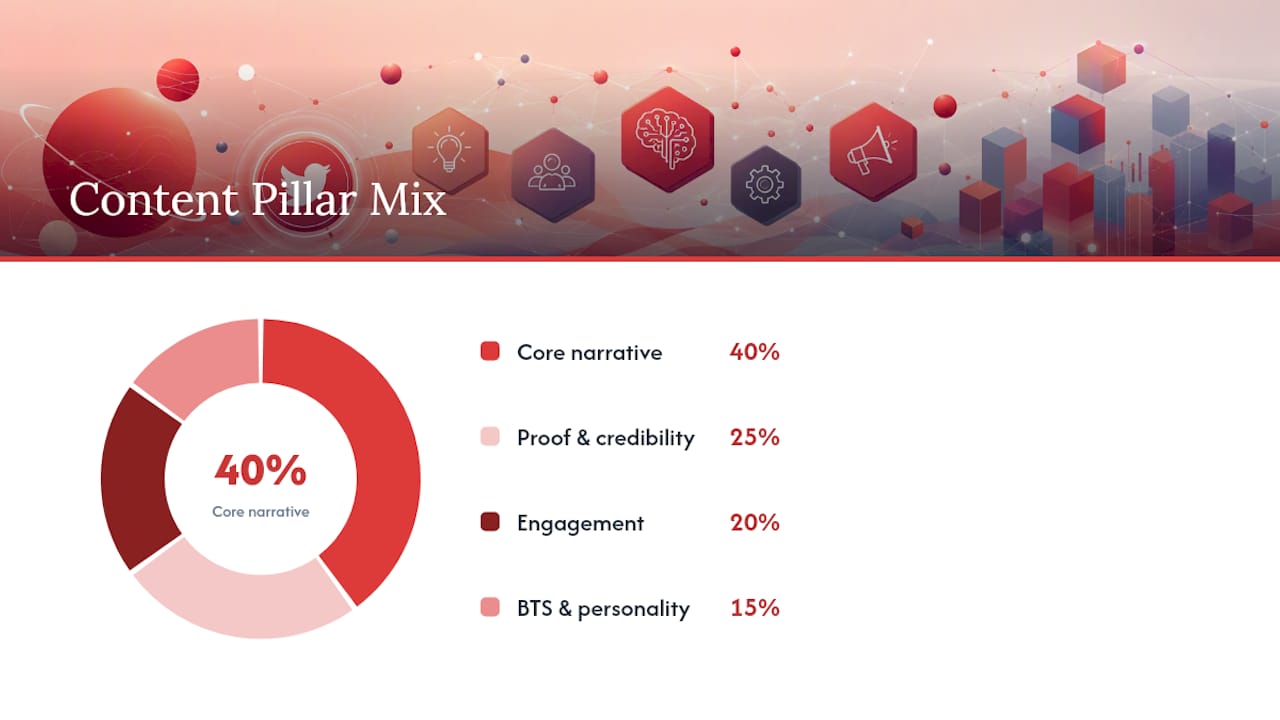
Content pillars keep a campaign from turning into a random stream of posts loosely connected to a theme. Four pillars, weighted by a 40/25/20/15 mix, cover most tech and AI brand launches:
- 40% — Core narrative posts. The main story of the campaign: the launch thread, the announcement, the “why now” post. This is your highest-investment content.
- 25% — Proof and credibility posts. Screenshots, metrics, third-party mentions, customer reactions. These posts do the convincing work the core narrative can’t do alone.
- 20% — Engagement and conversation posts. Polls, questions, hot takes tied to your niche. These exist to keep reply rate and mention volume alive between big narrative beats.
- 15% — Behind-the-scenes and personality posts. Founder commentary, team moments, process shots. These humanize the account and tend to outperform on save rate.
Format choice should follow funnel stage. Awareness leans on video and thread formats, which get the widest organic reach. Engagement leans on polls, replies, and quote-tweet prompts. Conversion leans on single-image or link posts with a clear, single CTA, since link posts asking for two actions at once consistently underperform.
Creative testing cadence matters more than most teams plan for. Run every core narrative post as an organic-only test for 24 to 48 hours before deciding whether to amplify it. Don’t test cold creative directly in paid campaigns. Use organic performance as the signal, then move only the winners into amplification. That single habit is the difference between a campaign that burns budget on guesses and one that spends against evidence.
Pro Tip: Write three headline variants for every core narrative post before you schedule anything. Post the strongest-performing version organically first, and hold the other two in reserve as quote-tweet fuel once amplification starts.
For a deeper bank of post ideas by pillar, our guide to content ideas that drive growth breaks down formats by funnel stage in more detail than fits here.
Choosing The Right Ad Formats And Creative Setup
X’s ad formats each solve a different job, and mismatching format to objective wastes spend fast. Promoted tweets amplify existing organic content and work best once you already know a post performs. Video ads carry the highest completion-based engagement for awareness goals. Follower ads build audience directly but rarely convert on their own. Website/traffic ads push UTM-tracked clicks and belong at the conversion stage of your funnel, not the awareness stage.
Cost and format guidance from current Twitter Ads Guide research shows CPM and engagement ranges shift by format and targeting tightness, so a broad awareness campaign and a narrow retargeting push should never share the same budget assumptions.
Before any creative goes into an ad account, run it through a short checklist:
- Copy: Does it read like a native post, not a press release? Ad copy stuffed with hashtags reads as spam and actively suppresses engagement.
- Visual: Is the first frame legible on mobile without sound?
- CTA: Is there exactly one action requested, with a UTM-tagged link?
- Tone check: Would this post get engagement if you removed the “Promoted” label?
The most common pitfall is over-producing the creative. Ads built like TV commercials get scrolled past on a platform built for text and quick video. The second most common pitfall is treating ad copy like SEO copy, packing in hashtags that belong in organic posts but actively hurt paid delivery. Strip both out before launch.
Building A Campaign Timeline That Actually Holds
Every campaign needs runway before, during, and after the active window, and skipping the runway is the fastest way to launch late or measure nothing. High-performing campaigns start with research and build budget around production, distribution, creator fees, and tools well before the active window opens. A rushed one-week campaign with zero pre-launch runway almost always underperforms one with even a modest seven-day setup period.
- Pre-launch (5 to 10 days before go-live): Audit your profile bio, pinned post, and header image for consistency with the campaign message. Install or verify your X Pixel and build your UTM naming convention. Get creative and copy approvals locked. Confirm your posting cadence and who owns publishing each day.
- Active window (length depends on campaign type, typically 3 to 30 days): Publish on a fixed cadence, not an ad-hoc one. Batching and scheduled posting maintain consistency, and recommended cadence varies by format, so a daily thread schedule needs a different rhythm than a twice-weekly video push. Monitor engagement daily and flag any post that’s underperforming its own organic baseline by more than 30%.
- Post-campaign (3 to 5 days after the window closes): Pull final numbers against your primary KPI, archive top and bottom performers with notes on why, and write the one-page recap that feeds your next campaign brief.
Official campaign planning guidance also recommends aligning posts to calendar moments and ongoing community-building activity around the campaign window, not just during it. A campaign that goes quiet the day it ends signals to your audience that the account was only ever a megaphone. For the full scheduling framework, our Twitter content calendar guide covers slot planning in more depth.
How Should You Structure Your Paid Amplification Budget?
Budget staging beats a single lump-sum spend almost every time. Start with small daily spends to validate which organic winners actually hold up under paid distribution, then scale to higher daily budgets once you’ve found stable creative and audiences. Jumping straight to a large daily budget on unproven creative is the single most common way teams burn a launch budget in 48 hours with nothing to show for it.
A workable three-stage model looks like this:
- Testing stage: Small daily spend, spread across 3 to 4 organic winners, running 2 to 3 days per creative. The goal here is signal, not scale.
- Scaling stage: Concentrate spend on the one or two creatives that clear your engagement or click-through threshold, running for the bulk of your active window.
- Growth stage: Reserve a smaller tail-end budget to push your single best-performing asset to a broader lookalike audience once the core window closes, extending reach without extending the campaign’s core timeline.
A/B testing inside this model means changing exactly one variable per test: headline, first-frame visual, or CTA, never all three at once. Testing three variables simultaneously tells you nothing about which one actually moved the number. Seed each new audience segment with a small budget slice before committing the bulk of spend to it, since even a lookalike audience built from good data can underperform for reasons you won’t see until real impressions run against it.
Signal to watch for scaling decisions: organic posts that clear roughly double your account’s average engagement rate within the first four hours are your strongest amplification candidates. High-performing campaigns consistently amplify posts that prove themselves organically rather than paying to test cold creative, which is the single highest-leverage habit in this entire budgeting framework.
For a deeper walkthrough of amplification mechanics, including how quote-tweet activation compounds reach, see our guide on amplifying posts on X.
How Do You Select And Brief Creator Partners?
Creator selection should follow your objective and budget, not the other way around. Nano and micro creators (roughly 5,000 to 100,000 followers) deliver higher engagement rates and lower cost per interaction, and they’re the better fit for niche tech and AI audiences where trust matters more than reach. Macro creators make sense when the objective is pure impression volume for a broad launch, but expect a lower engagement-to-follower ratio in exchange for that scale.
A usable creator brief includes:
- The single message the creator should communicate in their own voice, not a script to read verbatim
- Required assets (a quote-tweet, an original post, a reply) and the exact delivery window
- Approved links and UTM tags so their contribution is trackable independent of your own posts
- Disclosure requirements and any words or claims to avoid
- A delivery deadline with a buffer of at least 48 hours before your amplification window opens
Once creator content is live, feed the strongest-performing posts into your paid amplification budget the same way you would an internal organic winner. Measuring creator ROI means comparing UTM-tracked clicks and engagement rate from creator posts against your own baseline content, not just counting impressions.
Setting Up Measurement, Dashboards, And Attribution
Tracking has to be live before launch day, not added after you notice the numbers look thin. Every link in the campaign needs a consistent UTM structure (source, medium, campaign name, and creative variant at minimum), and your X Pixel needs to be verified and firing before the first post goes live. Skipping pixel verification is the single most common reason a campaign’s post-mortem ends in a shrug instead of an answer.
Three dashboard views cover essential marketing metrics during and after a campaign:
- Overview dashboard: impressions, engagement rate, follower growth, and spend aligned to KPIs.
- Creative breakdown dashboard: performance by individual post and creative variant.
- Audience funnel dashboard: UTM-tracked sessions by audience segment and creator source.
Pro Tip: Build your UTM naming convention in a shared spreadsheet before the campaign starts, and require every team member to pull tags from that sheet instead of typing them fresh. Inconsistent UTM naming is the number one reason post-campaign data ends up impossible to segment.
After the window closes, run through a short post-campaign checklist: did the primary KPI hit target, which single creative drove the majority of conversions, which audience segment underperformed its seed budget, and what would change in the next brief based on those answers. That last question is the one most teams skip, and it’s the one that actually makes the next campaign better. For hands-on tracking setup, our guide on turning link clicks into tracked sessions walks through the UTM build in five minutes.
A Ready-To-Use Rapid-Launch Checklist
Nowix runs this same sequence internally for tech and AI brand launches, and it’s compact enough to copy into a shared doc today.
- Day 0 to 2: Lock your single objective, primary KPI, and campaign end date. Assign one owner for content, one for paid, one for community replies.
- Day 3 to 5: Draft core narrative posts across your four content pillars. Set UTM naming convention and verify X Pixel firing.
- Day 6 to 8: Run organic-only tests on your top three headline variants. Track engagement rate against your account’s baseline.
- Day 9 to 10: Identify the top-performing organic post. Begin small-budget paid amplification on that post only.
- Day 11 to 12: Layer in creator quote-tweets and replies on the winning post to build a visible wave of activity.
- Day 13: Scale budget on any creative that has cleared your engagement threshold. Pause anything underperforming.
- Day 14: Pull your first dashboard snapshot and adjust targeting or creative for the remaining campaign window.
This 14-day rapid activation plan compresses the full organic-to-paid sequence into two weeks, which fits most product launch and awareness campaigns without forcing the timeline. For real examples of this sequence in action, our library of Twitter campaign examples breaks down ten launches step by step, and the viral campaign checklist covers the compressed version for launches under 72 hours.
Competitive Analysis: What Are Rivals Actually Doing On X?
Benchmarking against competitors on X means tracking three things: posting cadence, format mix, and engagement rate relative to follower count, not just follower count itself.
Build a simple competitive tracker covering two or three direct competitors: how often they post, which format gets their highest engagement, and what topics generate the most replies versus the most quote-tweets. Replies signal conversation; quote-tweets signal distribution. A campaign aiming for reach should study what earns quote-tweets from competitor accounts, while a campaign aiming for community depth should study what earns replies.
Revisit this benchmark monthly, not just at campaign kickoff. X’s engagement patterns shift fast, and a format that drove a competitor’s growth six months ago may already be fatigued with their audience by the time you plan around it. Use your own historical performance, benchmarked against platform-wide engagement data, as the primary check on whether a target is realistic, and use competitor tracking as the secondary check on whether your format mix is still fresh.
Planning For Crisis Response During A Live Campaign
Every live campaign needs a response plan before launch, not one improvised after a post goes sideways. Define in advance who has authority to pause paid spend, who drafts a public response, and how fast that response needs to go out. A 24-hour delay on a brewing issue is often the difference between a contained moment and a spreading one.
Build a short severity scale before you launch: a minor complaint gets a reply from the community owner within a few hours; a factual error in campaign copy gets a correction post within the same day; a broader backlash gets an immediate pause on all paid amplification while leadership reviews the message. Pausing paid spend costs you nothing you can’t restart, but continuing to amplify a post that’s generating backlash multiplies the problem.
Assign one person as the single point of contact for crisis decisions during the active window. Campaigns that route decisions through multiple approvers in a live moment lose the hours that matter most. Keep a short list of pre-approved holding statements ready, even if they’re never used, since drafting a response from scratch while a thread is already trending against you rarely produces your best writing.
How Do Twitter Campaigns Fit With Your Other Channels?
A Twitter campaign rarely lives in isolation, and treating it as a silo wastes cross-channel momentum you’ve already built elsewhere. Repurpose your core narrative post as the opening line of an email send, and pull performing X threads into LinkedIn posts adapted for that platform’s longer-form tone. The reverse works too: a blog post or press mention makes strong proof-pillar content on X once trimmed down.
Timing coordination matters more than content duplication. Launching your X campaign the same day as an email send or a press release creates compounding visibility, while staggering them across a week dilutes the moment you’re trying to build. Align your UTM naming convention across every channel so a single dashboard can show whether X, email, or paid search drove a given conversion, rather than reconciling three separate reporting systems after the fact.
Cross-channel integration also means respecting where the content performs best rather than pushing an identical post everywhere. A video that works as a 30-second X clip may need a longer cut for LinkedIn and a square crop for Instagram. Building the campaign’s core creative with those variations in mind from day one saves the scramble of reformatting mid-launch. For teams juggling content across every channel at once, tools built for AI-assisted social scheduling can help keep a multi-platform calendar from splintering into separate, uncoordinated efforts.
What Twitter Campaign Planning Looks Like When It Works
Most campaign advice treats organic testing as a nice-to-have step teams skip when timelines get tight. Nowix treats it as the entire foundation. Skipping the organic test doesn’t save time. It moves the guessing into the paid budget, where mistakes cost real money instead of a wasted afternoon.
The three habits that separate campaigns that trend from campaigns that quietly underperform: organic-first testing on every core post, a content arc that builds narrative tension instead of announcing everything on day one, and rapid iteration that kills underperforming creative within hours, not days. None of these require a bigger budget. They require discipline about sequencing.
The results worth chasing aren’t vanity impressions. They’re the campaigns where a launch thread earns enough organic quote-tweets that paid amplification becomes a multiplier instead of a crutch.
— Knowix
How Nowix Turns Your Campaign Plan Into A Trending Launch
Some agencies follow the sequence this playbook describes: organic validation followed by controlled, fast amplification, without the multi-week ramp-up a traditional agency retainer usually requires. Once an organic winner is identified, they may activate large creator groups within a short launch window, layering quote-tweets and comments that turn a proven post into a visible wave across X. For teams that need the account itself managed day to day, such agencies may also run full X account operations: strategy, daily content, replies, and community engagement.
This fits teams at tech and AI companies who’ve already built a content calendar and identified strong organic posts but don’t have the creator network or hour-by-hour execution capacity to amplify them at scale on launch day. If you’ve got a campaign plan and a proven post ready to move, the next step is straightforward: check how post amplification works and get your launch window scheduled before your next campaign date locks in.
Where To Go For Deeper Campaign Data
For platform-wide benchmarks, Business of Apps tracks aggregate engagement and user metrics useful for setting realistic targets. For campaign structure and budgeting frameworks, Sprout Social and ContentStudio both cover planning components in depth. For public-sector-grade campaign discipline, the UK Campaign Resource Centre offers a useful scheduling framework.
Sources
- Twitter marketing strategy: The complete 2026 guide
- Social media campaigns: 4 examples and tips | Sprout Social
- Set up a Twitter presence - Campaign Resource Centre
- Twitter statistics | Business of Apps
FAQ
What Is A Twitter Campaign?
A Twitter campaign is a time-bound activity on X built around one objective, a defined content arc, and specific tracking (UTMs and pixel data) used to measure whether that objective was met.
How Much Does It Cost To Run An Ad On Twitter?
Costs vary by format and targeting tightness, with CPM and engagement-based pricing shifting depending on how narrow the audience is; staging spend from small daily test budgets to larger scaling budgets, as covered in the Twitter Ads Guide, keeps early costs controlled while you find what works.
How Much Does Twitter Pay Per 1,000,000 Views?
X’s creator monetization payouts depend on engagement from verified subscribers rather than a flat rate per view, and the amount varies by account and program eligibility, so there’s no single fixed figure that applies across all accounts.
How Much Is A 30-Second Ad Worth?
Video ad value on X depends on completion rate, targeting precision, and format rather than a fixed price, and campaigns that amplify an already-proven organic video tend to get more value per dollar than one testing unproven creative cold.
Where Can I Find A Twitter Campaign Planning Template?
A workable template covers six fields: objective, audience profile, content pillars, posting cadence, primary and secondary KPIs, and tracking setup; keeping the template this compact speeds internal approvals and helps prevent scope creep as the campaign moves through drafts.