
Twitter card optimization for agency campaigns comes down to three moves: engineer the first line, build reply bait into the close, and choreograph amplification the moment the card goes live. Get those right and the creative carries the launch. This isn’t about meta tags or link preview settings. It’s about the copy, images, and timing an agency tunes on every card before creators post it, then a tactical breakdown of how to build and launch cards that actually move the needle for tech and AI brands.
TL;DR:
- Craft initial hooks that state specific outcomes or numbers, as these are proven to increase engagement and set the tone for virality.
- Use proven reply-bait questions directly related to the content to boost replies, which outperform likes in algorithm-driven reach.
- Schedule posts during tested optimal times through data-driven testing rather than guesswork to maximize immediate engagement.
- Coordinate replies within the first 30 minutes of posting by seeding organic engagement through reply teams and micro-influencers for amplified reach.
- Prioritize reply-bait design and timing strategies over perfecting the copy, since early engagement and timing criticality drive overall campaign success.
Table of Contents
- What Makes a Twitter Campaign Card Actually Convert?
- Six Hook Formulas and the Thread Arc That Actually Scales
- Timing and Amplification: Getting the Drop Sequence Right
- Measuring What Worked: KPIs and the Post-Campaign Audit
- How Nowix Applies This Playbook to Real Launches
- The Part of This Playbook Most Teams Get Backwards
- Ready to Run This Playbook Without Building the Team Yourself?
- Sources
What Makes a Twitter Campaign Card Actually Convert?
A campaign card lives or dies in the first line. You have roughly 120 characters before a reader decides to expand, scroll past, or engage, and that window is where hook strength does its heaviest lifting. Hook strength scores 9.0 out of the measured virality factors, trailing only timing, so the opener isn’t decoration. It’s the mechanism.
Here’s what every card needs before a creator posts it:
- Front-loaded payoff. State the outcome or number in the first sentence. “We cut inference latency 40%” beats “Here’s an update on our latest model.”
- A specific, bounded reply-bait question. Not “thoughts?” Ask something a reader can answer in five words: “Which of these three would you ship first?”
- One clear CTA, placed once, not stacked at the top and bottom.
- Visuals that clarify, not decorate. A readable screenshot with one or two data points beats a stock illustration every time.
- Pinned tweet and bio alignment, so anyone who clicks through from the card lands on a profile that matches the promise.
That last point gets skipped more than anything else. A card can rack up hundreds of replies and still generate zero pipeline if the bio still says “building something new” and the pinned tweet is three months stale. Nowix’s pinned tweet archetypes and profile optimization guide both exist because this gap kills more launches than weak copy does.
Reply-bait design deserves its own scrutiny. The strongest reply prompts are tied directly to the content, not bolted on as an afterthought. If your card claims a benchmark result, the reply-bait question should invite readers to name their own benchmark, not ask an unrelated “agree or disagree?” This matters because engagement carries outsized weight in X’s distribution algorithm, and replies specifically outperform likes for reach.
Pro Tip: Write the reply-bait question before you write the rest of the card. If you can’t think of a question tied to your content, the content probably isn’t specific enough yet.
Six Hook Formulas and the Thread Arc That Actually Scales
Creators need templates, not vague direction. Handing 50 micro-KOLs a brief that says “be authentic” produces 50 different tones and zero consistency. Handing them six proven hook formulas produces variation within a controlled structure, which is what a coordinated drop actually requires.
- Numbered promise. “3 ways we cut our AI inference costs in half.” Specificity signals substance before the reader even opens the thread.
- Moment or metric. “We just crossed 10,000 API calls in a single day.” Concrete numbers outperform vague milestones.
- Bold opinion. “Most teams are optimizing the wrong layer of their stack.” Controversy, used sparingly, earns quote-retweets.
- Audience callout. “If you’re building a RAG pipeline right now, read this.” Naming the reader increases relevance instantly.
- Before/after. “Our model used to hallucinate 12% of the time. Now it’s under 2%.” Contrast does the persuading for you.
- Micro-story. “We almost killed this feature three weeks ago. Here’s why we didn’t.” Narrative pulls readers into a thread faster than a straight claim.
Once the hook lands, the thread needs an arc, not a list of loosely related tweets. High-performing threads in 2026 follow a five-part structure. These include an opener, three to five value nodes, a micro-cliffhanger between each, and a reply-generating close. Each tweet should carry one discrete idea and end in a way that makes the next tweet feel necessary, not optional.
Length matters here too, and it splits by objective. Consistent-reach posts perform best in the 26 to 100 word range, but breakout posts are disproportionately shorter, often 13 to 25 words. If your goal for a given card is steady, dependable reach, write medium length. If you’re swinging for a breakout moment, cut it down and drop the hashtags. Hashtag use should stay minimal, ideally zero to two, and breakout attempts often do best with none at all.
Pro Tip: Give creators the hook formula and the thread skeleton, but let them write the actual sentences in their own voice. A templated structure with a copy-pasted voice reads as an ad, not a creator post.
Timing and Amplification: Getting the Drop Sequence Right
Timing outranks every other factor measured for virality on X, scoring 9.8 out of the tracked drivers. That single number should reset how much energy you put into scheduling versus copywriting. A great card posted at the wrong hour underperforms a decent card posted at the right one.
Run a simple two-week test before locking your launch window: post similar content at three or four different times, track impressions and replies for each, and let the data pick your slot rather than guessing based on your own time zone. Nowix’s posting time research walks through this exact method in more depth.
Drop patterns split into two approaches:
- Simultaneous burst. All creators post within the same narrow window, useful when you want a timeline takeover effect and have enough creators to make it visually overwhelming.
- Staged cascade. Creators post in waves over a few hours, useful when you want sustained visibility across different time zones or audience segments.
Whichever pattern you choose, coordinate replies within the first 30 minutes of each post going live. Early replies compound the timing effect, since the algorithm reads fast engagement as a signal worth amplifying further. This is where controlled quote-retweets and reply seeding from vetted micro-influencers earn their place, adding organic-looking momentum before the algorithm has even finished evaluating the post.
Before anything launches, run a short checklist: preview how the card renders on mobile and desktop, confirm the profile is conversion-ready, and click every CTA link yourself.
| Pre-launch check | Why it matters |
|---|---|
| Card renders correctly on mobile | Most X traffic is mobile, and broken previews kill momentum instantly |
| Bio and pinned tweet match campaign message | Prevents a strong hook from landing on a stale profile |
| CTA link loads and tracks correctly | A dead or untagged link wastes every click the card generates |
| Reply team is briefed and online | Early replies within 30 minutes amplify distribution |
Measuring What Worked: KPIs and the Post-Campaign Audit
Impressions matter, but they’re a vanity number without context. Track engagement rate, reply count, repost count, profile visits, link clicks, follower delta, and any downstream conversion event tied to your CTA. Those seven numbers tell you whether the card actually moved anyone, not just whether it was seen.
A useful rule of thumb for spotting a genuine breakout: if a card pulls in roughly 1.4 times or more of your account’s typical impressions or engagement rate, treat it as a signal worth studying, not just celebrating.
| Metric | What it tells you |
|---|---|
| Engagement rate | Whether the hook and copy resonated with the audience that saw it |
| Reply count | Whether the reply-bait CTA actually worked |
| Profile visits | Whether the card made people curious enough to check who posted it |
| Link clicks | Whether curiosity converted into intent |
| Follower delta | Whether the campaign built lasting audience, not just a one-day spike |
When a card underperforms, run a five-step post-mortem: check the hook against your six formulas, check whether the reply-bait question was specific enough, check the posting time against your test data, check whether amplification happened within the first 30 minutes, and check profile readiness last. This order matters because a strong card only converts to business value when the profile, offer, and next step are already prepared. Isolating which layer broke tells you whether to rewrite the copy or fix the choreography around it. Nowix’s engagement testing framework breaks this audit down further for teams running multiple cards per month.
How Nowix Applies This Playbook to Real Launches
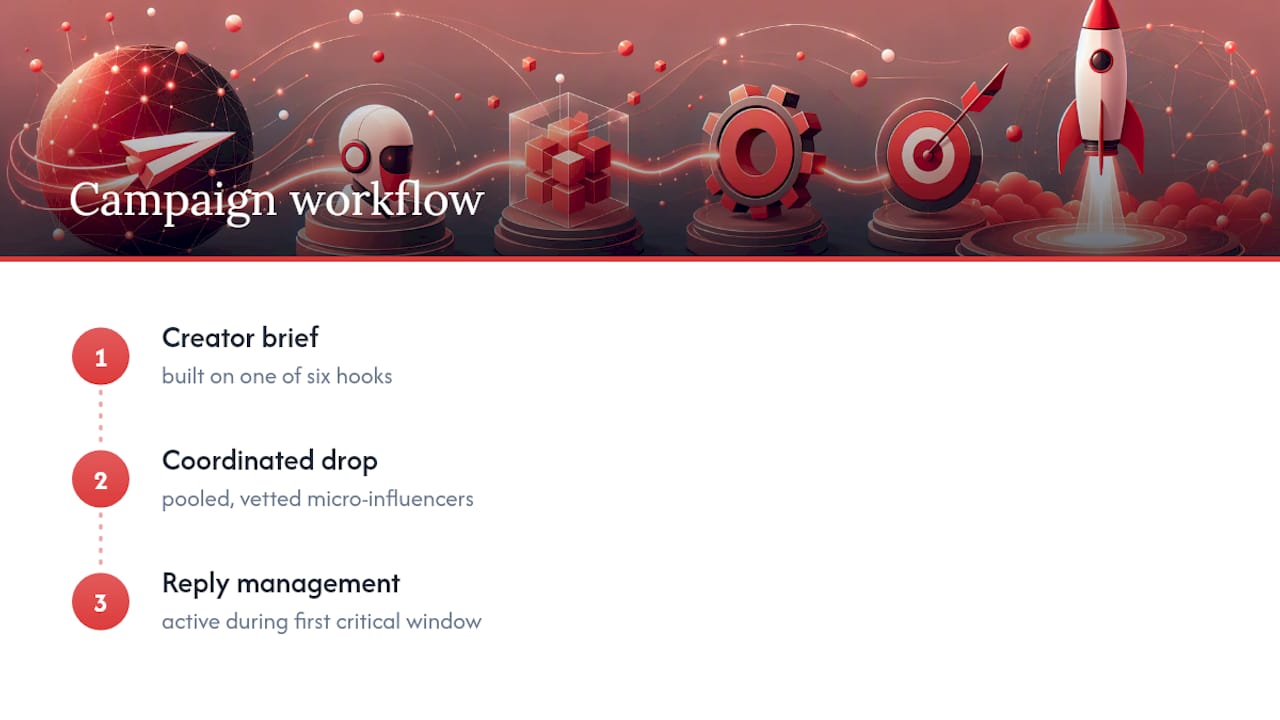
Knowix built this framework by running creator-driven launches for tech and AI brands where the card, the reply choreography, and the amplification sequence all get engineered together instead of handled by separate teams. A typical campaign workflow starts with a creator brief built around one of the six hook formulas, moves through a coordinated drop across a pool of vetted micro-influencers, and closes with active reply management during the first critical window after launch. Case studies and internal benchmark data will expand this section as results are published. For now, the real campaign examples documented show the same structure in action across different launch types.
The Part of This Playbook Most Teams Get Backwards
Most teams treat the hook as the whole job and amplification as an afterthought, something you bolt on after the copy is “done.” That ordering is backwards. Timing scores higher than hook strength in every measured breakdown of what drives virality on X, which means a mediocre card posted at the right moment with coordinated early replies will consistently beat a brilliant card posted into silence.
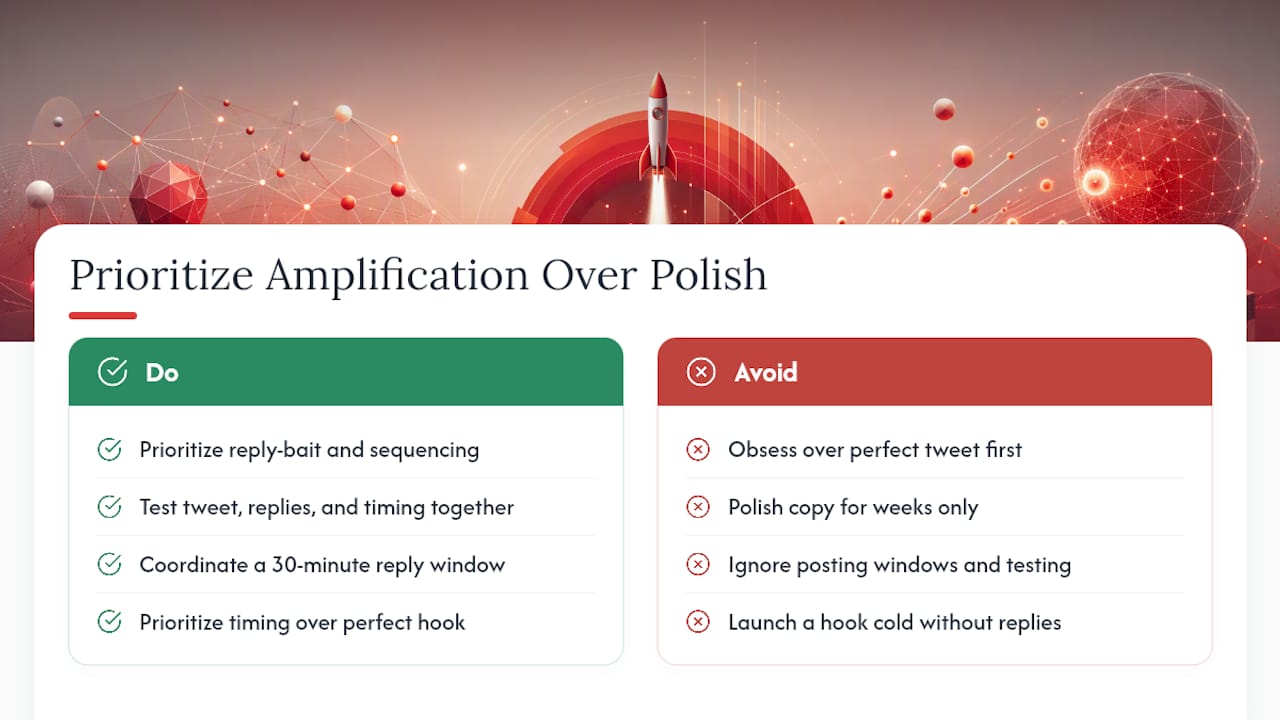
The conventional advice tells founders to obsess over the perfect tweet. The better advice is to treat the tweet, the reply choreography, and the drop timing as one system, tested together, not three separate decisions made by three separate people. Teams that get this wrong usually spend weeks polishing copy and zero hours testing posting windows or briefing a reply team.
If you’re prioritizing one thing first, prioritize reply-bait design and amplification sequencing over another round of copy edits. A good-enough hook with a sharp reply CTA and a coordinated 30-minute reply window will outperform a perfect hook launched cold, almost every time.
— Knowix
Ready to Run This Playbook Without Building the Team Yourself?
Everything above works, but running it well means briefing creators, testing timing windows, writing six hook variants per card, and managing replies in real time during a launch window. That’s a full job, not a side task for a founder already running product and fundraising. This system coordinates a large number of creators within a one-hour launch window and handles the reply choreography that makes those first 30 minutes count.
If you’re planning a single launch moment, Amplify Your Reach on X covers post amplification with vetted micro-influencer quote-retweets and controlled reply seeding, built for exactly the drop patterns described above. If you’re managing an ongoing presence rather than a one-off campaign, X Management covers daily content, replies, and community engagement on retainer. Teams also weighing the landing page side of a launch often pair this with a conversion-focused marketing partner to make sure the traffic a breakout card generates actually converts once it lands. Get in touch with Nowix to scope your next launch window before you lock a date.
Sources
- What makes content go viral on X (Twitter) — Neil Patel
- How to Go Viral on X (Twitter) in 2026: Hooks, Threads & Algorithm Strategy — Metadata Reactor
- How to go viral on Twitter/X to grow your brand (2026) — Shopify
- What works on Twitter: 9,556 tweets analyzed — ClimbX
Recommended
- How to Launch an AI Product on Twitter: The Founder’s Playbook
- Tech Startup Announcement Strategy: Engineering a Timeline Takeover on X
- How to Increase Twitter Engagement in 2026
- For Tech & AI Teams: Twitter Tone of Voice, Prove It in One Tweet
Frequently asked questions
What should an X profile visitor be able to understand quickly?
What the product does, who it helps, the evidence behind the claim and the next useful action. Align the bio, pinned post and linked page around that decision.
How can I evaluate whether the next step is useful?
Track the relevant link or website action and review the quality of recorded enquiries. Profile views and link clicks are useful observations but are not qualified leads by themselves.