
X’s Rules set the behavior limits for posting and interacting on the platform. Break the labeling, privacy, or authenticity rules and you risk downranking, content removal, or account suspension, with enforcement varying by region under applicable laws. The fix is simple: know the categories, label what needs labeling, and check the official Help Center before you post something borderline.
TL;DR:
- Enforcement often triggers visibility filtering when posts or accounts violate rules, reducing reach without notifying the user.
- Repeated offenses like hate speech, targeted harassment, doxxing, or non-consensual intimate media lead to content removal or account suspension.
- Compliance requires labeling sensitive media, obtaining explicit consent, avoiding fake engagement schemes, and maintaining thorough campaign records.
- Regional laws, especially in the EU, can alter enforcement speed and scope, necessitating local policy review beyond the global rules.
- Treat X’s community standards as a continuous operational process, not a one-time legal check, to prevent campaign disruptions and reach losses.
Table of Contents
- Twitter Community Guidelines: The Core Policy Categories
- What Content Actually Gets You Flagged
- How X Enforces These Rules Behind the Scenes
- How to Report a Violation and Appeal a Decision
- Why Enforcement Looks Different in the EU and Elsewhere
- A Compliance Checklist Before You Post or Launch
- What Brand Teams Get Wrong About X’s Rules
- Sources
Twitter Community Guidelines: The Core Policy Categories
X organizes its Rules into buckets that cover almost everything you’d want to post, promote, or reply to. The Rules and policies hub at the X Help Center groups them into five practical areas, and knowing which bucket your content falls into tells you exactly what standard it gets held to.
- Safety: covers violence, terrorism, child exploitation, suicide/self-harm content, and hateful conduct
- Privacy: governs sharing private information, non-consensual media, and doxxing
- Authenticity: targets platform manipulation, spam, fake engagement, and coordinated inauthentic behavior
- Intellectual property: handles copyright and trademark claims
- Platform use: covers account security, ban evasion, and third-party API misuse
Behavior gets scrutinized as heavily as content itself. A Carnegie Endowment review of platform community standards found that platforms increasingly police how people act (spam patterns, coordinated posting, fake amplification) rather than judging posts on content alone. That matters for anyone running a campaign: your posting cadence and network behavior can trigger the same authenticity review as your actual copy.
One wrinkle worth knowing: policy text isn’t frozen in place. TechCrunch reported that X quietly removed a clause explicitly prohibiting targeted deadnaming and misgendering, with no major announcement. Treat the Help Center as a living document, not a one-time read.
What Content Actually Gets You Flagged
Most enforcement actions trace back to a short list of repeat offenders. Hate speech targets someone based on race, religion, gender, or a similar protected trait. Targeted harassment means repeated unwanted contact aimed at intimidating a specific person. Doxxing is publishing someone’s home address, phone number, or other private identifiers without consent. Violent threats, even ones framed as jokes, get treated as credible risk signals by reviewers.
Sensitive media has its own lane. Consensual adult content is allowed under labeling rules, but it can’t appear in profile photos, header images, or other spots where it displays without a warning. Non-consensual intimate media and content depicting sexual violence get removed outright, no exceptions.
- Impersonating a real person, brand, or organization without disclosure
- Using someone else’s copyrighted images, video, or trademarked assets without permission
- Buying followers, running engagement farms, or coordinating fake retweet networks
- Posting unsolicited bulk replies or duplicate content across accounts (spam patterns)
Pro Tip: Before launching any campaign asset, run it through a simple test: would this need a warning label if it appeared in someone’s feed with zero context? If yes, label it or don’t post it in a prominent placement.
How X Enforces These Rules Behind the Scenes
Enforcement runs on two layers working together. Machine learning models scan for pattern matches (spam signatures, known hate terms, coordinated posting behavior) around the clock, while human moderators review flagged edge cases and appeals. California’s state oversight reporting on X confirms this structure directly: the California OAG’s H1 2025 ToS Report documents X’s combined use of machine learning heuristics and human review, alongside enforcement actions that range from restricting reach to full removal.
That “restricting reach” piece is what catches people off guard. Visibility filtering is a middle-ground penalty: your post stays live, but its reach and engagement quietly drop without any notification. You keep posting into what feels like silence.
- Visibility filtering: content stays up, discoverability drops sharply
- Labeling: a warning screen or context note gets attached
- Account-level actions: temporary locks, feature restrictions, or suspension for repeat violations
For brands running paid amplification, an invisible reach cut is often more damaging than an obvious takedown, because there’s no clear signal telling you something went wrong.
How to Report a Violation and Appeal a Decision
Reporting works best when you give X’s reviewers everything they need in one pass, instead of a vague complaint.
- Use the in-app “Report” button on the specific post, profile, or DM for standard violations.
- For serious threats or crimes, contact local law enforcement directly in addition to reporting on the platform.
- Attach URLs, screenshots, and timestamps. Context matters more than volume.
- If your content gets actioned, file an appeal through the account notification or the Help Center appeals form.
- Expect a review window measured in days, not hours, especially for cases requiring human judgment.
Pro Tip: Screenshot the violating content the moment you see it. Posts get deleted fast once a reporting wave starts, and a missing screenshot can stall your appeal.
Why Enforcement Looks Different in the EU and Elsewhere
X doesn’t apply one uniform standard everywhere; local law reshapes both the rules and how strictly they’re enforced. The European Commission issued preliminary findings that X may be breaching the Digital Services Act, citing gaps in ad repository transparency, dark patterns around verified account design, and restricted researcher data access.
- The DSA pushes large platforms toward stricter transparency reporting and faster removal timelines for illegal content in the EU
- National laws can require X to report certain content directly to authorities, beyond standard platform moderation
- Enforcement speed and thresholds can shift by country, so a post treated one way in one market may get flagged faster elsewhere
Brands running cross-border campaigns should check regional Help Center guidance rather than assuming one policy applies globally.
A Compliance Checklist Before You Post or Launch
Building good habits here takes less effort than recovering from a suspension mid campaign.
- Label sensitive media before posting, and never place it in a profile photo, header, or cover image
- Confirm written consent before sharing intimate images or private details about anyone
- Skip follower-buying services and fake engagement schemes entirely, even from “trusted” vendors
- Keep a running record of creator briefs, contracts, and asset approvals for every campaign
Brand teams running paid ad activity in the EU should build ad transparency and recordkeeping into standard workflow, given the regulatory scrutiny on ad repository practices. A Facebook Ads audit framework offers a useful model for the kind of recurring transparency check that translates well to X campaigns.
Pro Tip: Set a recurring calendar reminder to skim the Rules and policies hub monthly. Clauses get added or dropped without fanfare, and last year’s compliant asset might not be compliant today.
What Brand Teams Get Wrong About X’s Rules
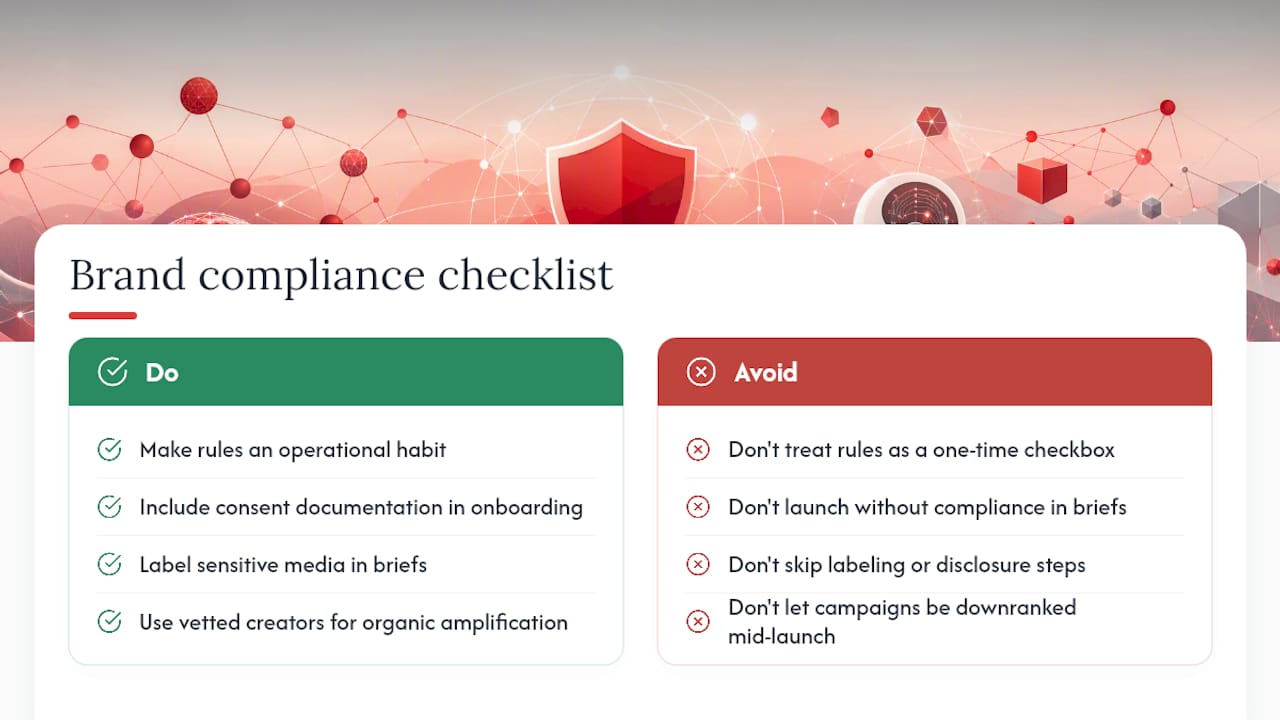
Most brand teams treat X’s Rules as a one-time legal checkbox instead of an operational habit, and that’s the gap that gets campaigns downranked mid-launch. Policy compliance is built into creator onboarding from the start: consent documentation, sensitive media labeling, and paid amplification disclosure are included in the creator brief before a single quote-retweet goes live. This helps ensure campaigns can trend well and avoid losing reach halfway through their window.
For a look at how that discipline plays out at scale, the Enlivex case study shows a compliant creator campaign hitting the day’s top trending spot with over 600 creators involved. If you’re planning a launch and want reach that doesn’t evaporate to invisible visibility filtering, organic post amplification built around vetted, policy-aware creators is worth a look before you brief your next wave.
— Knowix
Sources
- Rules and policies — X Help Center
- Commission sends preliminary findings to X for breach of the Digital Services Act — European Commission press release
- X Corp. — H1 2025 California ToS Report (OAG)
- Twitter removed deadnaming/misgendering policy — TechCrunch
Recommended
- Twitter Brand Safety for Tech and AI Marketers
- For Tech & AI Teams: Twitter Tone of Voice, Prove It in One Tweet
- How to Launch an AI Product on Twitter: The Founder’s Playbook
- Engineering Organic Reach on X for Tech Brands: A 2026 Operator’s Guide
Frequently asked questions
Does this guide mean Nowix offers X customer support or community management?
No. This is informational content. Nowix’s services cover X content, publishing and marketing campaigns; reply handling, moderation, customer support staffing and DM management are outside the offer.
How should a brand define responsibilities around sensitive conversations?
Agree an internal approval owner, escalation route and verified facts before publication. Keep marketing content responsibilities separate from customer support and moderation responsibilities.