
A Twitter content calendar is a structured plan that schedules your tweet publishing frequency, timing, and content themes to maximize reach and engagement while maintaining consistency. Without one, you post reactively, miss peak windows, and burn out fast. With one, you build momentum that compounds. The data backs this up: consistent daily posting produces 40% faster follower growth compared to irregular posting, with accounts posting regularly seeing 2–3x higher engagement. That gap is not a coincidence. It reflects the X algorithm rewarding predictable, quality signals over sporadic bursts.
A well-built posting plan also forces you to think before you type. You define what you stand for, who you are talking to, and what action you want readers to take. That clarity is what separates accounts that grow from accounts that just exist.
What is a Twitter content calendar and why does it matter?
A Twitter content calendar is a planning system, not just a spreadsheet. It maps out what you post, when you post it, and why each piece of content serves a specific goal. As research confirms, a calendar is a mechanism to execute strategy, not a strategy itself. Calendars without a clear content strategy produce consistent posts that never achieve specific goals.

The distinction matters. You can post every day and still lose followers if your content has no direction. The calendar is the container. Your strategy is what fills it.
How often should you post on Twitter for real growth?
Posting frequency is the most misunderstood variable in Twitter growth. More is not always better. Posting more than 5 original tweets daily can trigger spam penalties and reduce your engagement reach. The algorithm reads volume spikes as bot-like behavior and suppresses your distribution.
The right frequency depends on where your account stands right now:
- 0–1,000 followers: Post 1–2 original tweets per day. Prioritize replies heavily. 40+ genuine replies daily drive more profile visits and discovery than broadcast posts alone at this stage.
- 1,000–10,000 followers: Post 2–3 original tweets per day. Your audience is growing, so content quality and consistency matter more than volume.
- 10,000–100,000 followers: Post 3–5 original tweets per day. You have enough social proof to experiment with formats and topics.
- 100,000+ followers: Frequency becomes secondary to voice and relevance. Your audience expects depth, not just output.
The sustainable baseline for growth across all tiers is 1–3 original posts per day, supplemented by 40–60 replies. That ratio keeps you visible without triggering penalties.
When is the best time to post?
Timing your posts correctly multiplies the reach of every tweet you send. Tuesday through Thursday between 12 PM and 6 PM local time produces the highest engagement across most accounts. Wednesday at 9 AM ET is the single highest engagement window on the platform. For B2B and professional audiences, Tuesday through Thursday morning slots between 8 AM and 11 AM ET consistently outperform afternoon windows.
Space your posts at least 90 minutes apart. Clustering two tweets within 30 minutes of each other splits your impressions and confuses the algorithm about which post to amplify.
Pro Tip: Schedule your highest-effort original post for Wednesday morning and use Tuesday and Thursday for supporting content like threads, replies, or repurposed insights.
How to build your content calendar around pillars and a content mix
The strongest Twitter accounts do not post whatever feels relevant that day. They define 4–5 content pillars and rotate through them deliberately. Common pillars for tech and AI brands include education, personal story, opinion, entertainment, and promotion. Each pillar serves a different audience need and a different algorithmic signal.
Content mix ratios prevent your feed from becoming a sales channel. The 4:1 rule is the most widely used framework: for every promotional post, publish four value-driven posts. A sharper version is the 4-1-1 rule, which specifies one promotional post, one curated or reshared post, and four original value posts per six-post cycle. Both frameworks exist to prevent promotional overload, which kills follower retention faster than low posting frequency.
Here is how to build your weekly content structure:
- Define your pillars. Write down 4–5 categories that reflect your brand’s expertise and your audience’s interests. For a tech brand, this might be product education, founder story, industry opinion, case study proof, and one promotional slot.
- Assign pillars to days. Monday for education, Tuesday for opinion, Wednesday for your best original post, Thursday for a case study or proof point, Friday for something lighter or community-driven.
- Set your mix ratio. Commit to the 4:1 or 4-1-1 rule before you draft a single post. This decision shapes every week’s content before you write a word.
- Plan monthly themes. Align one overarching topic per month with a product launch, industry event, or seasonal moment. This creates cohesion across individual posts without making every tweet feel like a campaign.
- Map posts to outcomes. Content calendars should map directly to business outcomes, matching content types and posting frequency to specific audience segments and goals like client acquisition or course sales.
Pro Tip: Build your pillar list before you open any scheduling tool. The tool is just a container. The pillar list is your editorial policy.
How to use batching and a rolling 14-day topic grid
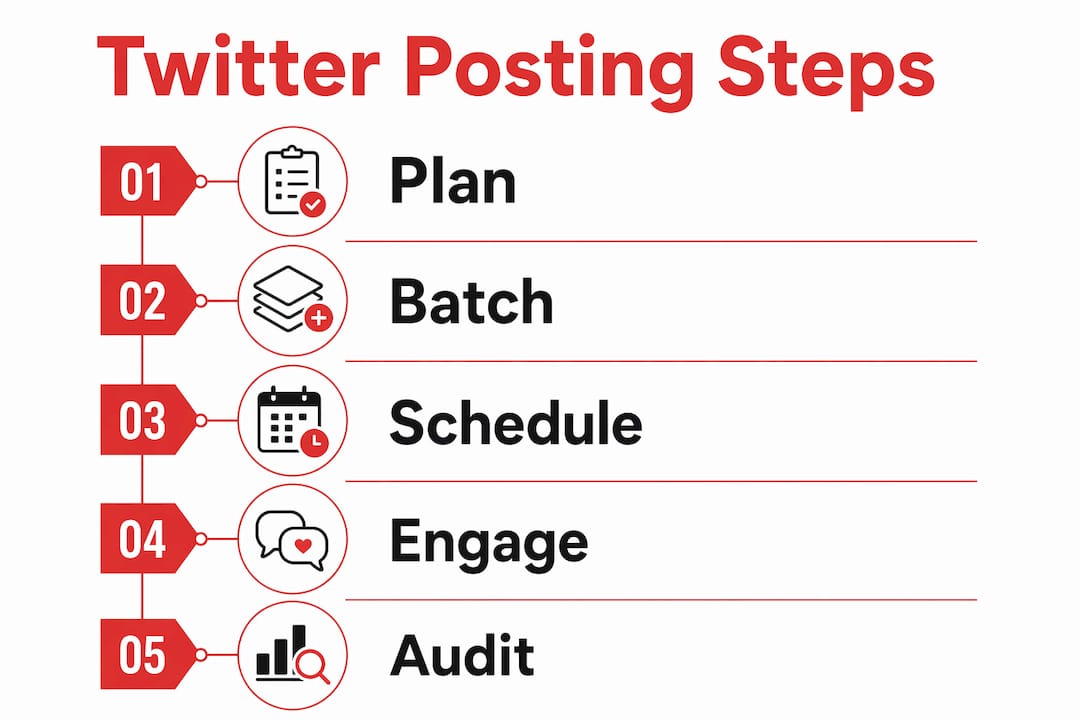
Most social media managers waste time by mixing planning, drafting, and posting into one chaotic session. Batching separates these modes, and the results are measurable. Separating creation time from engagement time boosts productivity because writing requires focused effort while engagement requires a conversational mindset. Trying to do both at once degrades the quality of each.
The most effective system uses a two-layer approach:
Layer 1: The 14-day topic grid. This is your planning horizon. Every Sunday, map out the topics, pillars, and formats for the next two weeks. You are not writing posts yet. You are deciding what each slot is about. Top-quartile Twitter accounts use exactly this rolling method to stay aligned with evolving conversations without locking themselves into a rigid 30-day plan.
Layer 2: The 24-hour drafting window. Draft the actual post text no more than 24 hours before it publishes. Pre-scheduling entire months leads to stale posts and engagement decline. A tweet about an industry trend written three weeks ago reads like old news by the time it goes live.
Here is a practical Sunday workflow:
- Review last week’s top and bottom performing posts. Note what format and topic drove the most impressions.
- Fill in the 14-day topic grid with pillar assignments and any time-sensitive hooks (product launches, industry events, trending topics).
- Draft posts for Monday through Wednesday only. Leave Thursday and Friday slots open for reactive content.
- Schedule Monday’s posts using your preferred tool. Draft Tuesday’s posts on Monday evening.
Batch writing on a dedicated day and treating daily engagement as a separate session improves both quality and consistency. You write better when you are not also monitoring notifications.
AI tools like ChatGPT or Claude work well for generating topic variants and headline options during the Sunday planning session. Use them for ideation, not for final copy. Your voice is the asset. AI is the brainstorming partner.
Pro Tip: Keep a “swipe file” of your best-performing tweets. When the topic grid feels empty, pull from that file for repurposing ideas rather than starting from scratch.
What tools and templates work best for planning your schedule?
A basic Twitter calendar template needs five columns: date, content pillar, post draft, format (text, image, thread, poll), and status (draft, scheduled, live). That structure covers 90% of what a social media manager needs to track. You can build this in Google Sheets, Notion, or any project management tool your team already uses. The format matters less than the discipline of filling it in every week.
For scheduling, native X scheduling works reliably for individual posts and carries no algorithmic risk. Third-party scheduling tools add team collaboration, bulk upload, and analytics dashboards, but scheduling tools are only safe if posts are spaced naturally and varied in format. Robotic, repetitive scheduling patterns trigger algorithm penalties regardless of which tool you use.
For a deeper look at how to structure your planning process, this guide on content calendar planning covers the strategic framework that applies across platforms.
Track these three metrics every week to know if your calendar is working:
| Metric | What it tells you |
|---|---|
| Impressions per original post | Whether your content is getting distributed by the algorithm |
| Follower growth rate | Whether your content is converting new viewers into followers |
| Reply engagement rate | Whether your audience is actively responding, not just scrolling |
Audit your calendar every four weeks. Pull the top five and bottom five posts by impressions. Look for patterns in format, topic, and posting time. Adjust your pillar assignments and posting windows based on what the data shows, not what you assumed would work. Regularly auditing key metrics weekly allows dynamic adjustment to your calendar rather than relying on fixed plans that go stale.
Key Takeaways
A Twitter content calendar only produces results when it is built on a clear strategy, a defined content mix, and a batching workflow that separates planning from drafting.
| Point | Details |
|---|---|
| Post frequency by tier | Post 1–3 original tweets daily and add 40–60 replies to maximize discovery without triggering spam penalties. |
| Timing drives reach | Tuesday through Thursday between 12 PM and 6 PM local time produces the highest engagement across most accounts. |
| Pillars prevent drift | Define 4–5 content pillars and assign them to days before you draft a single post. |
| Use a rolling 14-day grid | Plan topics two weeks out but draft post copy no more than 24 hours before publishing to stay relevant. |
| Audit weekly, adjust monthly | Track impressions per post, follower growth, and reply rate every week to catch what is working before it stops. |
Quality beats volume every time on X
Here is the uncomfortable truth I have seen play out repeatedly with tech and AI brands on X: the accounts that obsess over posting frequency almost always plateau faster than the accounts that obsess over voice. Voice-rich, distinct posts three times per week outperform a high volume of templated or generic posts in both engagement and growth. That finding runs counter to what most social media advice tells you, but it matches what I see in practice.
The mistake I watch teams make is treating the calendar as the goal. They fill every slot, hit their daily quota, and then wonder why their follower count is flat. The calendar is a tool for showing up consistently. It is not a substitute for having something worth saying.
My practical advice: set a cadence ceiling before you build your calendar. Decide the maximum number of original posts you can write at full quality per week. Then build your calendar around that number, not around what a benchmark study says you should post. Prioritizing voice consistency leads to more sustainable and authentic audience growth than chasing arbitrary post counts.
The other mistake is conflating scheduled content with engagement. Your calendar handles broadcast posts. Engagement, meaning replies, QRTs, and conversations, happens in real time and requires a separate daily block. Block 20–30 minutes each morning for engagement only. Do not draft during that window. The two modes require different mental states, and mixing them produces mediocre results in both directions.
— Knowix
How Nowix amplifies what your content calendar builds
Your calendar creates the foundation. Nowix turns that foundation into momentum.
Nowix works with tech and AI brands to amplify original posts through organic post amplification, placing your content in front of the right audiences at the right moment. The X Management service puts your profile in the hands of practitioners who understand posting timing, reply strategy, and content pacing at a level that most in-house teams cannot maintain alone. When a campaign needs maximum velocity, Timeline Takeover Campaigns coordinate creator waves that turn a single post into the biggest story on the timeline. If you want your content calendar to produce results that compound, Nowix is built for exactly that.
FAQ
What is a Twitter content calendar?
A Twitter content calendar is a planning system that maps out what you post, when you post it, and which content pillar each post serves. It executes your strategy rather than replacing it.
How often should you tweet for growth?
Post 1–3 original tweets per day and add 40–60 replies daily. Posting more than 5 original tweets per day can trigger spam penalties and reduce your reach.
What are the best times to post on Twitter?
Tuesday through Thursday between 12 PM and 6 PM local time produces the highest engagement. Wednesday at 9 AM ET is the single highest engagement window on the platform.
What is the 4-1-1 rule for Twitter content?
The 4-1-1 rule means publishing four original value posts, one curated or reshared post, and one promotional post per six-post cycle. This ratio prevents your feed from becoming a sales channel.
How far in advance should you plan Twitter posts?
Plan topics on a 14-day rolling grid but draft the actual post copy no more than 24 hours before publishing. Pre-scheduling full months leads to stale content and lower engagement.