
The highest-performing Twitter CTAs right now are short, specific reply-bait triggers (“comment with X”), prediction and contest formats, urgency-gated resource drops, and clearly sequenced multi-step giveaways. Every other CTA style is a variation on those four. Below you’ll find copy-ready templates, the rules for matching a CTA to your actual objective, and the timing tactics that decide whether your ask gets amplified or buried.
TL;DR:
- Specific reply-bait CTAs that ask for comments with a clear prompt outperform vague asks by several hundred percent due to ease of compliance and algorithm signals.
- Multi-step asks like follow, retweet, and comment boost reach, but require higher effort and are best used with high-value prizes or when follower growth is the primary goal.
- Early replies within the first 15 to 60 minutes significantly influence a tweet’s visibility, emphasizing the importance of active engagement and reply monitoring during that window.
- Using a keyword-for-DM format captures high-intent leads privately, trading some reach for deeper engagement, especially effective for conversions or gated offers.
- Testing should isolate one variable at a time, with a minimum of three to five repetitions, to identify the most effective CTAs based on reply, click, or conversion metrics specific to the campaign goal.
Table of Contents
- Twitter CTA Examples You Can Copy and Adapt Today
- How to Choose the Right CTA for Your Objective
- CTA Formulas That Consistently Outperform
- Timing, Reply Strategy, and Platform Signals That Affect CTA Performance
- Twitter Ad CTAs and Conversation-Button Formats
- Examples by Goal: Copy, Context, and What to Track
- Metrics, Benchmarks, and How to Measure CTA Success
- How to Test, Iterate, and Scale Winning CTAs
- Practitioner Notes on Crafting CTAs for Tech and AI Brands
- Nowix for Teams That Need CTA Execution at Speed
- Sources
Twitter CTA Examples You Can Copy and Adapt Today
Vague CTAs get ignored. Specific ones get replies. Dataset analysis on tweet performance shows that phrases like “reply with” and “comment your [X]” outperform vague asks by several hundred percent, because the platform’s algorithm treats a reply as a stronger signal than a like, and a specific ask is simply easier to comply with than an open-ended one. Below are the templates worth stealing, grouped by what you’re actually trying to accomplish.
Reply-focused templates work because they remove the guesswork. The reader knows exactly what to type before they’ve finished reading your tweet.
- “Reply with the tool you’d cut from your stack tomorrow if you had to.”
- “Comment your current MRR. No judgment, just curious how the community’s tracking.”
- “Reply with a number 1 to 5: how confident are you in your Q1 roadmap?”
- “Drop your worst onboarding screenshot below. We’ll feature the top three.”
Growth and distribution templates ask for more effort but pay off with wider reach, since each action (follow, retweet, comment) touches a different distribution lever on the platform.
- “Follow + RT + comment your favorite AI tool from this year. Picking 3 winners for a free month of [product] on Friday.”
- “Predict our next feature launch in the replies. Closest guess gets early access.”
- “Quote tweet this with your hottest take on [industry topic]. Best one gets pinned.”
Conversion and lead-capture templates trade a small ask for a private, high-intent follow-up. This is where the “keyword-for-DM” format earns its reputation.
- “Comment ‘TEMPLATE’ and I’ll send you the exact prompt structure we use for cold outreach.”
- “Reply ‘SEND’ for the free audit checklist. First 50 only.”
- “Comment your biggest bottleneck and I’ll DM you the resource that fixes it.”
The keyword-for-DM structure works because it satisfies the algorithm through public engagement while converting the actual lead privately, which sidesteps the reach penalty that comes from dropping a raw link into the body of a tweet.
Bookmark and thread CTAs target a signal most marketers ignore entirely, even though it’s one of the clearest indicators that someone found real value in what you wrote.
- “Bookmark this thread. You’ll want it next time your CAC creeps up.”
- “Save this for your next planning session. Thread below.”
- “This is the checklist I wish I had at launch. Bookmark it before you close the tab.”
A few formatting details separate templates that convert from templates that flop. Keep the CTA to one sentence, place it either as the opening hook or the final line of the tweet (never buried in the middle), and use a single emoji at most if it clarifies rather than decorates. If you’re linking to something, put the link in the first reply rather than the main tweet, since external links in the primary tweet tend to get throttled in distribution. Capitalize the actual keyword you want people to type (“comment YES”) so it visually stands apart from the rest of the sentence.
How to Choose the Right CTA for Your Objective
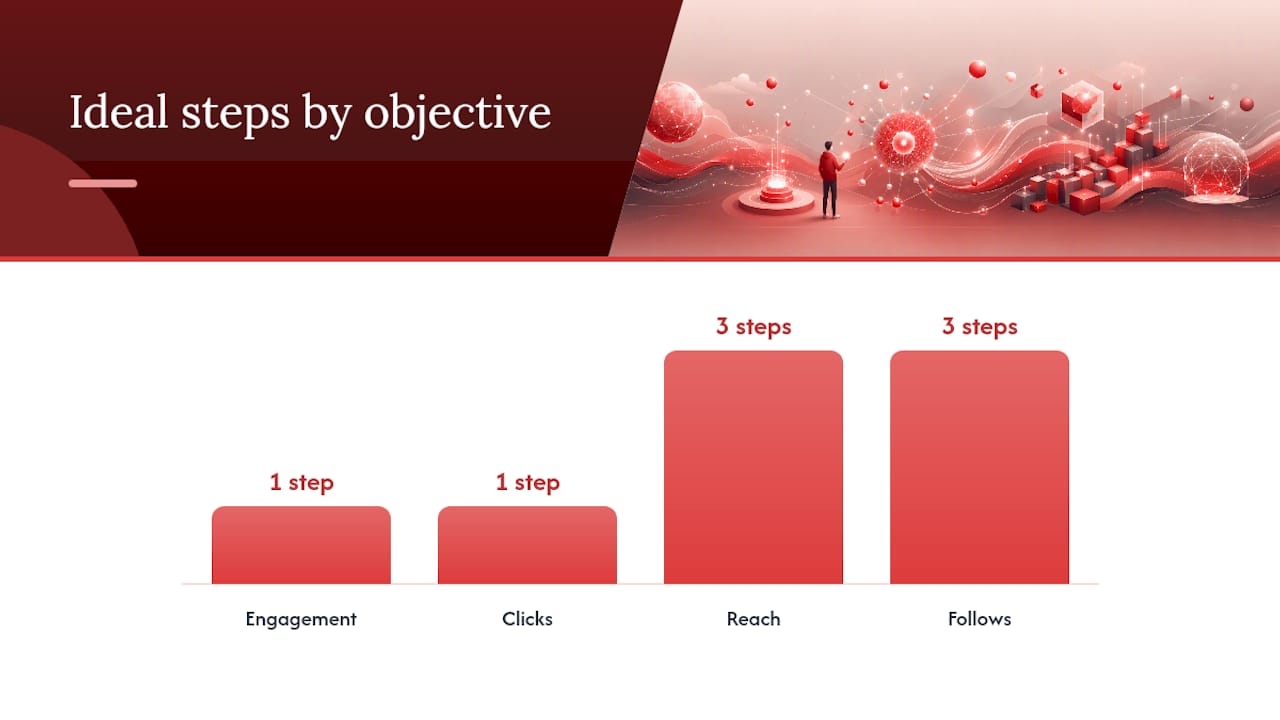
Every CTA should map to exactly one objective. Trying to drive engagement, clicks, and follows with a single tweet usually gets you mediocre results on all three.
- Engagement is the goal → use reply-bait: a specific comment trigger, an opinion prompt, or a scaled question (“rate 1 to 10”).
- Reach is the goal → use multi-step asks like follow + RT + comment, or a prediction contest that rewards public replies.
- Clicks are the goal → use a single-step ask with the link placed in the first reply, not the tweet itself.
- Follows are the goal → pair a giveaway with an explicit, numbered set of steps (“1. Follow. 2. RT. 3. Comment your pick.”).
- Conversions are the goal → use keyword-for-DM or an urgency-gated resource with a clear deadline.
Before you post, run the ask through a quick friction check. Count the number of steps you’re requesting: one is ideal for engagement, two or three is fine for growth if the prize justifies it. Weigh the value you’re offering against the difficulty of the ask. If you’re running anything that resembles a giveaway or contest, check your jurisdiction’s basic sweepstakes rules first (no purchase requirement, clear entry period, and a stated method of winner selection are the common minimums).
Pro Tip: Match your success metric to your CTA type before you post, not after. If you’re running a reply-bait tweet, track reply count and reply rate. If you’re running a link CTA, track click-through rate on the first reply, not on the original tweet.
CTA Formulas That Consistently Outperform
Four formats show up again and again in high-performing tweets, and each one earns its place for a different structural reason.
- The specific comment trigger. “Reply with your favorite [X]” beats “What do you think?” because specificity removes the cognitive load of figuring out what to say. Vague prompts require the reader to invent their own answer format; specific ones hand it to them.
- The prediction contest. Asking people to guess an outcome (a launch date, a metric, a winner) triggers both replies and quote tweets, since predicting publicly carries a small social stake that a plain comment doesn’t.
- Keyword-for-DM. This format captures leads without forcing a public link click, but it trades reach for depth. You’ll get fewer total public replies than a pure reply-bait tweet, but the ones you get are higher intent.
- The urgency-gated resource. “First 50 replies get the template” borrows scarcity from direct response marketing and translates cleanly to Twitter’s reply mechanics.
- The multi-step giveaway. Follow + RT + comment structures ask for more from each participant, so they work best when the prize value is high enough to justify the friction, or when your primary goal is follower growth rather than pure engagement volume.
Pick the formula based on what you’re optimizing for that week, not out of habit. A brand that runs the same giveaway format every Monday will see diminishing returns as the audience starts to anticipate and discount the ask.
Timing, Reply Strategy, and Platform Signals That Affect CTA Performance
The first 15 to 60 minutes after you post decide most of a tweet’s fate. Early replies signal to the algorithm that a post is worth surfacing further, and your own reply rate during that window matters almost as much as the original CTA, because a fast author reply closes the reciprocity loop and encourages the next person to jump in.
Not every engagement signal carries equal weight. Sprout Social’s platform analysis places replies and bookmarks above likes and passive impressions, which means your CTA design should actively chase those two signals rather than settling for a like-friendly prompt. A tweet that racks up 400 likes and 3 replies is doing worse, by the metrics that matter, than one with 60 likes and 40 replies.
Build this into your operating rhythm:
- Assign a specific team member to monitor replies for the first hour after any CTA post goes live.
- Reply to the first 10 to 15 comments personally within that window, even with something short.
- Use AI-drafted reply suggestions as a starting point only. Edit every one before sending. A canned-sounding reply kills the reciprocity signal you’re trying to build.
- Track reply velocity at the 15, 30, and 60 minute marks so you can spot early winners worth boosting.
Pro Tip: If a CTA tweet hasn’t cleared a handful of organic replies within the first 30 minutes, that’s your signal to seed the conversation yourself, whether that means replying with your own answer to the prompt or quote tweeting it from a secondary account.
Twitter Ad CTAs and Conversation-Button Formats
Paid campaigns give you CTA mechanics that organic posts don’t: dedicated buttons, conversation cards, and promoted polls. The format you choose should match the ad objective, not just whatever looks cleanest in the ad builder.
- Website click button fits when the objective is traffic and you have a landing page ready to receive it directly.
- Conversation button works when you want the ad’s engagement to stay native to the platform. Conversation ads can generate asymmetric engagement because the interaction never leaves Twitter, which the algorithm tends to reward.
- Promoted poll suits low-friction engagement objectives, since voting takes one tap and still counts as a meaningful interaction signal.
- App install button is the right call only when the objective is literally installs, not general awareness.
A few short copy pairings for paid use: for a conversation button, try “Tap to pick which feature ships first.” For a promoted poll, try “Which one are we building next?” paired with two or three concrete options rather than an open-ended question. For a website click objective, keep the copy to a single benefit statement and let the button do the asking, rather than repeating “click here” in the text itself.
Examples by Goal: Copy, Context, and What to Track
Different objectives call for different tweet structures, and the metric you watch afterward should shift with them.
- Engagement goal. “Reply with the metric you check first thing every morning.” This works because it’s personal, quick to answer, and invites comparison in the replies. Track reply count and reply rate, not impressions.
- Engagement goal, contest variant. “Predict which AI feature gets deprecated first in 2026. Closest guess gets a shoutout.” Predictions generate both replies and quote tweets because guessing publicly carries a small stake. Track total reply volume plus quote tweet count.
- Click and conversion goal. Post: “We just shipped the update everyone’s been asking for.” First reply: “Full breakdown + before/after benchmarks here: [link].” Track click-through rate on the reply, not the parent tweet.
- Click and conversion goal, gated variant. “First 50 replies get our internal prompt library. Comment ‘SEND’ and I’ll DM it over.” This works because scarcity plus a private delivery path increases both urgency and completion rate. Track DM completion rate, not just reply count.
- Follow and growth goal. “Follow + RT + comment your top launch mistake. Picking 3 for a free strategy call, ends Friday.” The explicit numbered steps reduce confusion about what qualifies as an entry. Track new follower count attributable to the post window.
- Bookmark goal. “Bookmark this before your next sprint planning: the 5 metrics that actually predicted our best-performing launches.” Threads framed as reference material get saved rather than just liked. Track bookmark rate specifically, since it’s reported separately from likes in native analytics.
Metrics, Benchmarks, and How to Measure CTA Success
There’s no single engagement-rate formula that applies to every campaign. The right formula depends on your objective: engagement rate by impressions measures how a specific tweet performed against the people who actually saw it, engagement rate by reach measures performance against unique viewers, and engagement rate by followers measures performance against your total audience size regardless of who saw the post.
Worked example: A tweet gets 12,000 impressions and 480 total engagements (replies, retweets, likes, bookmarks combined). Both numbers are correct. They just answer different questions.
Statistic callout: A “good” engagement rate is not one fixed number. ReachMore’s benchmark analysis shows nano accounts (1,000 to 10,000 followers) typically post materially higher engagement rates than larger accounts, because smaller, tighter audiences interact more proportionally than large, passive follower bases. Judging a 50,000-follower B2B account against a 5,000-follower niche account with the same benchmark is a mistake that leads teams to misjudge otherwise strong campaigns.
| Follower tier | Typical engagement focus | Signal to prioritize |
|---|---|---|
| Nano (1K to 10K) | Reply-bait, community questions | Reply rate |
| Micro (10K to 50K) | Contests, gated resources | Reply rate + bookmark rate |
| Mid to enterprise (>50K) | Ad-supported CTAs, conversation buttons | CTR and conversion rate |
For CTA types specifically, prioritize reply rate for reply-bait, bookmark rate for reference threads, click-through rate for link CTAs, and DM completion rate for keyword-for-DM offers. Trying to judge every CTA type against the same single metric is how good campaigns get mislabeled as failures.
How to Test, Iterate, and Scale Winning CTAs
Testing a CTA properly means isolating one variable at a time, not swapping out the phrasing, the image, and the posting time all in the same week.
- Design single-variable tests. Change only the CTA phrasing, keep the topic, format, and posting time constant. Run each variant for a minimum of one posting cycle before comparing results.
- Use a holdout window. Give each variant at least 60 minutes before judging performance, since early engagement in the first 15, 30, and 60 minutes tends to predict whether a post gets algorithmic lift or fades quietly.
- Set a minimum sample. Don’t declare a winner off a single post. Wait until you’ve run each variant at least three to five times across different days before trusting the pattern.
- Replicate across formats. Once a CTA phrasing wins organically, test the same core ask as a thread opener, then as a paid conversation ad, to see whether the lift holds outside its original context.
Pro Tip: Keep a simple running log of every CTA you post along with its 60 minute reply count. After a month, you’ll have your own internal benchmark that matters more than any industry-wide average.
Practitioner Notes on Crafting CTAs for Tech and AI Brands
Tech and AI audiences respond to specificity, not hype. A CTA that name-drops a real metric, a real feature, or a real trade-off reads as credible; a CTA built on generic excitement reads as marketing filler to a technical crowd.
Curated micro-influencer replies can accelerate the reply velocity a CTA needs in its first critical minutes, giving a launch tweet the early momentum that pure organic posting often struggles to generate on its own. Pairing that amplification with data-led CTAs, ones that reference a real benchmark or a real number, tends to outperform pure hype for this audience. For more launch-specific breakdowns, our Twitter campaign playbook walks through real examples in more depth.
— Knowix
Nowix for Teams That Need CTA Execution at Speed
Writing a great CTA is only half the equation. If nobody replies in the first 30 minutes, even the sharpest template goes quiet.
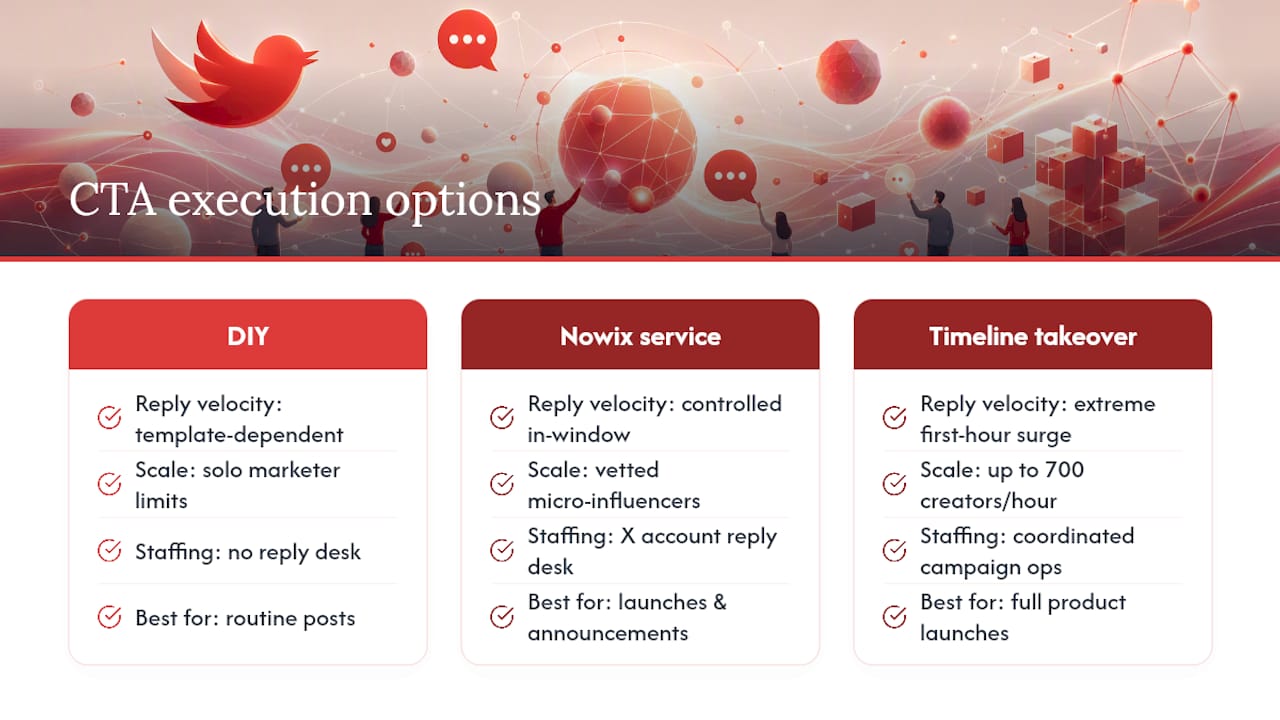
 Nowix exists for the moment a template alone can’t carry a launch: when you need real reply velocity fast, not just a well-worded ask sitting in the timeline. Our organic post amplification service drives controlled, vetted micro-influencer replies and quote-tweets in the exact window your CTA needs them, while our X account management service staffs the reply desk so your reciprocity loop never goes cold. For a full product launch, our timeline takeover campaigns coordinate up to 700 creators within a single hour, the kind of velocity a solo marketer simply can’t manufacture alone.
DIY works fine for a routine reply-bait post. Hire professional help when the CTA is tied to a launch, a fundraising announcement, or any moment where the first hour genuinely decides the outcome. If your team also handles lead nurture after a keyword-for-DM CTA converts, a partner like Brainiac Consulting can help turn those DMs into a real follow-up sequence.
Check current availability and get a campaign quote through our services page.
Sources
Recommended
- How to Increase Twitter Engagement in 2026
- Tech & AI Marketers: Six Pinned Tweet Archetypes That Convert Visits
- How to Launch an AI Product on Twitter: The Founder’s Playbook
- For Tech & AI Teams: Twitter Tone of Voice, Prove It in One Tweet
Frequently asked questions
What should an X profile visitor be able to understand quickly?
What the product does, who it helps, the evidence behind the claim and the next useful action. Align the bio, pinned post and linked page around that decision.
How can I evaluate whether the next step is useful?
Track the relevant link or website action and review the quality of recorded enquiries. Profile views and link clicks are useful observations but are not qualified leads by themselves.