Twitter (X) works for a product launch when you treat it as a distribution engine, not a press release. The single most effective approach is a short, structured launch thread backed by a several-day warm-up sequence and fast, reply-driven amplification in the first two hours. The goal isn’t one viral tweet. It’s visibility, social proof, and a low-friction link that turns attention into signups.
TL;DR:
- A structured, short launch thread combined with rapid replies and dedicated amplification can significantly increase visibility and engagement within the first two hours.
- Pre-launch activities should run for five to seven days, building curiosity, social proof, and testing different hooks to maximize response and relevance.
- Response speed and targeted engagement during the first 48 hours are crucial, requiring a prepared support team and a mix of organic replies and paid boosts.
- Success metrics focus on engagement rate, click-through rate, and signups from specific traffic sources, rather than impressions or likes, with ongoing follow-up post-launch.
- Outsourcing or coordinating with specialized service providers can streamline preparation, amplification, and sustained engagement, especially for larger or frequent product launches.
Table of Contents
- What Twitter Launch Formats and Features Actually Work
- How Long Should Your Pre-Launch Sequence Run?
- How to Write a Launch Thread That Converts
- Launch-Day Amplification: Replies, Crew, and Paid Boosts
- Which Metrics Actually Matter After Launch
- How Nowix Runs Timeline Takeovers for Tech Brands
- Getting Influencers and Advocates to Show Up on Launch Day
- Handling Feedback and Questions During and After Launch
- Legal and Compliance Points Founders Skip
- What Founders Get Wrong About Launching on X
- How Nowix Helps You Execute the Launch
- Sources
What Twitter Launch Formats and Features Actually Work
Not every product needs the same playbook. An AI tool and a physical product don’t launch the same way on X, and picking the wrong format wastes your best 48 hours.
Here’s how the major native options map to launch type:
- Launch threads: the default for SaaS and AI products. A short tweet thread structure lets you show problem, solution, and proof without losing readers.
- Product Drops: built for ecommerce. Merchants get a product page, a “Remind me” button, and an in-app reminder before the drop that pushes buyers back to checkout.
- First View: a paid takeover slot for the top of a feed, useful when you need guaranteed reach on hour one.
- Video and GIFs: raise click-through because they show the product doing something instead of describing it.
- Pinned tweet: keeps your launch thread visible to every profile visitor for weeks after the initial spike fades.
Prepare assets before you touch any of these: a 30 to 60 second demo clip, two or three clean screenshots, and one CTA link. Brands coordinating paid formats alongside organic launch activity tend to get more mileage out of both than either alone.
How Long Should Your Pre-Launch Sequence Run?
Five to seven days is the sweet spot for most founders. Longer sequences work for bigger audiences, but a tight week keeps momentum from going stale, and it’s backed by structured pre-launch playbooks that founders have run repeatedly with consistent results.
Run it like this:
- Day 1: name the problem. Post about the pain point your product solves, no mention of the product itself yet.
- Day 2: tease behind the scenes. A screenshot, a whiteboard photo, a half-built UI. Curiosity, not detail.
- Day 3: drop social proof. A beta user quote, a waitlist number, an early access screenshot.
- Day 4: countdown post. Tell people something ships in 72 hours. Ask them to turn on notifications.
- Day 5 to 6: test your hook. Post two variations of your launch-day opening line as standalone tweets and watch which gets more replies.
- Day 7: final prep. Brief your support crew, confirm your thread copy, schedule your demo video upload, and triple-check your CTA link works.
Track early engagement signals, replies and quote-tweets specifically, not just likes, since those predict whether your launch thread will get distribution once it goes live.
How to Write a Launch Thread That Converts
A 6 to 8 tweet thread outperforms both a single announcement tweet and a long-winded ten-tweet essay, according to maker-focused launch strategy guides. Here’s a template you can copy and adapt tonight:
- Tweet 1 (hook): “We just shipped something that took us 14 months and one very bad prototype to get right.”
- Tweet 2 (problem): Name the specific frustration your audience already feels. Be concrete, not abstract.
- Tweet 3 (solution): One sentence describing what your product does. No jargon.
- Tweet 4 to 6 (features): One feature per tweet, each with a screenshot or short clip. Show, don’t list.
- Tweet 7 (social proof): A beta result, a user quote, a waitlist number.
- Tweet 8 (CTA): Tell people exactly what to do next, and point them to the reply below for the link.
Put your actual link in the first reply, not the main thread. Links inside posts get reach suppressed by the platform, so keeping the thread link-free while the CTA tweet points to a reply preserves distribution and still gives you a clear conversion path.
Use short demo clips over static screenshots wherever you can. Threads with a 30 to 60 second demo video tend to drive more clicks to the landing page because they prove the product works before anyone has to click away.
Pro Tip: Write your hook tweet five different ways two days before launch. Post the two strongest as standalone tweets during your warm-up week and let real replies, not your gut, pick the winner.
Launch-Day Amplification: Replies, Crew, and Paid Boosts
Your first two hours decide whether the thread travels. Reply to every comment within minutes, not hours, during that window. Practitioners running SaaS launches recommend 20 to 30 targeted replies a day leading into launch, and that pace should double on launch day itself.
Line up your support crew in advance:
- 3 to 5 early amplifiers with different reply angles agreed ahead of time, so nobody posts the same generic “congrats” comment.
- A support crew of 10 to 20 trusted accounts who reply and retweet in the first 30 minutes, which is often what pushes a thread past the platform’s initial visibility threshold.
- A 24 hour follow-up post sharing a real number, signups, revenue, or a milestone, to catch a second wave of attention.
Layer paid formats only once organic activity is already moving. A First View slot or a small ads boost works best as fuel on a fire that’s already lit, not as a substitute for a thread with zero traction.
Pro Tip: Assign one person to own replies exclusively for the first two hours. Multitasking between replies and monitoring metrics guarantees you’ll be slow at both.
Which Metrics Actually Matter After Launch
Impressions feel good but don’t pay rent. Prioritize these instead:
- Engagement rate on your launch thread, not just the opening tweet.
- Click-through rate from the CTA reply to your landing page.
- Signups per traffic source, tagged with UTMs so you know which tweet actually converted.
- Conversion rate from X-driven traffic specifically, since it often behaves differently than search or email traffic.
Use UTMs on every link and separate first-touch signups from assisted conversions; someone might see your thread Monday and sign up Thursday after a friend’s retweet. Run a 7 day post-launch check: revisit your top-performing tweet, reply to any lingering questions, and post one follow-up with real numbers. If the launch underperforms, don’t panic and go quiet. Post again. The X to email to trial to paid funnel rewards founders who keep showing up, not ones who fire once and disappear.
How Nowix Runs Timeline Takeovers for Tech Brands
Launch campaigns can be built around three playbooks: timeline takeovers that coordinate creator amplification within a tight launch window, post amplification using vetted micro-creators for quote-tweets and comments, and ongoing X account management for brands that need daily reply cadence long after launch day.
Each playbook fits a different scenario:
- Timeline takeover: best for a hard launch date where you need a visible wave of activity in a specific hour.
- Creator amplification: best when you have the thread ready but lack an audience large enough to get initial traction on your own.
- Account management: best for brands that keep launching, features, updates, integrations, and need the daily reply habit maintained between big moments.
Founders running a first launch solo can lean on the detailed operational playbook Nowix uses internally, which covers T-60 and T-0 asset checks and reply-owner assignments. Bigger launches, or teams without bandwidth to run replies for 48 straight hours, are where hiring outside help usually pays off.
Getting Influencers and Advocates to Show Up on Launch Day
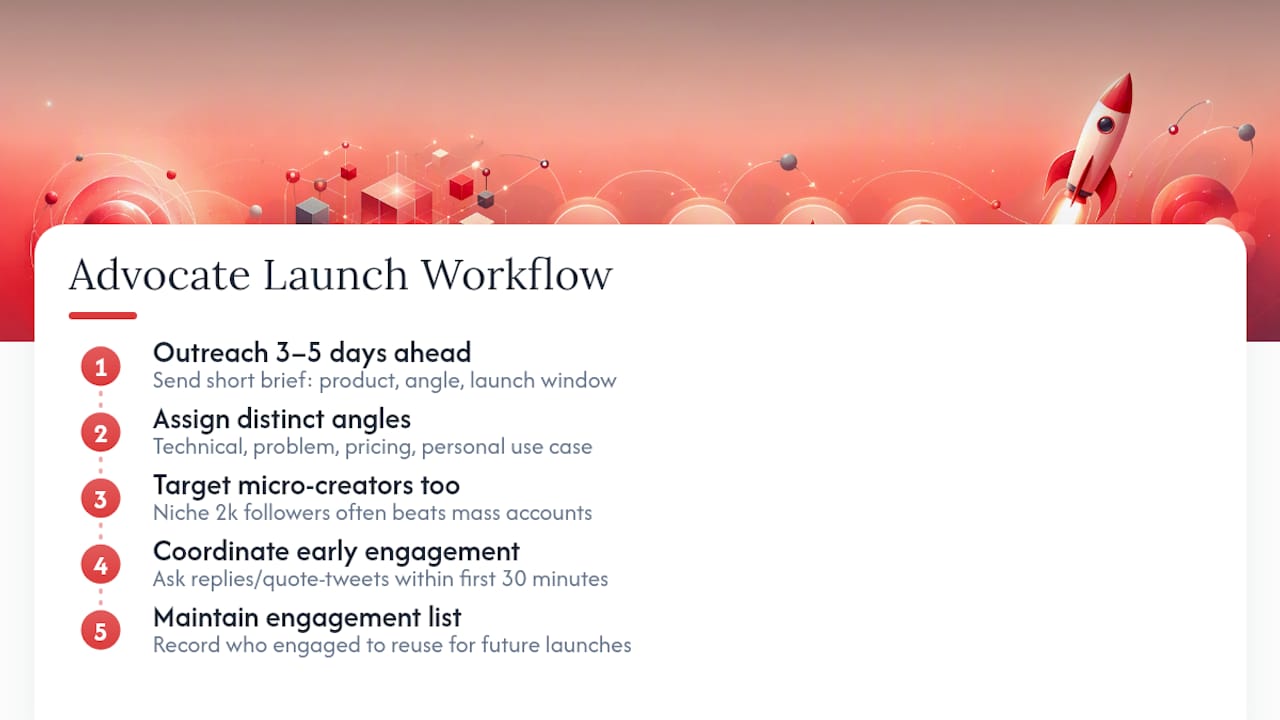
Influencer support only works when it’s arranged before launch, not requested in a panic an hour after you go live. Reach out 3 to 5 days ahead with a short brief: what the product does, one specific angle you’d like them to comment on, and your launch window.
Give each advocate a different angle. If five creators all post “This is huge,” it reads as coordinated and inauthentic, and readers notice. Instead, brief one on the technical build, one on the problem it solves, one on pricing, and one on a personal use case. Variety is what makes amplification look organic instead of staged.
Timing matters as much as messaging. Ask your advocates to comment or quote-tweet inside the first 30 minutes of your thread going live, not whenever they happen to check their notifications. That early window is exactly when the platform decides whether your thread deserves wider distribution, and a cluster of genuine replies from established accounts helps make that case.
Don’t limit outreach to people with huge followings. A founder with 2,000 highly engaged followers in your exact niche often drives more qualified clicks than a generalist account with 200,000 followers scrolling past. Micro-creators and genuine product users, people who already followed you before launch week, tend to produce replies that read as authentic because they are.
Keep a running list of who engaged and how. That list becomes your advocate pool for the next launch, and the next one after that, so you’re never starting influencer outreach from zero.
Handling Feedback and Questions During and After Launch
Every reply you get in the first 24 hours is doing double duty: it’s a customer service ticket and a piece of public marketing collateral at the same time. Treat both jobs seriously.
Answer questions publicly whenever possible instead of moving to direct messages immediately. A public answer to “does this work with Zapier?” helps the next ten people who had the same question and never had to ask it.
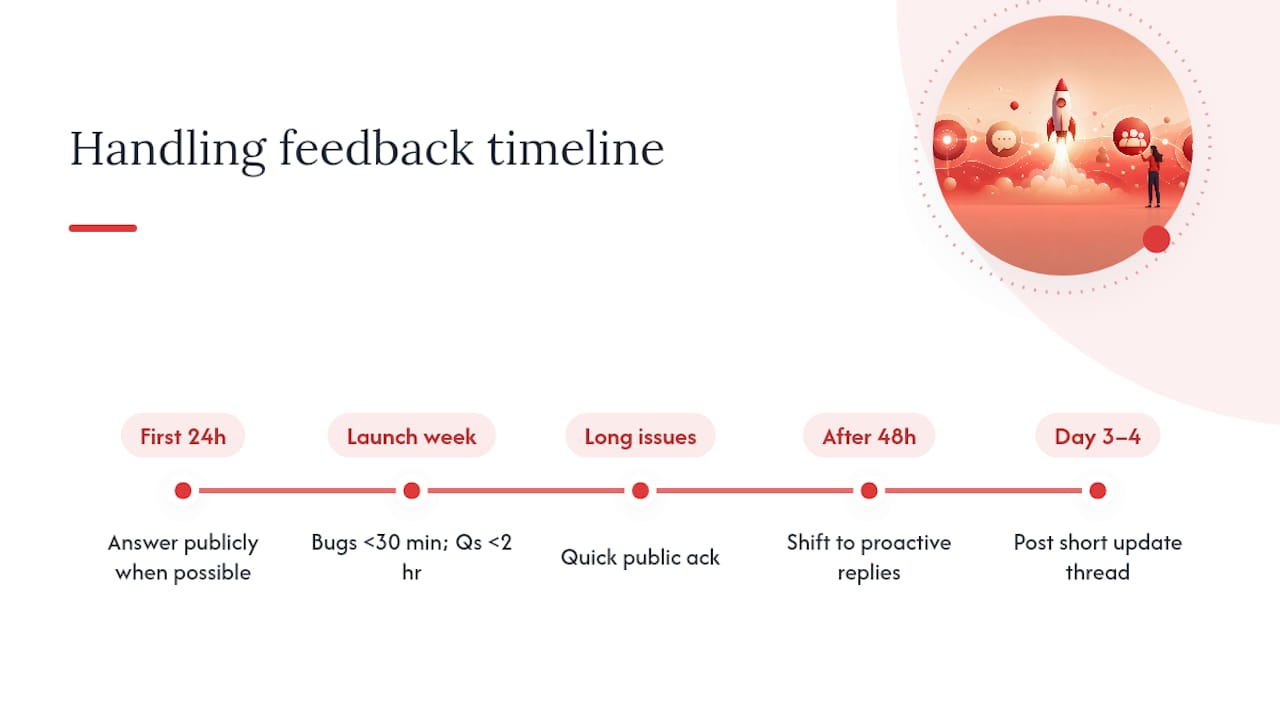
Set an internal rule for triage: technical bugs and complaints get a first response within 30 minutes during launch week, general questions within two hours. Anything that requires a longer investigation gets a quick public acknowledgment (“looking into this now”) followed by a real answer once you have one. Silence reads as indifference even when you’re just busy.
Negative feedback needs a different tone than praise, but the same speed. Thank the person for flagging it, state what you’re doing about it, and follow up publicly once it’s resolved. Deleting critical replies or arguing in the thread almost always backfires and turns a small complaint into a screenshot that outlives your launch by weeks.
After the initial 48 hours, shift from reactive replies to proactive check-ins. Post a short update thread on day 3 or 4 addressing the most common questions you got, even if nobody’s currently asking. It shows you’re paying attention and gives late arrivals to your launch thread the answers they need without having to dig through fifty replies.
Legal and Compliance Points Founders Skip
Disclose paid partnerships. If a creator is compensated, given free access, or otherwise incentivized to post about your launch, that relationship needs a clear disclosure like #ad or #partner in the post itself, not buried in a bio. Regulators in multiple countries treat undisclosed paid endorsements as a consumer protection issue, and enforcement has only gotten stricter as creator marketing has grown.
Be careful with claims about performance, especially for AI products. “10x faster” or “99% accurate” needs to be defensible with real data you can produce if asked. Vague enthusiasm is fine; specific numeric claims you can’t back up are a liability, not just a marketing risk.
Screenshots and testimonials from users need permission before you repost them, even when the original post was public. A quick reply asking “mind if we share this?” takes ten seconds and avoids a genuinely awkward situation later.
If your product touches regulated categories, financial services, health claims, or anything involving personal data, run your launch copy past whoever handles compliance before it goes out, not after a version is already live and screenshotted. Platform terms of service also matter: automated mass-replying or purchased engagement violates X’s platform rules and can get an account restricted right when you need it most.
What Founders Get Wrong About Launching on X
Most launches fail for a boring reason: founders treat the thread as the finish line instead of the starting gun. They post once, check metrics for an hour, and go quiet by day two, right when replies matter most.
The other common mistake is cramming every feature into the launch thread instead of picking the two or three that actually change someone’s day. A feature dump reads like a spec sheet, not a story.
The habit that separates launches with lasting traction from one-day spikes is simple: consistent, useful replies for weeks afterward, not just the first 48 hours. Twitter rewards a distribution system you keep feeding, not a single announcement you fire and forget.
— Knowix
How Nowix Helps You Execute the Launch
Some services are options for founders who’ve read this playbook and don’t have the two weeks of bandwidth it takes to run it properly. Instead of hiring a generalist agency or trying to coordinate 15 creators yourself over Slack, some specialized providers run the timeline takeover, the reply crew, and the creator amplification as one coordinated engagement.
If you’re staring at a launch date and a thread draft with no support crew lined up, Amplify Your Reach covers exactly that gap: organic post amplification through vetted micro-creators who quote-tweet and comment within the first critical hour. Teams that keep launching, features, integrations, updates, and don’t want to rebuild the playbook every time should look at X Management instead, since it covers the daily reply cadence between launches, not just launch week itself.
Founders coordinating paid amplification alongside creator activity often bring in a performance partner like Spicalo to handle the conversion side once traffic starts landing on the site.
Send a service provider your launch date and thread draft, and get a plan back within a day for how the amplification would run.
Sources
For deeper templates and examples beyond this guide, these resources cover specific pieces in more detail:
- Twitter’s latest feature lets merchants tease upcoming product drops and remind customers to shop
- How to Announce a Product Launch on Twitter (X) in 2026: A Step-by-Step Guide for Founders — Monolit Blog
- Twitter Launch Strategy for Makers
- X/Twitter for SaaS Founders: The Distribution Playbook | Postory
Recommended
- How to Launch an AI Product on Twitter: The Founder’s Playbook
- X Launch Campaign for Tech Startup: The Engineered Distribution Playbook (2026)
- Tech Startup Announcement Strategy: Engineering a Timeline Takeover on X
- The Startup Checklist for a Twitter Viral Campaign on X in 2026
Frequently asked questions
What belongs in an X product launch thread?
Explain what changed, who it helps, a useful demo or proof point and the next step. Approve the facts and destination before publishing.
Can a launch thread guarantee distribution?
No. Content quality, audience fit, timing and distribution affect visibility. Measure observed reach and website actions separately from the work delivered.