
For an agency managing a tech or AI brand’s X account, the recommended twitter response time targets are: public mentions within 15–30 minutes during business hours, comments within 30–60 minutes, and DMs within 1–2 hours. After hours, public mentions should receive acknowledgment within 2 hours and DMs within 4 hours.
CampaignSwift’s 2026 benchmarking shows top-performing agencies average 12–18 minutes on X mentions, while the median agency sits at roughly 2 hours 40 minutes. That gap is where brand trust and campaign momentum are won or lost. Sprout Social research confirms the 1-hour mark as the industry standard during business hours, with after-hours replies expected within 12 hours. Tools like Hootsuite Inbox and a managed service like Nowix give you the infrastructure to hit the premium tier consistently.
Recommended SLA targets at a glance:
- Public mentions (business hours): 15–30 minutes
- Comments on posts (business hours): 30–60 minutes
- DMs (business hours): 1–2 hours
- Public mentions (after hours): within 2 hours
- DMs (after hours): within 4 hours
Key Takeaways
Hitting a sub-30-minute twitter response time on X requires a documented SLA, a unified inbox with escalation timers, and a hybrid routing model that separates triage from resolution.
| Point | Details |
|---|---|
| Premium SLA target | Public mentions within 15–30 minutes; DMs within 1–2 hours during business hours. |
| Industry baseline | Average first response time across businesses is 2.8 hours; top brands target under 1 hour. |
| Routing model | Hybrid (marketing triage + support resolution) gives the best balance of voice and speed. |
| Measurement rule | Use median first response time per channel; exclude automated replies from SLA calculations. |
| Nowix execution | Nowix manages X accounts with SLA-backed reply workflows, creator amplification, and CSAT tracking. |
Table of Contents
- What are the right SLA targets by channel and urgency?
- Why response speed on X directly affects your brand’s growth
- Which routing model should your agency use?
- How to set SLA targets and build escalation workflows
- What tools does your agency need to hit these SLAs?
- How to measure and report SLA performance
- Staffing and scaling your response team
- Your 30/60/90-day rollout checklist
- Copyable SLA clauses, reply templates, and escalation pings
- The SLA standard most agencies still miss
- Nowix delivers managed X response with SLA-backed execution
- Sources
What are the right SLA targets by channel and urgency?
The table below maps each X channel to four urgency tiers. These are the targets to paste directly into a retainer or agency proposal.
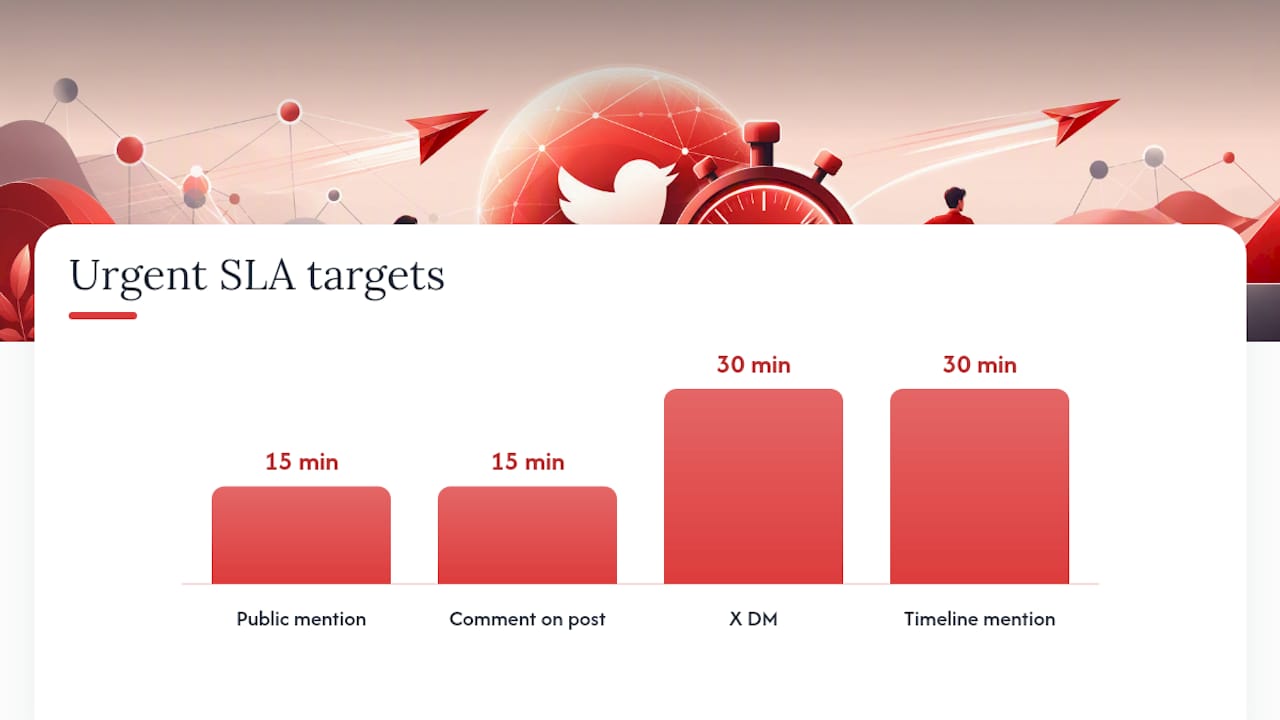
| Channel | Urgent (crisis/viral) | Priority (business hours) | Standard (business hours) | After Hours |
|---|---|---|---|---|
| Public mention | 15 min | 30 min | 60 min | 2 hours |
| Comment on post | 15 min | 30 min | 60 min | 2 hours |
| X DM | 30 min | 1 hour | 2 hours | 4 hours |
| Timeline mention | 30 min | 60 min | 2 hours | 4 hours |
Copyable SLA snippets for proposals:
- Business-hours package: “Agency will deliver a first human response to all public X mentions and post comments within 60 minutes during agreed business hours (Monday–Friday, 9 AM–6 PM ET). DMs will receive a first response within 2 hours during the same window.”
- Premium package: “Agency will deliver a first human response to all public X mentions within 30 minutes, 7 days a week, 9 AM–9 PM ET. DMs will be acknowledged within 1 hour and resolved or escalated within 4 hours.”
Measurement notes:
- SLA timers start at the message timestamp, not when the agent opens the queue.
- Automated acknowledgments and bot replies do not count toward SLA compliance.
- Measure median first response time per channel, not average, to avoid outliers skewing the report.
Why response speed on X directly affects your brand’s growth
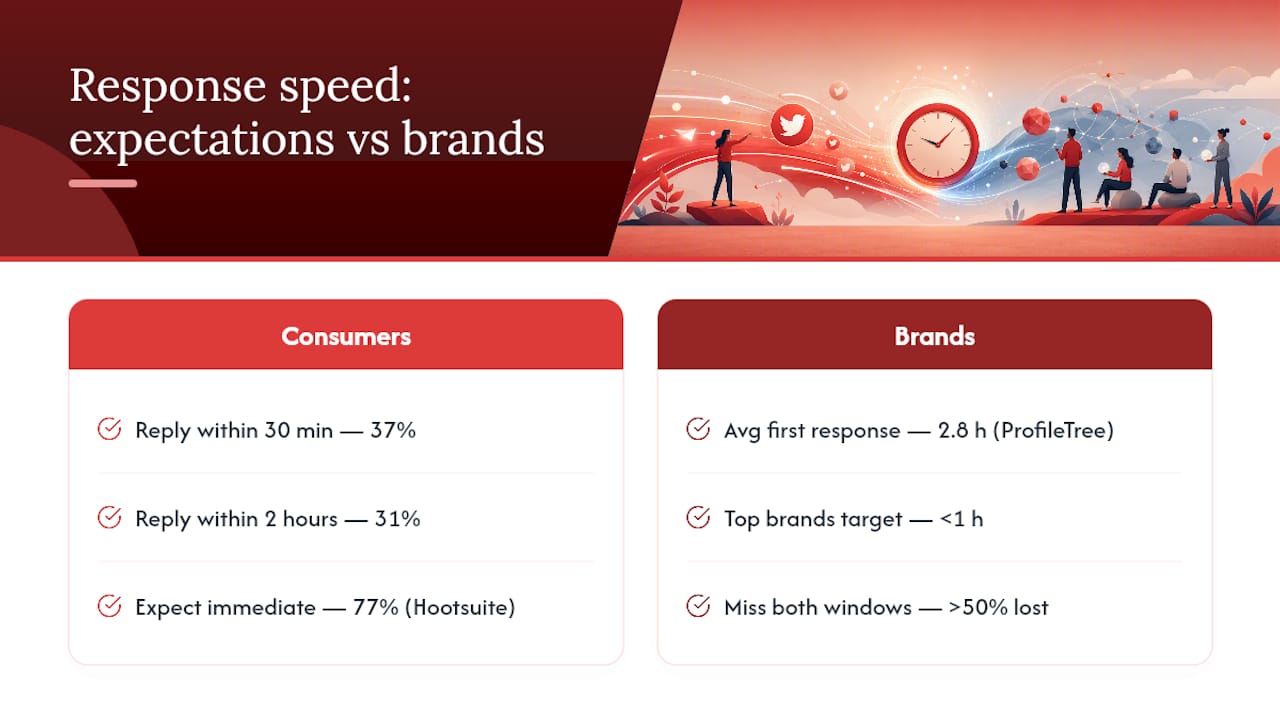
Speed is not a courtesy metric. For tech and AI brands, it is a conversion lever. ElectroIQ 2025 data, cited by TryOrdinal, shows 37% of consumers expect a reply within 30 minutes and another 31% within 2 hours. Miss both windows and you have lost more than half your audience before a human even types a word.
Hootsuite reports that 77% of customers expect to interact with someone immediately when they contact a company. On X, “immediately” is not a metaphor. A public mention that sits unanswered for three hours during a product launch is visible to every follower, every journalist, and every competitor watching your timeline.
The algorithm compounds the problem. X’s feed ranking rewards engagement velocity. A fast public acknowledgment generates a reply thread, which signals activity and extends organic reach. A slow one does the opposite. For a tech brand mid-launch, a 2-hour silence on a critical mention can suppress the entire post’s distribution at exactly the moment you need it most.
ProfileTree data puts the average first response time across businesses at 2.8 hours. Top brands target under 1 hour. That 1.8-hour gap is your competitive edge if you staff and tool correctly.
Which routing model should your agency use?
Three models cover most agency setups. Each has a distinct ownership structure and a different failure mode.
Marketing-led routing means the social media team owns all X replies, escalating to support only when a technical issue is confirmed.
- Pros: Consistent brand voice, fast triage, no handoff friction for routine engagement.
- Cons: Marketing reps lack resolution authority for billing or product bugs, which creates delays on complex tickets.
Support-led routing puts the customer support team in the primary queue, with marketing reviewing for tone.
- Pros: Faster resolution on technical issues, cleaner CSAT tracking.
- Cons: Support agents often write in a clinical register that conflicts with a tech brand’s voice on X.
Hybrid routing is what Hootsuite recommends and what most enterprise teams use. Marketing handles triage and first response; support takes ownership once a conversation is flagged as a resolution case.
Escalation triggers for hybrid:
- Escalate to support after 2 unanswered follow-ups from the user.
- Escalate immediately for billing disputes, account access issues, or any mention of legal action.
- Escalate to a senior brand lead for any mention gaining more than 50 organic engagements before resolution.
Pro Tip: Build the escalation handoff as a tagged DM thread, not an internal Slack ping. The full conversation context travels with the ticket, and no message gets dropped between teams.
How to set SLA targets and build escalation workflows
Follow this sequence when onboarding a new client or renegotiating a retainer.
- Measure your baseline. Pull median first response time per channel for the last 30 days. If no data exists, use the industry average of 2.8 hours as your starting point.
- Map the client’s ICP. A B2B SaaS brand with enterprise buyers can often accept a 2-hour standard SLA. A consumer AI app with a vocal community needs 30 minutes or less.
- Prioritize channels. Rank by volume and visibility: public mentions first, then comments, then DMs.
- Select your SLA tier. Match the tier to the client’s budget and staffing capacity. Do not commit to a 15-minute SLA without 24/7 coverage or AI-assisted triage.
- Write the contract clause. Use the PostingCat SLA template structure as your framework: define channels covered, business hours, response windows, escalation ladder, and monthly review cadence.
Sample contract language:
Escalation flow with timers:
- 0–5 min: Triage agent reviews and categorizes (routine, priority, urgent).
- 5–15 min: First response sent or assigned to specialist.
- 15–30 min: If unresolved and flagged priority, escalate to support lead.
- 30–60 min: If unresolved and urgent, escalate to senior account manager with full thread context.
What tools does your agency need to hit these SLAs?
Four tool categories are non-negotiable for SLA compliance at scale.
- Unified inbox: Aggregates mentions, comments, and DMs into a single queue with assignment and priority flags. Hootsuite Inbox is the standard reference here, with native Salesforce integration for support handoffs.
- Social listening: Catches brand mentions that do not use your handle. Without it, a viral complaint thread goes undetected until it is too late.
- AI-assisted replies: Handles instant acknowledgments, suggests draft responses, and routes routine questions automatically. Effective for 24/7 coverage without a full overnight team.
- Helpdesk integration: Syncs resolved X tickets into your CRM or support platform (Salesforce, Zendesk) so CSAT and resolution data are captured alongside other channels.
Integration checklist:
- Auto-assign incoming mentions by keyword and urgency tag.
- Set SLA timer alerts at 50% and 80% of the response window.
- Enable CSAT capture on DM resolution threads.
- Sync escalated tickets to the helpdesk with full thread context.
- Configure weekly SLA compliance exports to the client dashboard.
Pro Tip: AI-suggested replies cut response time, but they need a human approval step for anything beyond a simple acknowledgment. Set your AI to draft, not send, for any reply that contains a product claim or a resolution commitment.
How to measure and report SLA performance
| Metric | Definition | Calculation |
|---|---|---|
| Median first response time | Middle value of all first human responses per channel | Sort response times; take the midpoint |
| % within SLA | Share of messages answered within the agreed window | (On-time responses ÷ total messages) × 100 |
| CSAT score | User satisfaction rating on resolved conversations | Average of post-resolution survey scores |
| Resolution rate | Share of conversations fully resolved | (Resolved ÷ total conversations) × 100 |
| Message volume | Total inbound messages per channel per period | Direct count from inbox platform |
Reporting cadence:
- Daily: Automated alert if any channel breaches SLA threshold.
- Weekly: Trend report covering median response time, volume by channel, and top escalation reasons.
- Monthly: Full SLA compliance summary shared with the client, including CSAT, resolution rate, and any service credits triggered.
Use median, not average, for response time. A single viral incident with a 6-hour resolution thread will inflate an average and misrepresent your team’s actual performance.
Staffing and scaling your response team
Capacity planning starts with one number: how many messages per hour does each channel generate? Most tech brand accounts see peak volume between 9 AM and 1 PM ET, per CampaignSwift’s benchmarks.
Coverage model:
- One trained agent handles 15–20 routine X replies per hour.
- Overlap shifts by 30 minutes at handoff to prevent queue gaps.
- A minimum of two agents on during peak hours for any account with more than 10,000 followers.
RACI for core tasks:
Peak-event rules:
- Activate a dedicated on-call agent for the 4-hour window around any major announcement.
- Pre-draft 10–15 reply templates covering expected question categories before the event.
- Set AI triage to auto-acknowledge all inbound within 2 minutes during the event window.
AI-assisted triage reduces the headcount needed for overnight and weekend coverage by routing routine questions to templated responses and flagging only genuine escalations for human review.
Your 30/60/90-day rollout checklist
Days 1–30: Discovery and setup
- Audit current X account: pull baseline response time, volume, and top message categories.
- Agree on SLA tier and document it in the retainer.
- Set up unified inbox with assignment rules and SLA timers.
- Connect helpdesk integration and CSAT capture.
- Draft the reply playbook: voice guidelines, escalation triggers, and template library.
Days 31–60: Training and dry run
- Train all agents on brand voice, escalation flow, and tool usage. Reference Nowix’s reply workflow tactics for tech brand-specific guidance.
- Run a two-week dry run with daily SLA compliance checks.
- Identify gaps: channels missing coverage, templates that need refinement, escalation paths that are unclear.
- Align client stakeholders on escalation contacts and approval flows.
Days 61–90: Go live and optimize
- Launch full SLA enforcement with live reporting.
- Deliver first monthly SLA compliance report to the client.
- Adjust staffing model based on actual volume data.
- Review and update the playbook based on the first 30 days of live data.
Copyable SLA clauses, reply templates, and escalation pings
Contract SLA clause (business hours):
Contract SLA clause (premium/24-7):
Public acknowledgment template (move to DM):
DM triage templates:
- Billing: “Thanks for your message. I’m pulling up your account now. Can you confirm the email address on file? We’ll have an update for you within [X] hours.”
- Bug report: “Got it — thank you for flagging this. I’m logging it with our product team now. Can you share your device and the steps to reproduce? We’ll follow up within [X] hours.”
- Product question: “Great question. [Answer or link to docs.] Let me know if you need anything else.”
Escalation ping (Slack/email):
The SLA standard most agencies still miss
Most agency retainers define a response window. Few define what counts as a response, who owns escalation, or what happens when volume spikes during a launch. That gap is where client relationships break down, not during normal operations.
The 15–30 minute premium SLA is achievable. Nowix’s managed X accounts consistently operate within that window because the tooling, triage rules, and escalation paths are built before the first message arrives, not after. The 2026 engagement benchmarks show that brands hitting sub-30-minute response times during launch windows see measurably stronger thread engagement and organic amplification than those relying on reactive staffing.
The real differentiator is not speed alone. It is the combination of speed, brand voice consistency, and a clean escalation path that keeps a public thread from becoming a liability. Build the playbook first. The SLA numbers follow naturally.
Nowix delivers managed X response with SLA-backed execution
You have the SLA targets, the contract language, and the playbook structure. The next question is whether your team has the capacity to execute it at the speed tech and AI brands demand.
Nowix runs X account management for tech and AI brands end-to-end: daily content, community replies, escalation routing, and CSAT tracking, all within defined SLA windows. When a launch needs amplification on top of response coverage, Nowix’s post amplification service deploys vetted micro-KOLs to extend reach while the reply team holds the SLA line. No dropped messages, no brand voice drift, no scrambling to staff a peak event at the last minute. If you want SLA-backed X management built for your next launch, get started with Nowix.
Sources
- Social Media Response Time Benchmarks 2026 | CampaignSwift
- Social Media Customer Service (Hootsuite blog)
- Twitter for Customer Service: 7 Tips and Examples | Sprout Social
- How to Use Social Media for Customer Service | TryOrdinal
- Twitter for Customer Service: Tactics That Build Trust | ProfileTree