
Your Twitter tone of voice must be concise, recognizable, and repeatable. Pick 3 core traits, turn them into reply and statement templates, and test the replies first since that’s where drift actually happens. Nowix treats this as a practitioner skill, not an accident of personality, and the fastest way to prove it works is one tweet template you can measure this week.
TL;DR:
- Maintaining a concise, confident, and human tone is crucial for tech and AI brands on Twitter, especially during launches or crises.
- Focusing on three core traits and using specific reply and statement templates helps ensure consistency across different formats and audiences.
- During a crisis, brands should shift to clear, factual communication that confirms issues and provides next steps rather than maintaining usual personality traits.
- Tone should be adapted per audience segment—prospective customers, current users, or industry peers—by adjusting vocabulary and technical depth while keeping core traits intact.
- Running a consistent voice across daily posts and urgent moments requires operational support, which can be managed internally or through agencies like Nowix.
Table of Contents
- What is Twitter tone of voice and why does it matter on X?
- How do you pick 3 to 5 core tone traits for X?
- How should tone show up in tweets, replies, bios, and threads?
- What templates make it easy to write on-brand tweets fast?
- How do you measure and iterate on your Twitter tone?
- Nowix Practitioner Playbook: Tactics for Tech and AI Brands on X
- How do you adapt tone for different audiences on Twitter?
- How should tone change during a crisis on Twitter?
- Which brands show a strong, distinctive tone on Twitter?
- How does Twitter tone fit into your broader brand voice?
- Personality vs. polish: an author’s take
- How Nowix helps you build a Twitter tone that actually holds up
- Sources
What is Twitter tone of voice and why does it matter on X?
Twitter tone of voice is how your brand sounds inside the specific constraints of X: 280-character limits, public reply threads, and conversations that shift direction every few minutes. Voice is the constant personality behind everything you post. Tone is how that personality flexes for context: playful in a product announcement, direct in a reply, restrained when a thread turns critical. There’s no single winning tone for X. Some brands succeed mixing “fun,” “help,” and “info” based on what they actually sell, and tech and AI brands often perform best blending informative authority with a bold, direct personality while staying human in replies. Twitter itself frames good brand voice around three C’s: concise, clear, conversational. That framework matters because tone measurably shifts brand consideration: promoted tweets and bio phrasing changed willingness to buy, recommend, and trust in Twitter-backed research with Isobar and Cambridge.
How do you pick 3 to 5 core tone traits for X?
Cap your trait list at 3 to 5. Fewer traits force sharper choices; more traits produce vague, unenforceable guidelines nobody can apply under deadline pressure. Brand voice on X forms through repeated patterns of tone, phrasing, and how you react to replies, so each trait needs a rule a writer can follow without guessing.
A workable trait set for a tech or AI brand:
- Direct. Do lead with the point in the first line. Don’t bury the news under a setup sentence.
- Confident. Do state claims plainly (“this cuts setup time in half”). Don’t hedge with “we think” or “hopefully.”
- Curious. Do ask real questions in replies. Don’t ask rhetorical questions with no intent to engage.
- Human. Do use contractions and first-person plural. Don’t default to corporate third-person (“the team is pleased to announce”).
Guardrails matter as much as the traits themselves. Ban corporate filler like “excited to announce,” limit emoji to one per tweet if any, and drop the confident trait in favor of plain, careful language the moment a thread touches an outage, a security issue, or a customer complaint.
How should tone show up in tweets, replies, bios, and threads?
Each format on X carries its own tone job. A standalone tweet has to earn attention in one scroll; a reply has to sound like a person responding, not a brand broadcasting.
- Tweets: hook, point, support, then a call to action. Keep the hook under 12 words. Cut any sentence that doesn’t earn its place.
- Replies: answer fast, lead with empathy on complaints, and escalate to DM the moment a reply requires account details or a refund.
- Bios: state what you post about and set expectations. A bio that promises threads on AI infrastructure and then posts only memes breaks trust fast.
- Pinned posts: use them as a guardrail, not a highlight reel. Pin the post that tells a new follower exactly what your account is for.
- Threads: use a thread only when a single tweet can’t carry the argument. A tweet series with numbered posts works better for updates that unfold over hours, not minutes.
Pro Tip: Write your reply templates before your statement templates. Most tone drift happens in replies, where there’s no time to think, not in the polished announcement tweet.
What templates make it easy to write on-brand tweets fast?
Templates work because they separate the structure from the trait. Swap the variable, keep the shape, and the tone stays consistent even when three different people are writing.
- Statement tweet: [Context] + [Direct claim] + [CTA]. Practical version: “New API rate limits ship Thursday. Faster for 95% of calls. Docs here: [link].” Witty version: “Your API calls are about to get a lot less patient. Rate limits ship Thursday: [link].”
- Reply tweet: [Acknowledge] + [Answer] + [Next step]. Practical version: “Good catch, that’s a bug on our end. Fix goes out tonight, will update this thread.” Witty version: “Caught red handed. Fix incoming tonight, we’ll circle back here.”
- Quote post: [React to the quoted point] + + [Tag or CTA]. Practical version: “This matches what we saw in our own rollout data. Full breakdown: [link].”
Pro Tip: Keep a rejected-examples file next to your swipe file. Showing writers what got cut, and why, teaches the trait boundaries faster than any style guide paragraph.
How do you measure and iterate on your Twitter tone?
Track engagement rate, reply sentiment, share of voice against competitors, and how deep replies go before a conversation dies out. A tone that lands produces multi-reply threads, not one-off likes.
Two tests worth running every quarter:
- Reply style A vs. B: send the same customer question through two tone variants for a week, then compare reply-to-reply ratios.
- Statement tone A vs. B: post the same announcement with a direct headline versus a curiosity headline, then compare click-through and quote-post volume.
Run a monthly audit: read the last 30 posts and replies, flag anything that drifted from your trait list, and correct it before the next batch goes out.
Nowix Practitioner Playbook: Tactics for Tech and AI Brands on X
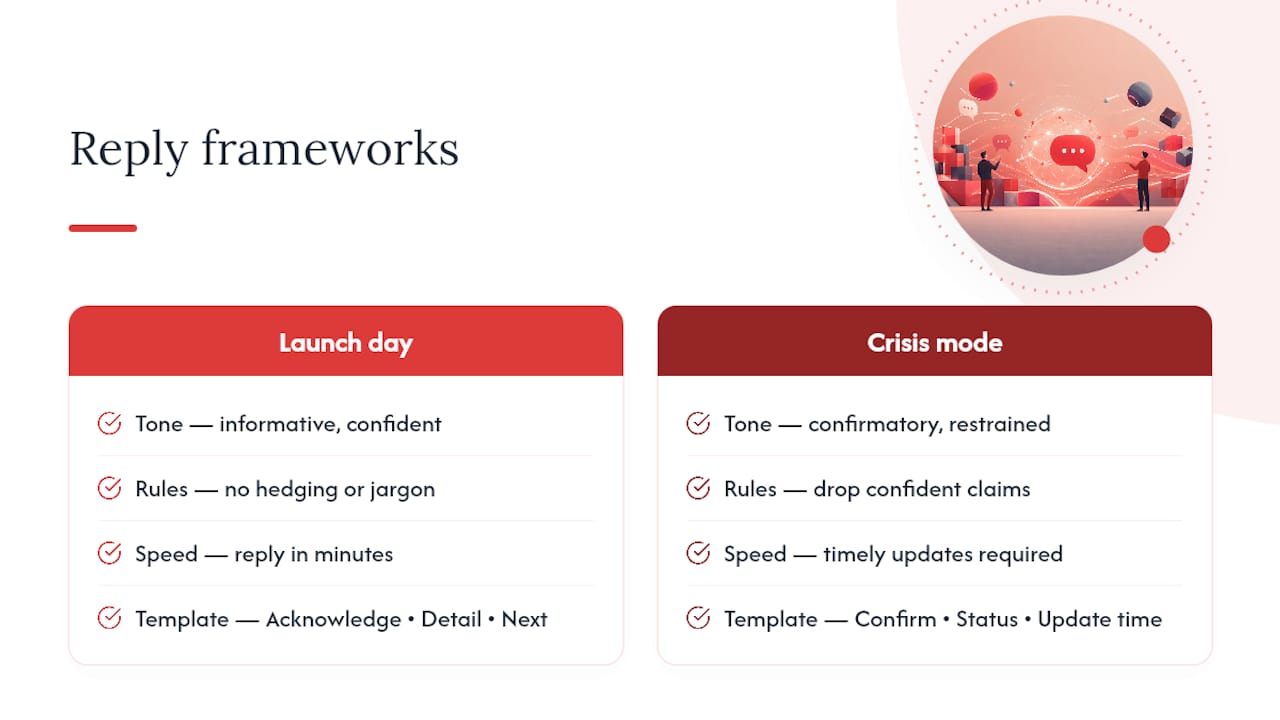
Nowix runs tone for tech and AI brands by pairing informative authority with confident, direct phrasing. Launch day gets stricter rules than a normal week: no hedging, no jargon, and every reply answered inside minutes while controlled quote retweets from vetted creators reinforce the same voice across hundreds of accounts at once. A launch-day reply template reads: “[Thanks/acknowledge] + [one concrete detail] + [where to go next].” A crisis-mode reply drops the confident trait entirely: “[Confirm the issue] + [what’s happening now] + [when we’ll update].”
How do you adapt tone for different audiences on Twitter?
A single account often serves three different audiences at once: prospective customers, existing users, and industry peers who show up mostly to argue or benchmark. Writing one tone for all three produces content that under-serves everyone.
Segment by intent, not demographics. A prospective customer reading your feed for the first time needs clarity over cleverness; lead with what the product does before you lead with personality. Existing users following daily updates already trust the brand, so tone can loosen into shorthand, inside references, and faster back-and-forth in replies. Industry peers, especially other founders and engineers on tech Twitter, respond better to specific technical claims and a willingness to disagree publicly than to marketing polish.
The practical fix is a tiered reply posture rather than three separate voices. Keep the core traits (direct, confident, human) constant across all three audiences, but adjust the vocabulary and pacing:
- New audience: define acronyms, spell out benefits, skip insider jokes.
- Existing users: reference shared context, respond faster, use more casual phrasing.
- Industry peers: get more technical, take clearer positions, and don’t soften disagreements into vague diplomacy.
The trait list doesn’t change. Only the register does. A brand that sounds like a different company depending on who’s reading loses the recognition that consistent tone is supposed to build, so the safest adjustment lever is vocabulary and depth, never the underlying personality.
How should tone change during a crisis on Twitter?
Drop personality first, keep clarity always. The moment a thread turns into an outage report, a security disclosure, or a public complaint, the confident, witty, or playful traits that work on a normal Tuesday become liabilities. Precision replaces personality until the situation resolves.
A crisis reply needs three things in order: confirmation of what’s happening, a plain statement of current status, and a specific time for the next update. Skip the corporate reflex to apologize extensively before saying anything useful. “We’re aware some accounts are seeing failed logins. Investigating now, next update in 30 minutes” does more for trust than a paragraph of contrition with no information in it.
Sensitive topics that aren’t full crises, like a competitor controversy, a public policy debate, or a customer’s viral complaint, call for the same shift in degree rather than kind. Cut jokes and hot takes from the queue immediately, even ones scheduled days earlier. A brand that posts a witty product tweet an hour after a serious news event tied to its industry reads as tone deaf regardless of how good the tweet is on its own.
Recovery matters as much as the response itself. Once the issue resolves, post a short, factual close-out (“Fixed as of 3:40 PM ET, root cause was X, full postmortem coming Friday”) before returning to normal posting. Skipping the close-out and jumping straight back to regular content makes the account look like it wants to move past the problem rather than actually resolve it. Teams that want a formal reference for this shift can build it directly into their brand safety guidelines so the crisis posture isn’t invented in the moment.
Which brands show a strong, distinctive tone on Twitter?
Distinctive tone on X usually comes down to one clear choice: which of the three families, informative, conversational, or performance-driven, a brand commits to, and how consistently it holds that choice across thousands of small interactions.
Performance-driven brands lean into humor and cultural commentary, treating nearly every reply as a chance for a joke or a viral moment. This works well for scaling attention fast, but it creates constant pressure to maintain that personality across every single post, and one flat or forced joke stands out immediately against a backdrop of consistently sharp ones.
Conversational brands sit closer to the middle: casual phrasing, frequent replies, first-person plural, and a willingness to engage in back-and-forth without turning every exchange into a punchline. This tends to work best for consumer brands with broad, varied audiences who want to feel like they’re talking to a person rather than a corporate account.
Informative brands, and this is where most tech and AI companies land most comfortably, lead with authority and specificity: exact numbers, direct product claims, technical detail delivered without unnecessary hedging. The risk with a purely informative tone is that it reads as dry or interchangeable with any other company posting the same category of update. Combining informative authority with a confident, opinionated edge is what separates a memorable tech account from a forgettable one; the facts stay the same, but the delivery takes a clear position instead of a neutral one.
The benchmark worth running against your own account isn’t “which brand should we copy.” It’s “which family are we actually committing to, and are we holding that line in replies as tightly as we hold it in scheduled posts.”
How does Twitter tone fit into your broader brand voice?
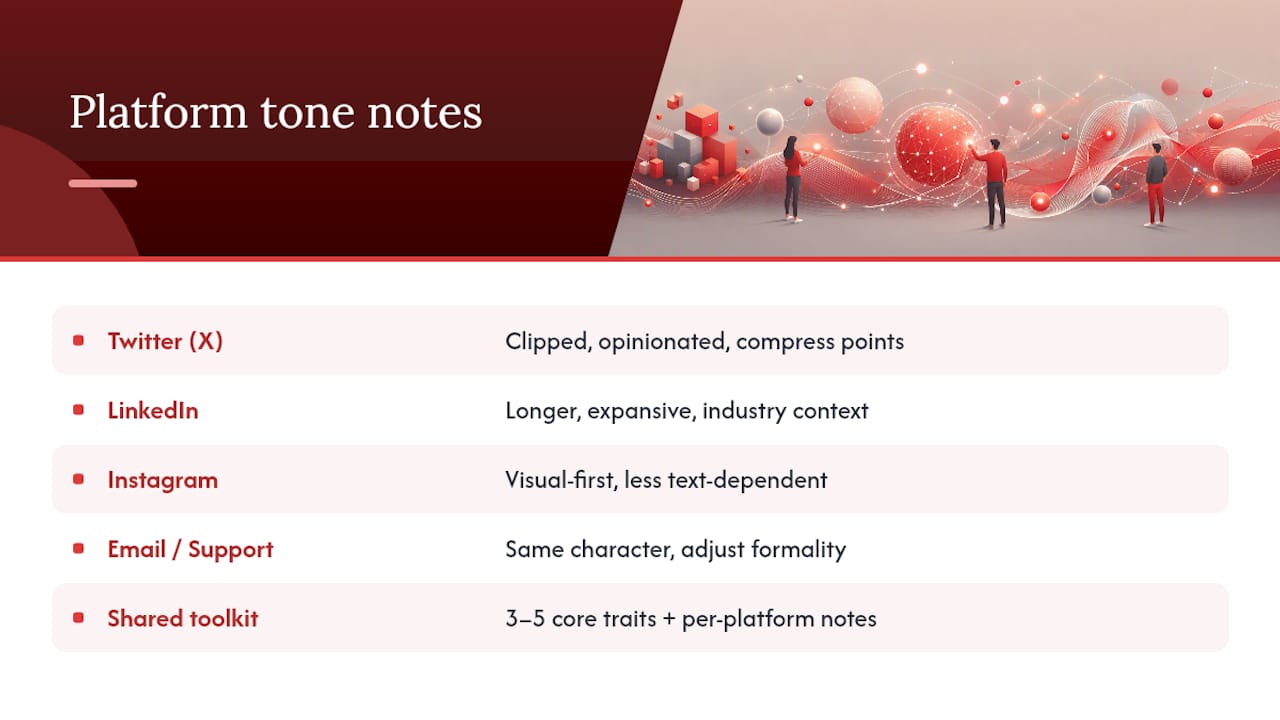
Twitter tone should be a dialect of your brand voice, not a separate language. The core personality, direct, confident, human, whatever traits you’ve settled on, needs to survive the move from a LinkedIn post to a tweet to a support email. What changes across platforms is pacing and formality, not the underlying character.
X rewards personality and opinion more aggressively than most other channels, so tone has to adapt by channel even while voice stays fixed. A LinkedIn post from the same brand can run longer and lean more into industry context; a tweet has to compress the same point into a single sharp line. If your LinkedIn voice sounds confident and direct but your Twitter account sounds cautious and corporate, readers who follow both notice the mismatch immediately, and it reads as inconsistency rather than platform fluency.
The practical integration step is a shared trait list with per-platform notes attached. Keep one document that names your 3 to 5 core traits, then adds a line under each platform explaining how that trait expresses itself differently: more clipped and opinionated on X, more expansive on LinkedIn, more visual and less text-dependent on Instagram. This keeps every channel recognizably the same brand without forcing identical phrasing everywhere, which rarely works given how differently each platform’s audience actually reads.
Coordinating content themes across channels helps too. A thread built around product updates on X can echo the same launch messaging your team uses in email or on LinkedIn, adjusted for length and format rather than rewritten from scratch. Teams managing multiple channels often find that a shared calendar of themes, paired with platform-specific tone notes, prevents the drift that happens when different people write for different channels without a common reference point. Partner resources on broader content strategy alignment can help formalize that shared calendar if your team hasn’t built one yet.
Personality vs. polish: an author’s take
Personality wins on ordinary days: opinionated replies and direct claims build the recognition that makes a brand’s tweets stand out in a crowded timeline. Polish wins the moment stakes rise, an outage, a legal question, a customer complaint gone public. The one-line check before you post: does getting this wrong cost more than getting it slow? If yes, write like support, not like marketing.
— Knowix
How Nowix helps you build a Twitter tone that actually holds up
Running a consistent tone across daily posts, replies, and a launch week is a full-time operational job, not a side project for whoever has time. Nowix builds the trait framework, writes the reply templates, and runs the account so your voice stays the same whether it’s a Tuesday update or a launch-day surge of replies.
For teams that already have a voice but need it amplified fast, Amplify Your Reach on X coordinates controlled quote retweets and comments from vetted micro-influencers so your tone spreads without sounding like a coordinated blast. For teams that need the tone developed and maintained day to day, X Management covers strategy, daily content, and replies from practitioners who already write in the informative-plus-confident register that works for tech and AI brands.
Run tone in-house when you have a dedicated writer who can own replies daily. Call in an agency when launch week is coming and you need hundreds of on-brand replies inside one hour. Start with a quick strategy call to see which fits your team right now.
Sources
- The Twitter Tone of Voice: Fun, Helpful or Informative
- Promoted Tweets and tone of voice help drive purchase intent
- Twitter Brand Voice: Strategies to Elevate Your Presence
Recommended
- Tuesday 9 AM Wins: How Tech and AI Teams Test the Best Time to Tweet
- Tweet Frequency for Brands: The 2026 Data-Backed Playbook
- Twitter Mention Strategy: Tactical Playbook for Social Teams
- Twitter Marketing for Developers: Engineering Narrative Distribution in 2026
Frequently asked questions
What inputs help Knowix write X content in my voice?
Share the product facts, target reader, writing samples, personal viewpoints you approve and the intended next step. Research and a clear review flow turn those inputs into usable drafts.
How should I judge whether the content is working?
Compare relevant posts over a consistent period and look for useful audience response, website actions and recorded enquiries. Avoid treating one viral post as a complete content strategy.