
The X algorithm in 2026 runs on Grok-powered semantic ranking plus early engagement velocity. Raw like counts no longer drive distribution. Semantic depth, meaningful replies in the first 30–60 minutes, and strategic amplification do. Here is your immediate action list:
- Publish one semantically deep post grounded in your topic niche, not a generic trending prompt.
- Seed five meaningful replies within the first 30–60 minutes from vetted community members or micro-KOLs.
- Add a rich-media asset (video, image carousel, or poll) to increase dwell time signals.
- Run a small paid amplification test via X Premium boost or a controlled QRT campaign to accelerate early velocity.
The rest of this guide unpacks exactly why each step works, what the Phoenix/Thunder architecture rewards, and how Nowix’s Timeline Takeover campaigns put these mechanics into practice.
Table of Contents
- How the X algorithm 2026 is actually architected
- What changed in 2026 — the specific updates creators must know
- How X ranks content in 2026 — the full flow across For You, Following, and Explore
- Top ranking signals in 2026 — what to optimize and why
- What the algorithm suppresses — stop doing these now
- Six prioritized strategies to win on X in 2026 — a 2-week playbook
- Metrics, experiments, and how to know if your approach is working
- Timeline and costs: what to expect and what to budget (U.S.)
- Case study: Nowix Timeline Takeover — reversing a narrative and triggering weekend virality
- Key Takeaways
- What practitioners should prepare for beyond 2026
- Nowix makes your next post the one that trends
- Useful sources and further reading
How the X algorithm 2026 is actually architected
X replaced its legacy ranking system with a Grok-based transformer called Phoenix in 2026. Phoenix handles both retrieval and ranking in a unified pipeline. A second component, Thunder, is an in-memory store that handles sub-millisecond lookups for posts from accounts you already follow (in-network content). Phoenix handles everything else: out-of-network discovery from the global corpus.

The system eliminates hand-engineered features almost entirely. The Grok transformer learns relevance from your engagement history, then predicts probabilities across multiple action types (like, reply, repost, click, dwell, bookmark, share) for every candidate post. A weighted scorer combines those probabilities into a final relevance score. Positive actions carry positive weights; negative actions (blocks, mutes, reports) push scores down.
What this means for creators: the algorithm no longer responds to surface-level signals like keyword stuffing or follow-for-follow tactics. It reads the semantic substance of your post against the user’s engagement history and decides whether your content belongs in front of them.
Pro Tip: Frame your post’s first sentence as a topic declaration, not a hook. Phoenix scores user-context fit, so “Why Solana’s fee market is broken” outperforms " This will blow your mind" for a crypto-native audience every time.
What changed in 2026 — the specific updates creators must know
Open-sourcing the algorithm
In January 2026, xai-org published the x-algorithm repository on GitHub under Apache 2.0. The repo exposes pipeline configs, model weights, and component documentation. Creators and engineers can now inspect the scoring logic directly rather than reverse-engineering it from behavior.
Grok classifiers (the pre-filter stage)
A May 2026 commit introduced the Grox content-understanding pipeline, a set of classifiers that run before the Phoenix ranker. These classifiers handle spam detection, post-category classification, and PTOS policy enforcement. Content flagged at this stage never reaches the ranker. It is invisible to Phoenix regardless of how strong your engagement signals are.
This is the most consequential change for marketers. You can have a large following and a well-timed post, but if Grok’s pre-filter classifies your content as low-value or engagement-bait, the ranker never sees it.
The mutuals visibility tweak
In mid-2026, X product lead Nikita Bier announced a mutuals visibility update designed to reduce “battleground” replies and boost posts to people who follow each other back. The change rewards accounts with genuine two-way relationships, not broadcast-only follower counts.
X Premium and author credibility
X Premium subscribers receive a measurable author-credibility weight in the ranking pipeline. The open-source repository confirms that verified and Premium accounts bypass certain reputation penalties that suppress newer or lower-credibility accounts. For brand accounts, X Premium is no longer optional if you want consistent distribution.
Statistic callout: The Phoenix pipeline predicts 15–18 engagement signals per candidate post depending on the component, combining them into a single weighted relevance score. Every signal you ignore is a lever your competitors may be pulling.
How X ranks content in 2026 — the full flow across For You, Following, and Explore
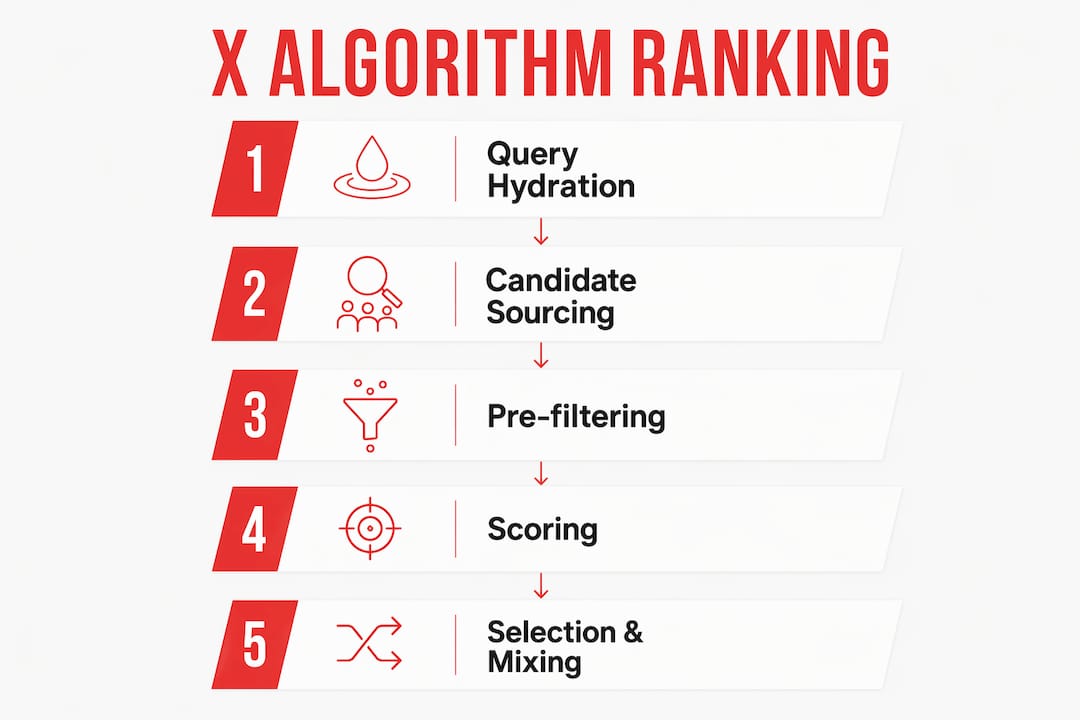
The pipeline runs in five stages. Understanding each stage tells you exactly where to intervene.
Stage 1: Query hydration. The system fetches your engagement history, following list, followed topics, mutual follow graph, and impression bloom filters.

Stage 2: Candidate sourcing. Thunder retrieves recent in-network posts. Phoenix Retrieval uses a two-tower ANN model to pull out-of-network candidates from the global corpus via dot-product similarity search.
Stage 3: Pre-filtering. Grok classifiers prune spam, brand-safety violations, and category mismatches. Survivors move to scoring.
Stage 4: Scoring. Phoenix transformer predicts engagement probabilities. The Weighted Scorer combines them. The Author Diversity Scorer applies exponential decay to prevent a single account from dominating a feed. The OON Scorer penalizes out-of-network content that lacks strong early engagement signals.
Stage 5: Selection and mixing. Visibility filters, deduplication, and diversity mixing produce the final feed.
| Surface | Primary signals | Best-practice format |
|---|---|---|
| For You | Phoenix semantic score, OON penalty offset by early engagement | Single post with rich media or short thread (2–4 posts) |
| Following | Thunder recency, in-network reply velocity | Single post, reply-inviting question, timely angle |
| Explore | Strict Grok classifier pass, trending topic alignment | Short, high-clarity post with a specific named claim |
The OON penalty is the key variable for discovery. Out-of-network content needs strong early engagement to offset it. That is why seeded replies in the first hour are not a vanity tactic — they are the mechanism that unlocks For You distribution for accounts without massive existing reach.
Top ranking signals in 2026 — what to optimize and why
These are the signals that move the needle, ranked by practical impact.
- Early reply velocity (first 30–60 minutes). First-hour engagement is the strongest predictor of long-term reach. Seed replies from real community members or micro-KOLs immediately after publishing.
- Reply quality and conversation depth. The pipeline rewards
reply_engaged_by_authoras a standalone prediction head. Reply to your own replies. Every author response is a separate positive signal. - Bookmarks and shares. Bookmark signals indicate reference-value content. Post guides, checklists, and data-backed takes that people save for later.
- Dwell time. Images, carousels, and dense threads increase the time a user spends on a post. The
click_dwellsignal rewards content that earns 2+ minutes of attention after a click. - Author reputation (TweepCred / X Premium). Accounts below a reputation threshold are filtered before reaching the heavy ranker. X Premium bypasses several of these gates. Keep your following/follower ratio healthy and avoid mass follow-for-follow tactics.
- Recency. The pipeline applies time-decay functions. Posting at peak audience hours matters, but a semantically strong post published off-peak still outperforms a shallow post published at the right time.
- Semantic topic match. Context engineering — grounding posts in domain-specific signals rather than generic trending prompts — yields better Phoenix scores. The transformer reads the substance of your post against the user’s engagement history.
Pro Tip: Design your reply prompts before you publish. Write the post, then write three reply-starter questions you want community members to answer. Brief your seeding list with those exact prompts. Structured seeding produces conversation depth, not just reply counts.
Combining human-driven seeding with organic triggers is where the real leverage lives. Vetted micro-KOLs who genuinely understand your topic generate replies that pass Grok’s quality classifiers. Generic “great post!” replies from low-credibility accounts do not. For high-quality content strategies that hold up under semantic scrutiny, the human layer is what separates passing from failing the pre-filter stage.
What the algorithm suppresses — stop doing these now
Grok’s pre-filter classifiers are the gatekeeper. Content that fails here never reaches Phoenix scoring, regardless of your follower count or posting history.
Suppressed behaviors:
- Engagement bait. “Like if you agree,” “RT to win,” and similar prompts are classified as low-value by the Grox pipeline. The pre-filter stage removes these before ranking.
- Low-value AI-generated content. Generic, prompt-only AI output without topic grounding reads as shallow to Grok’s classifiers. Authenticity remains the primary differentiator in 2026 — AI workflows are table stakes, but the human editing layer is what passes the quality bar.
- Mass automated posting. High-frequency, low-variation posting triggers the author-decay function and can suppress your entire account’s distribution, not just individual posts.
- Copy-pasted aggregation. Reposting others’ content without original context or commentary scores poorly on semantic depth.
- Policy violations. PTOS enforcement runs at the classifier stage. A single flagged post can suppress adjacent posts in the same session.
Pro Tip: If your reach drops suddenly with no obvious cause, check your last 10 posts for any of the above patterns. Then publish one high-quality, semantically grounded post and seed five genuine replies within the hour. This resets the velocity signal without requiring any account-level intervention.
Crisis management in one step: if a post is filtered and you need to protect adjacent content, publish a new, substantively different post immediately and seed it separately. Do not delete and repost the filtered content — that behavior can itself trigger additional classifier flags.
Six prioritized strategies to win on X in 2026 — a 2-week playbook
1. Context engineering first
Write every post with a topic declaration in the first sentence. Name the specific domain, claim, or data point. Generic hooks fail Grok’s semantic classifier. Specific, grounded claims pass it.
2. Seeded reply strategy
Build a seeding list of 5–10 vetted community members or micro-KOLs before launch day. Brief them with specific reply prompts tied to the post’s core claim. Deploy within the first 30 minutes of publishing.
3. Rich media sequencing
Lead with your strongest visual asset in the first post of a thread. Video earns the highest dwell-time signals. Images and carousels outperform text-only posts for click_dwell. Reserve text-only posts for high-credibility accounts with established reply communities.
4. Cadence optimization
Post 3–5 times per week across varied formats. The author-decay function penalizes accounts that flood feeds with similar content. Topic diversity across posts protects your distribution score. Use AI content tools to maintain output volume without sacrificing semantic depth.
5. Early paid amplification
Run a small X Premium boost or controlled QRT campaign within the first two hours of publishing. Paid amplification accelerates the early velocity signal that offsets the OON penalty. A minimum-valid test budget of $50–$150 per post is enough to generate measurable signal.
6. Creator and community amplification
Activate a creator wave — a coordinated group of micro-KOLs who QRT and reply within a defined window. This is the mechanism behind Nowix’s Timeline Takeover model. Coordinated amplification from vetted accounts generates the reply depth and bookmark velocity that Phoenix rewards most.
2-week test plan:
| Days | Task | Metric to track |
|---|---|---|
| 1–2 | Publish one context-engineered post with rich media | First-hour reply rate |
| 3–4 | Activate seeding list with structured reply prompts | Conversation depth (reply thread length) |
| 5–7 | Run $50–$150 paid amplification test | Impression persistence at 24 hours |
| 8–10 | Publish second post with varied format (video vs. image) | Bookmark ratio |
| 11–12 | Compare both posts: analyze which format drove more dwell | Dwell time, 72-hour impression retention |
Metrics, experiments, and how to know if your approach is working
Primary metrics
- First-hour reply rate: replies received within 60 minutes of publishing. This is your velocity signal.
- Bookmark-to-impression ratio: bookmarks divided by total impressions. A ratio above 0.5% indicates reference-value content.
- Dwell time: visible in X Analytics under “detail expands” and “media views.” Higher dwell correlates with
click_dwellsignal strength. - Impression persistence at 24–72 hours: if impressions drop to near-zero within 6 hours, the OON penalty was not offset. If they hold or grow, Phoenix is distributing the post beyond your follower base.
Secondary metrics
Follower growth rate, profile click rate, link clicks, and downstream conversions. These lag the primary signals by days to weeks.
A/B test plan
- Hypothesis: a context-engineered post with a seeded reply strategy will generate 2x the first-hour reply rate compared to an unseeded post of equal quality.
- Control: publish a strong post with no seeding. Record first-hour replies, bookmarks, and 24-hour impressions.
- Treatment: publish a comparable post with a 5-person seeding brief deployed within 30 minutes.
- Sample size guidance: run each condition at least 3 times before drawing conclusions. Single-post comparisons are noisy.
- Duration: 14 days minimum to account for day-of-week and time-of-day variance.
- Success criteria: treatment posts show a first-hour reply rate at least 50% higher than control, with 24-hour impression persistence above the control baseline.
Use UTM tags on any links in posts to track downstream clicks by post type. Label cohorts in X Analytics by date and format for clean comparison. Third-party tools like Sprout Social or native X Analytics both surface the dwell and engagement data you need.
Timeline and costs: what to expect and what to budget (U.S.)
Organic uplift from algorithm-aligned tactics is not instant. Here is a realistic timeline:
| Timeframe | What changes | What to measure |
|---|---|---|
| Hours (0–6) | Early velocity signal set; OON penalty offset begins | First-hour reply rate, initial impressions |
| Days (1–7) | Impression persistence; follower growth from discovery | 24–72 hour impression retention, new followers |
| Weeks (2–8) | Topic authority builds; Phoenix semantic score improves | Bookmark ratio trend, profile click rate |
| Months (2–6) | Account credibility (TweepCred) rises; consistent distribution | Follower growth rate, organic reach per post |
Paid amplification cost ranges (U.S.)
| Budget tier | What it buys | Expected outcome |
|---|---|---|
| $50–$150 per post | X Premium boost or small QRT seeding | Velocity signal test; 10–30% impression lift |
| $500–$1,000 per campaign | Mid-range creator amplification (10–15 micro-KOLs) | Measurable OON distribution; bookmark accumulation |
| $5,000+ | Timeline Takeover with up to 700 creators in 1 hour | Trending-level reach; sustained organic coverage |
Spend your first dollar on seeded replies, not impression boosts. Reply velocity is the signal Phoenix weights most heavily in the first hour. Impression boosts without reply depth produce reach that decays within hours. Once you have reply depth, paid impression amplification compounds the signal rather than substituting for it.
Case study: Nowix Timeline Takeover — reversing a narrative and triggering weekend virality
Objective: A tech brand needed to shift a negative narrative circulating on X and establish a positive story before a Monday product announcement.
Tactics deployed:
- A creator brief sent to a vetted pool of micro-KOLs with specific reply prompts tied to the brand’s core claim.
- A coordinated QRT wave launched within a 1-hour window on Friday afternoon, timed to catch weekend browsing behavior.
- Rich media (a short video clip) anchored the original post to maximize dwell time signals.
- Paid amplification via X Premium boost activated within 30 minutes of the original post going live.
Results (see the Solstice case study for full metrics):
- Reply velocity in the first hour exceeded the brand’s previous 7-day reply total.
- Bookmark ratio reached above 1% of total impressions, indicating strong reference-value classification by Phoenix.
- Organic coverage continued through the weekend without additional paid spend, as the initial velocity signal triggered For You distribution.
- The negative narrative was displaced from the top of relevant search results by Monday morning.
What we repeated: the structured creator brief, the 1-hour coordinated window, and the rich-media anchor. These three elements consistently produce the reply depth and dwell time that Phoenix rewards.
What we changed: we moved the launch window from Saturday morning to Friday afternoon after observing that weekend virality peaks on Friday evening in U.S. time zones. The Unfungible case study documents a similar timing adjustment that took a founder post from 97 views to 17,500 views.
Tactical recipe you can replicate:
- Write the post. Write three reply-starter prompts. Brief your seeding list 24 hours in advance.
- Publish at peak audience time. Activate seeders within 30 minutes.
- Run a $100–$500 paid boost within the first 2 hours.
- Monitor first-hour reply rate and 24-hour impression persistence. If persistence holds, let organic coverage run. If it drops, add a second seeding wave at the 6-hour mark.
Key Takeaways
The X algorithm in 2026 rewards semantic depth, early reply velocity, and mutual-follow community signals — not raw engagement volume or follower count.
| Point | Details |
|---|---|
| Grok pre-filters before ranking | Grok classifiers prune low-quality content before Phoenix scores it; passing the pre-filter is the first job. |
| Early velocity is the lever | Seeding five meaningful replies within 60 minutes of publishing is the single highest-impact tactic available. |
| Mutual follows drive visibility | The mid-2026 mutuals tweak rewards two-way relationships; build genuine follower reciprocity, not broadcast audiences. |
| Paid amplification compounds organic | A $50–$150 paid test accelerates velocity signals; spend on replies first, impression boosts second. |
| Nowix Timeline Takeover | Nowix deploys up to 700 vetted creators within one hour to generate the reply depth and dwell signals Phoenix rewards most. |
What practitioners should prepare for beyond 2026
The platform is moving in one clear direction: semantic understanding will deepen, and surface-level engagement manipulation will become less viable with every model update. Teams that invest now in context engineering playbooks, vetted creator relationships, and measurement maturity will compound those advantages as the algorithm evolves.
The risks worth watching: X’s model update cadence is accelerating. A classifier change can suppress an entire content category overnight, as the May 2026 Grox commit demonstrated. Accounts that depend on a single tactic (engagement bait, mass posting, or purely paid amplification) are exposed to those updates in ways that diversified strategies are not. Cross-platform competition from emerging short-form platforms will also pressure X to keep tightening quality signals to retain high-value creators.
The opportunity: topic authority built through consistent, semantically grounded content is durable. Phoenix’s scoring is user-context dependent and isolated per candidate, which means a strong track record of relevant engagement in your niche compounds into a measurable reputation advantage. Chase topic authority, not chase-y virality. The accounts that will dominate X in 2027 are the ones building that authority now, not the ones optimizing for this week’s trending hashtag.
Nowix makes your next post the one that trends
If the playbook above is clear but the execution feels like a full-time job, that is exactly the problem Nowix solves. Nowix deploys up to 700 vetted creators within a 1-hour launch window to generate the reply depth, QRT coverage, and dwell signals that Phoenix rewards. For brands that need consistent distribution without rebuilding their entire content operation, X account management from Nowix covers strategy, daily content, replies, and community engagement under one monthly arrangement.
For teams ready to test the playbook on a single post or campaign, amplify your reach on X with a controlled micro-KOL seeding campaign. You send the brief. Nowix activates the creator wave. The first-hour velocity signal does the rest. To go bigger, the Timeline Takeover campaign is built for brands that need to move a narrative fast. Book a campaign brief and get a deployment plan within 48 hours.
Useful sources and further reading
These are the primary documents and technical deep dives behind the claims in this article. Read them in this order if you want to design your own experiments from the source code.
- xai-org/x-algorithm (GitHub): The official open-source repository for the For You feed algorithm. Contains the Phoenix pipeline, Grox classifiers, Thunder integration, and the May 2026 update notes. Start here for any technical experiment design.
- Twitter/X: Timeline Architecture — Sujeet Jaiswal: The clearest architectural walkthrough of Phoenix, Thunder, author-decay, and candidate isolation. Essential reading for understanding why scores are consistent and cacheable.
- X Algorithm 2026: Every Question Answered From the Source Code — Tereza Tizkova: A practitioner-level code walkthrough that maps specific repository files to ranking behaviors. Use this to verify which signals are weighted and how classifiers interact with the ranker.
- How X Decides What 550 Million Users See — Codepointer: Covers the 15–18 engagement probability predictions, OON penalty mechanics, and weighted scoring formula. The best single source for signal prioritization.
- X just tweaked its algorithm to make it more friendly — TechCrunch: The primary source for the mutuals visibility update announced by Nikita Bier in July 2026. Read this before building any community-growth strategy.
- Twitter Algorithm 2026: Technical Deep Dive — Teract AI: Covers first-hour velocity mechanics and their downstream distribution effects. Useful for designing the A/B test plan in section 8.
- Hootsuite Social Trends 2026: The source for the “authenticity as primary differentiator” finding. Provides broader context for why AI-only workflows underperform human-edited content under Grok’s classifiers.
Recommended
- Nowix | Go Viral on X, Amplification & X Management
- Amplify Your Reach on X: Organic Post Amplification | Nowix
- Go Viral on X: Timeline Takeover Campaigns | Nowix
- Unfungible case study: founder posts from 97-164 views to 17,500 views | Nowix
Frequently asked questions
Can a fixed engagement formula guarantee X reach?
No. Distribution changes with audience, topic, context and the platform. Treat proposed ranking rules as hypotheses to evaluate, not guaranteed campaign outcomes.
Which outcome should a brand measure beyond views?
Track relevant website actions and recorded enquiries alongside post reach and engagement. A larger view count alone does not establish product demand or qualified leads.